
Karl Flinders
Post Office Capture appeal objections not ‘right, just or fair’
Influential advisory group tells Post Office there is a ‘clear case’ that Capture convictions are unsafe

The Horizon Compensation Advisory Board (HCAB) has once more rejected the Post Office’s latest justification for objecting to appeals against criminal convictions for users of its Capture software.
In a letter to Post Office chairman Nigel Railton, the latest in a series of exchanges, HCAB chair Christopher Hodges said the latest justifications given by Railton were neither balanced nor persuasive.
Last month, Hodges, an emeritus professor of justice systems at the Centre for Socio-Legal Studies at the University of Oxford, wrote to Railton expressing the group’s concerns over the Post Office’s controversial decision to contest appeals against convictions based on Capture software.
In response, Railton stated that the Post Office’s approach was “in accordance with the rules and requirements” of the judicial system.
Hodges wrote back in an excoriating letter, stating that contesting the Capture appeals “completely undermines any trust in statements that the Post Office is sorry, has changed and can now be trusted” in the ongoing scandal of subpostmasters who were wrongfully convicted because of flawed accounting software.
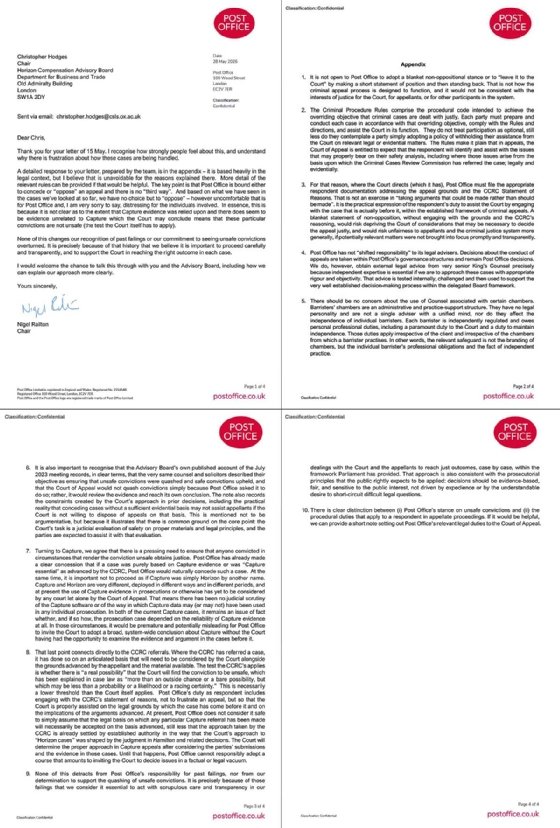
Railton then responded on 28 May, writing: “[The] Post Office is bound either to concede or ‘oppose’ an appeal and there is no ‘third way’. And based on what we have seen in the cases we’ve looked at so far, we have no choice but to ‘oppose’ – however uncomfortable that is for Post Office and, I am very sorry to say, distressing for the individuals involved.
“In essence, this is because it is not clear as to the extent that Capture evidence was relied upon and there does seem to be evidence unrelated to Capture which the court may conclude means that these particular convictions are not unsafe (the test the court itself has to apply).
“None of this changes our recognition of past failings or our commitment to seeing unsafe convictions overturned. It is precisely because of that history that we believe it is important to proceed carefully and transparently, and to support the court in reaching the right outcome in each case.”
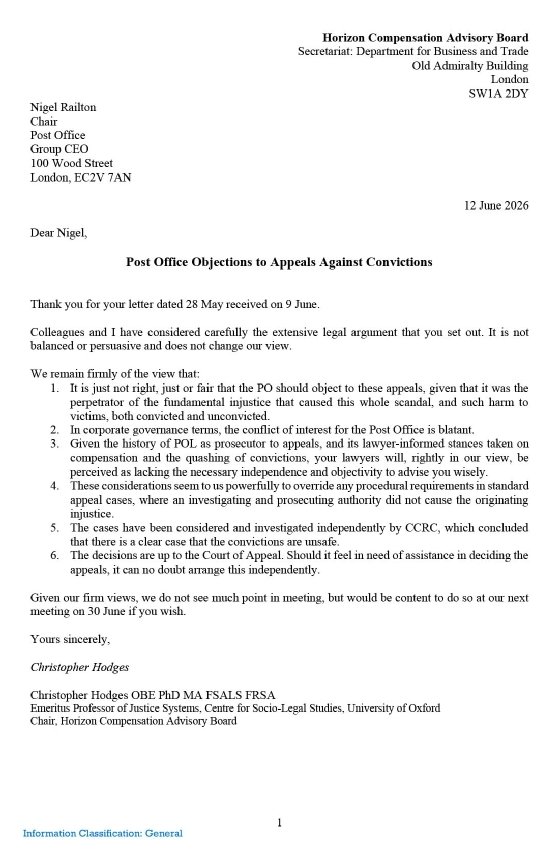
But in a letter dated 12 June, Hodges wrote in reply: “Colleagues and I have considered carefully the extensive legal argument that you set out. It is not balanced or persuasive and does not change our view.
“It is just not right, just or fair that the Post Office should object to these appeals, given that it was the perpetrator of the fundamental injustice that caused this whole scandal, and such harm to victims, both convicted and unconvicted. In corporate governance terms, the conflict of interest for the Post Office is blatant.”
As well as Hodges, the HCAB is made up of campaigning peers James Arbuthnot and Kevan Jones, along with Richard Moorhead, a law professor at Exeter University.
Hodges wrote that the “cases have been considered and investigated independently by the Criminal Cases Review Commission, which concluded that there is a clear case that the convictions are unsafe. The decisions are up to the Court of Appeal. Should it feel in need of assistance in deciding the appeals, it can no doubt arrange this independently.”
Railton’s view has changed since January, when, in a Business and Trade Select Committee hearing, he said legislation should be used to overturn Capture convictions, as it was with Horizon-related convictions.
Capture was a PC-based software application that pre-dated the Horizon system, which has been at the heart of the scandal.
Three appeals – known as pre-Horizon cases – have been sent to the Court of Appeal by the Criminal Cases Review Commission (CCRC) so far. Two of these are convictions based on the Capture system, and one is related to a conviction based on a system known as the Automatic Payment Terminal (APT).
The CCRC is also reviewing around 30 more cases of prosecutions based on software that pre-dates Horizon.
Computer Weekly first exposed the Post Office scandal in 2009, with the stories of seven subpostmasters who suffered due to faulty accounting software – our full coverage of the scandal since that time is shown in the timeline below.
Timeline: Computer Weekly articles about the scandal since 2009
- May 2009: Bankruptcy, prosecution and disrupted livelihoods – postmasters tell their story.
- September 2009: Post-masters form action group after accounts shortfall.
- November 2009: Post Office theft case deferred over IT questions.
- May 2010: A pilot of the new Horizon Online system at Royal Mail has been scaled back after connectivity problems and outages.
- February 2011: Post Office faces legal action over alleged accounting system failures.
- October 2011: 85 subpostmasters seek legal support in claims against Post Office computer system.
- June 2012: Post Office launches external review of system at centre of legal disputes.
- January 2013: Post Office admits Horizon system needs more investigation.
- January 2013: Post Office announces amnesty for Horizon evidence.
- January 2013: Post Office wants to get to bottom of IT system allegations.
- June 2013: Investigation into Post Office accounting system to drill down on strongest cases.
- July 2013: Post Office Horizon system investigation reveals concerns.
- October 2013: End in sight for subpostmaster claims against Post Office’s Horizon accounting system.
- October 2013: Former Lord Justice of Appeal Hooper joins Post Office Horizon investigation.
- November 2013: 150 subpostmasters file claims over “faulty” Horizon accounting system.
- September 2014: Fresh questions raised over Post Office IT system’s role in fraud cases.
- December 2014: MPs blast Post Office over IT system investigation and remove backing.
- December 2014: Why MPs lost faith in the Post Office’s IT investigation, but vowed to fight on.
- December 2014: MPs to debate subpostmaster IT injustice claims.
- December 2014: MP accuses Post Office of acting ‘duplicitously’ in IT investigation.
- January 2015: MPs force inquiry into Post Office subpostmaster mediation scheme.
- January 2015: Post Office faces grilling by MPs over Horizon accounting system.
- February 2015: Post Office CIO will talk to any subpostmaster about IT problems, promises CEO.
- March 2015: Post Office ends working group for IT system investigation day before potentially damaging report.
- March 2015: MPs seek reassurance over Post Office mediation scheme.
- March 2015: Retiring MP aims to uncover truth of alleged Post Office computer system problems.
- April 2015: Post Office failed to investigate account shortfalls before legal action, report claims.
- April 2015: Criminal Courts Review Commission set to review subpostmasters’ claims of wrongful prosecution.
- June 2015: Post Office looking to replace controversial Horizon system with IBM, says MP.
- July 2015: Campaigners call for independent inquiry into Post Office Horizon IT system dispute.
- October 2015: James Arbuthnot takes Post Office IT fight to House of Lords.
- November 2015: The union that represents Post Office subpostmasters has warned of a problem with the Horizon accounting system.
- November 2015: Post Office IT support email reveals known Horizon flaw
- November 2015: Group litigation against Post Office being prepared in Horizon dispute.
- February 2016: Post Office faces group litigation over Horizon IT as subpostmasters fund class action.
- June 2016: Post Office chairman Tim Parker says there would be “considerable risk” associated with changing its Horizon computer system.
- November 2016: The legal team hired by a group of subpostmasters will take their case to the next stage.
- January 2017: The group action against the Post Office that alleges subpostmasters have been wrongly punished for accounting errors gets green light from the High Court of Justice.
- March 2017: 1,000 subpostmasters apply to join IT-related group litigation against Post Office.
- April 2017: Investigation into claims of miscarriages of justice in relation to a Post Office accounting system has appointed a forensic accountant firm.
- May 2017: Hundreds of subpostmasters have applied to join IT-related legal action since March.
- July 2017: Post Office defence in computer system legal case due this week.
- August 2017: Campaigners submit initial evidence in group litigation against Post Office over controversial Horizon IT system.
- October 2017: Subpostmasters’ group action against the Post Office reaches an important milestone.
- November 2017: An end is in sight for subpostmasters’ campaign against alleged wrongful prosecution, which they blame on a faulty computer system.
- November 2017: High Court judge in subpostmasters versus Post Office case over an faulty system tells legal teams to cooperate.
- January 2018: Forensic investigation into Post Office IT system at centre of legal case nears completion.
- April 2018: Criminal Cases Review Commission examination of Post office IT system has raised further questions.
- May 2018: Post Office branches unable to connect to Horizon computer system for several hours after morning opening time.
- October 2018: After over a decade of controversy, next week marks the beginning of a court battle between subpostmasters and the Post Office.
- November 2018: Case against Post Office in relation to allegedly faulty computer system begins in High Court.
- November 2018: High Court case in which subpostmasters are suing the Post Office has revealed a known problem with a computer system.
- November 2018: A High Court trial, where subpostmasters are suing the Post Office for damages caused by an allegedly faulty IT system, ends second week.
- November 2018: Post Office director admits to Horizon errors and not sharing details with subpostmaster network.
- November 2018: The High Court trial in which subpostmasters are suing the Post Office has reached an important stage.
- December 2018: CCRC may hold off subpostmaster decision until after Post Office Horizon trial.
- December 2018: Court case where subpostmasters are suing the Post Office set to span at least four trials and extend into 2020.
- January 2019: Subpostmasters’ campaign group attacks Post Office CEO Paula Vennells’ New Year honour amid ongoing court case.
- January 2019: Thousands of known errors on controversial Post Office computer system to be revealed.
- March 2019: Tech under spotlight at High Court in second subpostmasters versus Post Office trial.
- March 2019: Post Office considered Horizon IT system “high-risk”, court told.
- March 2019: CCRC watching Post Office Horizon trial closely.
- March 2019: Judge rules that Post Office showed “oppressive behaviour” in response to claimants accused of accounting errors they blamed on Horizon IT system.
- March 2019: Post Office “lacked humanity” in the treatment of subpostmasters, says peer.
- March 2019: A High Court judge heard that the Post Office did not investigate a computer system error that could cause losses, despite being offered evidence.
- March 2019: The Post Office legal team in the case brought by more than 500 subpostmasters has called for the judge to be recused after questioning his impartiality.
- March 2019: A senior civil servant asked the Post Office to repay public money it had wrongly allocated to paying legal costs.
- April 2019: Subpostmaster claimants’ legal team makes application for the Post Office to pay millions of pounds of costs associated with trial.
- April 2019: Post Office to appeal judgment from first Horizon trial.
- April 2019: The Post Office’s claim that the judge overseeing the case concerning its controversial Horizon IT system was biased has been dismissed.
- April 2019: MP questions government over Post Office Horizon case.
- April 2019: Government says no conflict of interest in trial despite Post Office chairman’s dual role.
- May 2019: The Court of Appeal has refused the Post Office’s application to appeal a major decision in the Horizon IT trial.
- May 2019: The Post Office has applied for permission to appeal judgments from the first trial in its IT-related legal battle with subpostmasters.
- May 2019: The judge in the Post Office Horizon trial has ordered the organisation to pay the legal costs, and refused to give permission to appeal a major judgment.
- June 2019: Post Office asks Court of Appeal for permission to appeal judgment in first Horizon trial.
- July 2019: Post Office back-office error leaves subpostmaster with thousands of pounds extra.
- July 2019: Post Office fixes technical problem causing accounting errors in Horizon.
- August 2019: Subpostmasters suffering slow running and frozen terminals while Post Office searches for a fix to issues apparently caused by a software update.
- August 2019: The Post Office has fixed the latest problems with its Horizon system, affecting hundreds of branches.
- October 2019: A High Court judgment for a trial that focused on the Post Office’s IT system at the centre of a multimillion-pound litigation will be announced early next month.
- November 2019: The Court of Appeal has rejected a Post Office application to appeal judgments made in its multimillion-pound battle with subpostmasters over IT system failures.
- November 2019: Peer calls for clear-out of Post Office board after Court of Appeal confirms major court defeat.
- December 2019: The Post Office has settled its long-running legal dispute with subpostmasters, and will pay £57.75m in damages.
- December 2019: Subpostmasters ended their legal battle with the Post Office at the optimal time, according to the lawyer that managed the High Court action.
- December 2019: Subpostmasters proved right on IT system failures as calls for full public inquiry mount.
- December 2019: Criminal Courts Review Commission to review Horizon judgment “swiftly”.
- December 2019: National Federation of Subpostmasters cries foul after court ruling on controversial computer system.
- December 2019: Former Post Office CEO apologises to subpostmasters over Horizon scandal.
- December 2019: Call for former Post Office CEO to step down from public roles after IT court battle lost.
- January 2020: Fujitsu must face scrutiny following Post Office Horizon trial judgment.
- January 2020: Subpostmaster group calls for government to pay legal costs for Horizon trial.
- January 2020: Why subpostmasters are calling on the government to pay Horizon trial costs.
- January 2020: Department for Business, Energy & Industrial Strategy says it did not make decisions in the Post Office’s recent court battle.
- January 2020: Government should not be allowed to dismiss subpostmasters’ claims over Horizon IT scandal.
- January 2020: Police sent information about potential Fujitsu staff perjury in subpostmaster prosecutions.
- January 2020: Prosecutions are a significant step closer to being sent to the Court of Appeal as Criminal Courts Review Commission forms a group of commissioners to review them.
- January 2020: Alan Bates: The “details man” the Post Office paid the price for ignoring.
- February 2020: The government has refused to pay the huge legal costs subpostmasters incurred in their battle with the government-owned Post Office, which they won.
- February 2020: Members of Parliament seeking a public inquiry into the Post Office Horizon scandal face huge challenges, but pressure and time could force justice.
- February 2020: Calls for inquiry into Post Office IT scandal increase in Parliament, with cross-party support.
- February 2020: Care Quality Commission to review concerns over Paula Vennells’ appointment after they were raised by a former NHS consultant psychiatrist.
- February 2020: Government admits it was too passive managing Post Office as parliamentary pressure builds.
- February 2020: Minister says Post Office IT experts misled the government when it asked questions about subpostmasters’ concerns over Horizon IT system.
- March 2020: Boris Johnson commits to “getting to the bottom of” Post Office Horizon IT scandal.
- March 2020: Boris Johnson’s commitment to inquiry into Post Office scandal in doubt.
- March 2020: MPs call on PM to commit to full public inquiry into Post Office Horizon IT scandal.
- March 2020: Those who did not play by the rules in Post Office Horizon scandal “should face prosecution”.
- March 2020: MPs told to hold to account those responsible for Post Office Horizon IT scandal.
- March 2020: The Post Office has sparked anger with secret settlements with subpostmasters outside the recent legal action against it.
- March 2020: Labour MP Karl Turner tells Computer Weekly that the Post Office Horizon scandal is the most grotesque version of predatory capitalism he has ever seen.
- March 2020: MP Kevan Jones has warned a government minister not to repeat the mistakes of predecessors in relation to the Post Office Horizon IT scandal.
- March 2020: Criminal Cases Review Commission to use Microsoft Teams to ensure review of subpostmaster prosecutions is held on time.
- March 2020: Post Office postpones subpostmaster compensation scheme amid Covid-19 crisis.
- March 2020: Meeting reviewing subpostmaster applications to appeal criminal prosecutions moves into second day.
- March 2020: Subpostmaster prosecutions to be considered by Court of Appeal for miscarriages of justice.
- March 2020: How subpostmasters made legal history with biggest referral of potential miscarriages of justice.
- April 2020: Met Police examines information about evidence given in court by Fujitsu staff on the Horizon IT system.
- May 2020: Subpostmasters who had their lives ruined by the Post Office’s faulty IT system have received their damages after a High Court victory.
- May 2020: A senior Post Office executive at the centre of an IT scandal, who tried to mislead a High Court judge in relation to it, has left the organisation without fanfare despite many years of service.
- May 2020: Post Office re-examines hundreds of prosecutions that could have resulted from faults in Horizon IT system.
- June 2020: A campaign group representing subpostmasters wrongly prosecuted for theft and false accounting by the Post Office is raising money to help clear the names of victims of the scandal.
- June 2020: Subpostmasters to force scrutiny of government’s role in Post Office IT scandal.
- June 2020: The Criminal Cases Review Commission sends 47 more subpostmaster cases to Court of Appeal and asks government to review private prosecution powers.
- June 2020: Select committee chair writes to former Post Office CEO demanding answers over her role in IT scandal.
- June 2020: The government has been accused of launching a review that fails in getting to the bottom of one of the biggest miscarriages of justice in UK history.
- June 2020: Subpostmasters will not cooperate with government review into IT scandal.
- June 2020: The government’s proposed review of the Post Office IT scandal has received a further setback as forensic accountants join subpostmasters in refusing to back it.
- June 2020: Call for government review of Post Office Horizon scandal to have the power to force individuals to give evidence under oath.
- June 2020: Subpostmasters seeking justice in the Post Office Horizon IT scandal are regaining momentum in Parliament.
- June 2020: Healthcare regulator will be discussing concerns about former NHS boss chairing an NHS trust at an upcoming meeting.
- June 2020: Second Sight is working with law firm in appeals by subpostmasters against criminal convictions in Horizon IT scandal.
- June 2020: Post Office and Fujitsu blame each other for many of the failings in the Horizon IT scandal that wrecked lives.
- June 2020: Parliamentary Justice Committee to hold short inquiry into the rules and regulations surrounding private organisations’ ability to initiate criminal proceedings.
- July 2020: Victims of the Post Office Horizon IT scandal need to raise thousands of pounds in a week or those responsible for their suffering will avoid scrutiny.
- July 2020: The government is set to face scrutiny over its involvement in the Post Office Horizon IT scandal, described as one of the biggest miscarriages of justice in modern UK history.
- September 2020: The government repeats that it won’t pay victims’ legal costs and confirms review into the scandal will not have the power to call witnesses.
- September 2020: Subpostmasters still not being told about all the known errors in the controversial Post Office branch accounting and retail system that they use.
- October 2020: The Post Office has chosen not to contest 44 out of 47 appeals, meaning most are likely to have their names cleared, but others still face a Court of Appeal battle for justice.
- October 2020: MPs are demanding the government holds a full statutory public inquiry into the Post Office IT scandal.
- October 2020: NHS regulator continues enquiries about the appointment of former Post Office CEO at Imperial College Healthcare NHS Trust as more damning details emerge.
- October 2020: Government minister met with former subpostmaster online in an attempt to get victims of the Post Office Horizon scandal involved in government review.
- October 2020: The Post Office is focusing urgently on fixing an IT error suffered by a subpostmaster amid the ongoing IT scandal.
- October 2020: Labour politicians are calling for the government to give the Post Office Horizon scandal inquiry the power to force witnesses to give evidence if they don’t cooperate.
- October 2020: Imperial College Healthcare NHS Trust has asked for external review of its process when appointing controversial executive.
- November 2020: Government faces scrutiny of its handling of the Post Office IT scandal that destroyed subpostmasters’ lives and livelihoods.
- November 2020: Post Office branches offline during busy business hours after suffering an IT error that the Post Office said related to IT from supplier Fujitsu.
- November 2020: Fujitsu is refusing to explain what caused a national system outage in Post Office branches last week, despite the Post Office confirming the issue was the fault of the supplier.
- November 2020: The Metropolitan Police opens criminal investigation into Fujitsu staff who gave evidence in trials of subpostmasters wrongly prosecuted and even imprisoned for financial crimes.
- November 2020: Post Office criticised over vagueness of its explanation of the cause of a UK-wide IT failure that saw subpostmasters unable to do business.
- November 2020: Post Office says planned firmware update caused the problem that left branches unable to do business for 90 minutes.
- November 2020: Court documents reveal the names of the Fujitsu employees under investigation for potentially providing misleading information in criminal trials.
- November 2020: The government allowed the Post Office to ‘run amok’ and destroy lives, says complaint to Parliamentary Ombudsman.
- November 2020: Campaigning politician demands access to documents that could prove that the Post Office lied.
- December 2020: Government denies responsibility for the abuse inflicted on subpostmasters by the Post Office over faulty IT system.
- December 2020: CEO at the centre of the scandal that saw innocent people bankrupted and some sent to prison steps down from NHS role as pressure for her resignation grows.
- December 2020: History made as subpostmasters wrongly prosecuted in Horizon IT scandal have convictions quashed.
- December 2020: The appointment of a former Post Office executive, who tried to mislead a judge, in the Football Association of Wales has been questioned by an MP.
- December 2020: Court of Appeal indicates subpostmasters can pursue appeal route that could do more damage to Post Office’s reputation.
- January 2021: NHS trust defends its director appointment process following an external review of its recruitment of former Post Office CEO Paula Vennells.
- January 2021: Lawyers call for changes to digital evidence rule that made it easier for the Post Office to ‘bamboozle courts’ and make subpostmasters pay a heavy price for its IT failings.
- January 2021: The Criminal Cases Review Commission (CCRC) has referred four more subpostmasters’ criminal convictions to appeal, as part of the biggest miscarriage of justice in modern UK history.
- February 2021: A former senior developer who worked for Fujitsu on the Post Office IT system that led to subpostmasters being falsely accused of fraud, has claimed bosses knew of fundamental flaws before going live.
- February 2021: Subpostmasters call for Boris Johnson to pause and reshape the government’s Horizon inquiry.
- February 2021: Vote of no confidence in Football Association of Wales boss triggered by recruitment of former Post Office executive who tried to mislead a judge in IT trial.
- March 2021: Government agrees to change private prosecution rules that were abused by the Post Office in its pursuit of subpostmasters wrongly accused of financial crimes.
- March 2021: Subpostmaster victims who have spent millions bringing the Post Office IT scandal to light have received no reply to their concerns from Boris Johnson.
- March 2021: MP condemns department’s ‘bizarre’ rejection of freedom of information request linked to Post Office IT scandal.
- March 2021: Football Association Wales boss steps down after losing confidence motion triggered by appointment of an executive involved in the Post Office IT scandal.
- March 2021: The Scottish Criminal Cases Review Commission (SCCRC) is reviewing five cases of potential miscarriage of justice in relation to subpostmaster prosecutions.
- March 2021: Subpostmasters heading to Court of Appeal to clear their names in what is potentially the biggest miscarriage of justice in English legal history.
- March 2021: The Post Office does not have enough money to pay compensation to the subpostmasters it wrongfully prosecuted.
- March 2021: Angela van den Bogerd has left her role at the Football Association of Wales, following criticism of her part in Post Office IT scandal.
- March 2021: Court of Appeal hearing reveals Post Office instructed employees to destroy documents that undermined an insistence that its Horizon computer system was robust.
- March 2021: The Post Office was warned that a former Fujitsu employee had misled courts when giving evidence on its behalf.
- March 2021: Boris Johnson agrees with MP that those responsible for the Post Office Horizon scandal should be brought to book.
- March 2021: Former Post Office chief was paid over £400,000 when she left despite the organisation being involved in what would become the biggest miscarriage of justice in UK history.
- April 2021: The UK government faces a potential judicial review over its Post Office Horizon IT scandal inquiry, after subpostmasters formally wrote to the government seeking one.
- April 2021: The government is listening to calls for changes in how digital evidence is considered in court, as Post Office IT scandal spells out current rule’s inadequacy.
- April 2021: The Post Office’s controversial contract with Fujitsu has been extended another year to help the organisation manage its exit.
- April 2021: The Post Office is to move work done by Fujitsu in-house when its outsourcing contract ends, and is already recruiting IT experts.
- April 2021: The Post Office has revealed the end to its controversial Horizon IT system which, through its errors and the Post Office’s denial of them, caused huge suffering.
- April 2021: The UK government is the only block to fair compensation for subpostmasters who were wrongly punished for accounting shortfalls.
- April 2021: The Court of Appeal has overturned the criminal convictions of 39 subpostmasters who were blamed and punished for accounting shortfalls caused by computer errors.
- April 2021: Former Post Office CEO Paula Vennells has left roles in the church, Morrisons and Dunelm after postmasters’ convictions were overturned in the Court of Appeal.
- April 2021: The biggest miscarriage of justice in UK history is set to get bigger as more subpostmasters take their cases to the Court of Appeal.
- May 2021: Post Office IT scandal CEO has no excuse for her inaction in preventing the biggest miscarriage of justice in UK history, says Criminal Cases Review Commission chairperson.
- May 2021: Subpostmasters, MPs and the public call for a full statutory judge-led public inquiry into the Post Office Horizon scandal, following another damning court judgment.
- May 2021: Government says it wants to ensure a fair pay-out for the 555 subpostmasters who defeated the Post Office in a legal battle.
- May 2021: The Post Office has contacted hundreds of people it might have wrongly prosecuted for financial crimes.
- May 2021: The miscarriages of justice involving subpostmasters are the most disturbing element of the Post Office Horizon scandal – but it goes much deeper.
- May 2021: The supplier at the centre of the Post Office Horizon scandal has so far escaped the ramifications of its role in the biggest miscarriage of justice in UK history.
- May 2021: Another two former subpostmasters have had their convictions for financial crimes overturned, following a hearing in Southwark Crown Court.
- May 2021: The government inquiry into the Post Office Horizon scandal is set to be made statutory with the power to compel witnesses and evidence.
- May 2021: The government confirmed that the inquiry into the Post Office Horizon IT scandal will be given statutory status and wider scope.
- May 2021: The Justice for Subpostmasters Alliance has agreed to meet the former judge heading up the inquiry into the Post Office scandal that ruined the lives of hundreds of subpostmasters.
- May 2021: Criminal Cases Review Commission will not allow pressure on its resources to prevent subpostmasters seeking a review of their criminal convictions.
- May 2021: Professional IT body wants changes to how computer evidence is used in court in the wake of the Post Office case.
- June 2021: The Post Office Horizon scandal inquiry begins with subpostmaster campaign group waiting for full details before committing its support.
- June 2021: Whatever the Post Office told government about its decision to sack investigators examining subpostmaster prosecutions for theft could identify if the government was part of a cover-up.
- June 2021: The Post Office has so far compensated about 400 subpostmasters who suffered losses as a result of computer errors that they were wrongly blamed for.
- July 2021: Another 10 subpostmasters are set to have their criminal convictions quashed as part of one of the biggest miscarriage of justice in British history.
- July 2021: The government has made no contact with subpostmasters two months after it said it would work with them to ensure they get speedy and fair compensation.
- July 2021: The cost of a scheme set up to compensate subpostmasters who were victims of the Horizon IT scandal will exceed £300m.
- July 2021: The government will pay interim compensation within weeks to subpostmasters who were wrongly convicted of crimes due to computer errors.
- August 2021: A further four subpostmasters are set to have their wrongful convictions overturned in the latest development in the Post Office Horizon scandal.
- August 2021: The government has failed to provide fair compensation to the subpostmasters who exposed the full extent of the Horizon scandal to the world.
- August 2021: Subpostmasters demand more clarity on Horizon public inquiry before committing their support.
- September 2021: Six more subpostmaster convictions referred for appeal in Post Office IT scandal.
- September 2021: Government minister holds secret meeting with Post Office Horizon scandal victims.
- October 2021: The public inquiry into a scandal that saw subpostmasters imprisoned after being blamed for accounting shortfalls will hold its first public hearing early next month.
- October 2021: A government minister investigating the controversial Horizon IT project in 2000 described the Post Office board of directors as ‘appalling, short-sighted and partisan’.
- November 2021: The behaviour of Post Office senior management during the Horizon scandal was so egregious that the supplier of the faulty software has escaped a large financial penalty.
- November 2021: Former Fujitsu staff who gave evidence in subpostmaster trials have been questioned by police for a second time.
- November 2021: Former subpostmasters convicted of crimes based on data from error-prone Post Office computer system continue to embark on appeals.
- November 2021: The first hearing in the Post Office Horizon scandal public inquiry hears why victims should be paid compensation immediately.
- November 2021:The Scottish Criminal Cases Review Commission is investigating eight potential miscarriages of justice linked with faulty Post Office IT system.
- November 2021: The Post Office will waive professional legal privilege for documents relating to legal advice it received regarding subpostmaster prosecutions.
- November 2021 A total number of 65 subpostmasters have now had criminal convictions overturned in Post Office Horizon scandal.
- November 2021 Subpostmasters asked to withdraw support for Post Office scandal inquiry.
- November 2021: Seven more subpostmasters have been cleared after the Post Office charged them for crimes caused by its faulty Horizon software.
- November 2021: The Post Office made clear its support for a change in UK law regarding computer evidence that was making prosecution ‘onerous’ – a change which later helped to wrongfully convict subpostmasters.
- November 2021: The chair of the Post Office scandal public inquiry has confirmed the compensation of a group of subpostmasters will be revisited.
- December 2021: Government must go further after agreeing to pay compensation for wrongly convicted subpostmasters.
- December 2021: Pressure on government to pay fair compensation to subpostmasters left out of current schemes.
- January 2022: Almost 100 MPs have backed a call for the government to reverse its decision to exclude 555 subpostmasters from fair compensation.
- January 2022: A parliamentary select committee was told that the Post Office is unable to access information to accurately calculate compensation for some Horizon scandal victims.
- January 2022: The Post Office received subsidies worth over £1bn last year, including a £685m payment just last month, in a scheme labelled Post Office Historical Matters Compensation.
- January 2022: Government widens subpostmaster miscarriage of justice compensation scheme in Horizon scandal.
- January 2022: Government officials are open to finding a way to properly compensate victims of the Horizon scandal without setting a dangerous legal precedent.
- January 2022: The subpostmaster campaign group responsible for exposing the Post Office Horizon scandal is to meet with the government to discuss fair compensation for their suffering.
- January 2022: Fujitsu cannot hide away as taxpayers pick up the bill for the Post Office scandal triggered by its IT system, say peers.
- February 2022: Victims of the Post Office Horizon scandal are being denied the millions of pounds they are owed as the government delays compensation resolution.
- February 2022: Victims of the Post Office Horizon scandal are due to tell their devastating stories to the statutory inquiry.
- February 2022: MPs are demanding urgent action by the government to provide full compensation to a group of 555 Post Office Horizon scandal victims who have so far been left out.
- February 2022: Victims of the Post Office Horizon scandal have been suffering in silence for many years, but the current public inquiry is giving them a voice, and people are listening.
- February 2022: Horizon inquiry questioning raises hopes of fair compensation for victims so far left out.
- February 2022: Government set to backtrack on untenable position on subpostmaster compensation.
- March 2022: The Post Office and Fujitsu failed to alert subpostmasters to a software error that caused them to be wrongly blamed for accounting shortfalls.
- March 2022: Horizon inquiry hearing sheds light on subpostmaster federation’s role in hushing up IT problems.
- March 2022: 555 subpostmasters to get fair compensation after government U-turn on its stance on High Court settlement.
- March 2022: Compensation goal finally in sight for 555 Post Office scandal victims, after 13 year campaign.
- April 2022: Fujitsu bags £430m government contracts despite rising cost of Post Office Horizon scandal.
- April 2022: The Scottish Criminal Cases Review Commission expects more subpostmasters with potential wrongful convictions to come forward.
- April 2022: Former subpostmasters who were wrongfully convicted and punished for crimes have not yet received full compensation over a year after their convictions were overturned.
- April 2022: A former Fujitsu worker has been questioned under caution for the third time as police investigate potential perjury in trials of subpostmasters wrongfully convicted of financial crimes.
- May 2022: Paula Vennells could be stripped of her CBE as the Honours Forfeiture Committee commits to reconsider its award in the light of the Post Office Horizon scandal.
- May 2022: Lawyer negotiating compensation for victims of Post Office scandal says the two sides are ‘poles apart’ on valuations.
- May 2022: Inquiry into Post Office scandal moves to Scotland, with differences in English and Scottish law raising further serious questions about subpostmaster prosecutions.
- May 2022: The chair of the Post Office Horizon scandal inquiry has brought forward hearings about compensation as victims warn that at this rate “people will die” before they get anything.
- May 2022: The Criminal Cases Review Commission is to contact 88 more potentially wrongfully convicted Post Office workers.
- May 2022: The Post Office Horizon IT system at the centre of a national scandal will be replaced by 2025, with a supplier expected to be named in August.
- May 2022: Victims of the Post Office Horizon scandal in Scotland raise further questions about Post Office and government conduct.
- May 2022: Government accused of ‘passing the buck’ and ‘not knowing what it is talking about’ after stating it has no plans to review court rules on computer evidence.
- May 2022: Computer Weekly spoke to the barristers at Henderson Chambers that fought the Post Office in the High Court to expose the widest miscarriage of justice in UK history.
- June 2022: Two more Post Office Horizon scandal victims have had their wrongful convictions overturned.
- June 2022: The 555 subpostmasters who exposed the depth of the Post Office Horizon scandal could finally be fairly compensated.
- June 2022: Forensic accounting firm that ‘knows where the bodies are buried’ will be released from confidentiality obligations by the Post Office to give evidence to public inquiry.
- June 2022: Lawyers negotiating the compensation valuations for former subpostmasters who suffered wrongful convictions have brought in independent judicial scrutiny to break an impasse.
- June 2022: Subpostmaster campaign group is a step closer to achieving what it was originally set up to do as government launches compensation scheme for its members who did not receive fair payouts.
- July 2022: More former subpostmasters have their wrongful convictions for theft and fraud overturned in the Court of Appeal.
- July 2022: When the Post Office’s lie about the Horizon system failed to silence subpostmaster critics, it took more extreme measures, say victims of the scandal.
- September 2022: The Met Police have interviewed a former subpostmaster as part of an investigation into potential perjury by former Fujitsu staff.
- September 2022: Chair of statutory public inquiry into the Post Office Horizon scandal has aired his disappointment over the slow progress in making interim payments to victims.
- October 2022: The public inquiry into the Post Office scandal has begun phase two with a request for adjournment amid allegations that the Post Office is failing to disclose relevant documents.
- October 2022: Victims demand that the perpetrators of the Post Office Horizon IT scandal face the public inquiry.
- October 2022: Fujitsu’s part in causing the extreme suffering of subpostmasters will be made clear as the IT supplier begins giving evidence at a statutory inquiry.
- October 2022: A dereliction of duty saw subpostmaster federation ignore its members when IT problems hit and allowed the Post Office destroy their lives.
- October 2022: Politicians are keeping up the pressure to block government contracts being awarded to Fujitsu because of its role in the Post Office Horizon scandal.
- October 2022: Problems reported with the Post Office’s Horizon IT system before its roll-out should have been regarded as a “show-stopper.”
- October 2022: Horizon system code writers lacked basic programming skills, according to the task force set up to investigate reported problems with the controversial software.
- October 2022: Trials of the Horizon computer system in Post Office branches in 1999 led to a warning from subpostmasters that software problems meant “a tragedy was not far away”.
- November 2022: Game of ‘hardball’ in Horizon negotiations left subpostmasters exposed to tragedy.
- November 2022: Confirmation bias led Post Office to prosecute subpostmasters without investigation, inquiry told.
- November 2022: SCCRC has referred six cases of potential wrongful convictions of subpostmasters to the High Court of Justiciary.
- November 2022: Fujitsu expert witness in subpostmaster trial ‘manoeuvred’ into role, public inquiry told.
- November 2022: Post Office changed view of Horizon problems before roll-out, because of a ‘sunk cost fallacy’.
- November 2022: Team working on controversial Post Office Horizon EPOSS software was the ‘joke of the building’.
- November 2022: The Post Office IT scandal inquiry’s appointed expert IT witness was “troubled” by the lack of integrity of data from the Horizon system that was used to send people to prison.
- November 2022: Telegram from British Embassy in Tokyo to UK government reveals pressure on ministers to sign off controversial contract.
- November 2022: Subpostmaster federation deliberately kept public in dark over computer problems.
- December 2022: Post Office boosted its ‘coffers’ as Horizon system threw up unexplained shortfalls, inquiry told.
- December 2022: Post Office scandal – “cock-up or cook-up”?
- December 2022: Criminal Cases Review Commission calls on more convicted subpostmasters to come forward.
- January 2023: Former subpostmaster Alan Bates, who ‘pulled up trees and moved mountains’, turns down OBE offer.
- January 2023: Advisory board goal for Post Office scandal victims to be returned to rightful financial position.
- January 2023: Former Fujitsu staff under police investigation to face Post Office IT scandal inquiry.
- February 2023: Post Office’s most senior executives hushed up Horizon errors, public inquiry told.
- March 2023: Post Office attempted to replace controversial Horizon system 10 years ago, but was put off by project’s scale and cost.
- March 2023: IT worker tells public inquiry that the Post Office Horizon helpdesk was toxic, rudderless and racist.
- March 2023: Subpostmaster demands names of Post Office executives who crushed him to suffocate truth.
- April 2023: CCRC says ‘door open’ for more reviews of subpostmaster convictions.
- April 2023: The Post Office has extended a contract with Fujitsu after being unable to resolve technical issues related to migrating its IT to the cloud.
- April 2023: Post Office paid IBM millions when it ended proposed contract to replace Horizon.
- April 2023: The Post Office ended a proposed contract with IBM to replace its controversial Horizon system after work had already started.
- May 2023: More Post Office software-related convictions overturned takes total to 86.
- May 2023: Fujitsu staff had ‘unrestricted and unauditable’ remote access to Post Office branch systems.
- May 2023: Post Office lawyer bragged how team ‘destroyed attack on the Horizon system’ and put woman in prison.
- May 2023: Post Office executive told to report false bill of health on controversial software.
- May 2023: Campaigning former subpostmaster fears compensation for scandal victims will be delayed to 2025.
- May 2023: Post Office scandal – cover-up a ‘dark chapter’ in government, corporate and legal history.
- June 2023: Post Office CEO told MPs that the organisation is telling some subpostmasters it won’t oppose them if they appeal.
- July 2023: Public inquiry hears how Post Office security withheld evidence from people it suspected of theft.
- July 2023: Former Fujitsu IT chief evidence postponed after late Post Office disclosure.
- July 2023: Post Office inquiry must examine role of court rules around use of computer evidence that enabled it to prosecute innocent people.
- July 2023: Peer calls for every Post Office prosecution to be reviewed.
- July 2023: Horizon inquiry adjourned as Post Office disclosure failures threaten to ‘derail’ proceedings.
- July 2023: Horizon inquiry chief threatens Post Office with ‘criminal sanctions’ over disclosure failures.
- July 2023: Subpostmaster compensation deadline will be missed, warns public inquiry chair.
- July 2023: CCRC refers two more subpostmaster convictions for appeal.
- July 2023: Post Office tried to convince independent IT witness that he was wrong about Horizon.
- August 2023: MP calls for review of computer evidence rule which led to subpostmasters being wrongly convicted.
- August 2023: Six subpostmaster appeals to be heard in Scottish court.
- September 2023: Post Office employee changed story for witness statement used to destroy subpostmasters.
- September 2023: Post Office had no interest in subpostmaster welfare when taking legal action, says Fujitsu memo.
- September 2023: Government offers £600,000 to subpostmasters with overturned convictions.
- September 2023: Five more subpostmasters have IT system-related convictions overturned
- October 2023: Government ‘breached privacy’ of Horizon victims with compensation offer.
- October 2023: First subpostmaster Horizon conviction overturned in Scotland.
- October 2023: Amnesia hides names of individuals behind Post Office’s ‘head on a spike’ strategy.
- October 2023: ‘Angry’ lawyer warned against Post Office computer investigation in 2010 email.
- October 2023: Former Post Office executive admits he wouldn’t sign unfair contract he pushed on subpostmasters.
- October 2023: Post Office auditors presumed subpostmasters were ‘on the fiddle’ or ‘in a muddle’.
- October 2023: Bill for the scandal over £1bn, as campaign leader considers private prosecutions of Post Office executives.
- November 2023: Post Office disclosure failures delay Horizon scandal inquiry again.
- November 2023: Former Post Office manager has no memory of preparing witness statement in legal dispute.
- November 2023: Post Office scandal inquiry postpones more key witness hearings.
- November 2023: Controversial Fujitsu contract with Post Office extended again.
- November 2023: CCRC refers posthumous appeals against convictions to Crown Court for first time.
- November 2023: Paula Vennells’ email fuelled Post Office Horizon cult, inquiry told.
- November 2023: Slow government response to Post Office scandal compensation forces new legislation.
- December 2023: Post Office lawyer with his fingerprints all over IT scandal spreads blame
- December 2023: Undisclosed document could reveal pressure on Fujitsu expert witness in Post Office prosecution.
- December 2023: Post Office prioritised its ‘bottom line’ over justice.
- December 2023: Former Post Office investigator called subpostmaster campaigners ‘crooks’.
- December 2023: Current Post Office executive in denial of Horizon cover-up.
- December 2023: Government advised to overturn all Post Office scandal convictions.
- December 2023: Government reveals its own slow progress in compensating Post Office scandal victims.
- December 2023: ‘No hiding place’ for those responsible for Post Office Horizon scandal.
- December 2023: Post Office gets government handout as Horizon replacement costs increase ‘significantly’.
- January 2024: Metropolitan Police launches second criminal investigation in Post Office scandal.
- January 2024: The current rules around digital evidence are partly to blame for the widest miscarriage of justice in UK history.
- January 2024: Fujitsu gets stay of execution as MPs support exoneration of wrongfully convicted subpostmasters.
- January 2024: ‘Hero’ subpostmaster accuses government of diversion tactics through ‘weaselly’ statistics.
- January 2024: How Fujitsu became a central part of the Post Office scandal.
- January 2024: The government has chosen to introduce legislation that will enable it to exonerate hundreds of subpostmasters as a group
- January 2024: How legal disclosure failures disrupted the Post Office Horizon inquiry.
- January 2024: Fujitsu ‘morally obliged’ to contribute to subpostmaster financial redress amid ‘insane’ delays
- January 2024: More than 900 subpostmaster convictions wouldn’t have happened without Post Office-backed law change.
- January 2024: Anger sparked by TV drama forces Fujitsu to put public sector contract bidding on hold.
- January 2024: Fujitsu boss describes Post Office behaviour as ‘shameful and appalling’.
- January 2024: Fujitsu boss admits to missed opportunities to prevent miscarriages of justice
- January 2024: Concerns of an expert witness in subpostmaster trials were ignored by Fujitsu.
- January 2024: Urgent question asks which ministers knew of Post Office’s shocking plan to remove judge.
- January 2024: Fujitsu agrees to support former subpostmasters’ families beyond financial redress.
- January 2024: Committee chair asks minister to back ‘Mr Bates clause’ in Post Office compensation legislation.
- January 2024: Expert IT witness outsmarted an ‘aggressive’ Post Office to get to truth after inspection ‘madness’.
- January 2024: MP demands answers from government minister over second faulty Post Office IT system.
- January 2024: Pre-Horizon users contacting lawyers as more Post Office IT horror stories emerge.
- February 2024: Government ‘dragging it out’ by refusing to share knowledge of Post Office trial ‘delaying tactic’.
- February 2024: ‘People are now listening’: Post Office inquiry told as latest phase ends.
- February 2024: Post Office scandal: Phase four’s rogues’ gallery.
- February 2024: More than 1,000 subpostmasters could have used second faulty Post Office system.
- February 2024: Post Office Horizon IT scandal inquiry: Two years of shocking revelations.
- February 2024: Post Office CEO refused to meet government minister without her lawyer after 2015 Horizon report.
- February 2024: Post Office IT insider and the software decision that lit the Horizon scandal.
- February 2024: Controversial Post Office Capture system was developed in-house.
- February 2024: Law to clear hundreds of wrongfully convicted subpostmasters expected in July.
- February 2024: Unisys investigating potential involvement in controversial Post Office system.
- February 2024: King Charles strips disgraced Post Office CEO of her CBE.
- February 2024: Post Office scandal roundup: Fourth Estate in full throttle.
- February 2024: Government won’t rush to include Post Office Capture convictions in overturning legislation.
- February 2024: Government should face legal deadlines on paying Post Office victims.
- February 2024: ‘Pathetic’ Post Office spat detracts attention and fuels ‘disdain’ for authority.
- February 2024: Post Office CEO’s claim to be ‘working hard’ on Capture investigation in doubt.
- March 2024: MPs demand Fujitsu be ‘nailed down’ on financial promise to Post Office scandal victims.
- March 2024: KC names Post Office staff he believes conspired to pervert the course of justice
- March 2024: Perverting course of justice and contempt of Parliament: a week in post-drama Post Office scandal.
- March 2024: Post Office prosecutions during Horizon go-live phase are ‘frightening’.
- March 2024: ‘Brutal’ decisions required to sort out Post Office mess, says select committee chair.
- March 2024: MPs call for Post Office exclusion from compensation schemes, as trust hits rock bottom.
- March 2024: Fujitsu should pay half of Post Office scandal costs, says select committee chair.
- March 2024: Current subpostmaster account shortfalls reveal extent of Post Office’s pre-2019 neglect.
- March 2024: Unprecedented bill to exonerate hundreds of wrongly convicted Post Office workers arrives.
- March 2024: Children of Post Office victims to hold Fujitsu boss to his word.
- March 2024: Controversial Post Office Capture software was completely rewritten in 1994.
- March 2024: Post Office scandal fallout for Fujitsu could open UK public sector to Indian giants.
- March 2024: Post Office Capture users’ campaign for justice gathers pace.
- March 2024: Sums of money Post Office ‘stole’ from subpostmasters may never be known.
- March 2024: Leaked comms reveal Fujitsu eyeing huge UK government bounty.
- March 2024: Remote access is the Post Office’s known unknown.
- April 2024: Fujitsu staff instructed how to bid for government contracts during self-imposed ban.
- April 2024: Fujitsu should stop bending rules, stop bidding and pay up, says MP.
- April 2024: Environment Agency dumps Fujitsu as Post Office scandal takes its toll.
- April 2024: MPs will grill Cabinet Office over Fujitsu contract bidding pause.
- April 2024: Some former Post Office staff should be jailed over scandal, says government minister.
- April 2024: Further extension to controversial Post Office contract with Fujitsu inevitable.
- April 2024: Civil servants more to blame for Post Office cover-up than ministers, says Alan Bates.
- April 2024: Subpostmasters stealing from branches ‘didn’t make sense,’ former judge tells inquiry.
- April 2024: Fujitsu public sector contracts dry up in Post Office scandal aftermath.
- April 2024: Former Post Office executive’s neglect prolonged Horizon reliability myth.
- April 2024: Post Office boss said subpostmasters had hands in till and blamed technology.
- April 2024: Alan Bates and JFSA won’t back down in fight with government and Post Office.
- April 2024: Post Office boss signed off hush money to cover up smoking gun.
- April 2024: IT expert who helped expose Post Office scandal offers to investigate second controversial system.
- April 2024: Unisys reveals no link to development of controversial Post Office software.
- April 2024: Post Office lawyer was a jack of all trades, but failed his own.
- April 2024: Fujitsu to cut UK jobs as Post Office scandal fallout hits sales.
- April 2024: Expert investigating Capture system refuses to meet ‘untrustworthy’ Post Office.
- April 2024: Post Office boss used husband’s descriptions in ‘Orwellian’ ploy to downplay Horizon problems.
- April 2024: Lords debate amendment to law on use of computer evidence in light of Post Office scandal.
- April 2024: More evidence emerges that Post Office executive misled High Court judge.
- April 2024: Post Office ‘lied’ to subpostmasters when forced to meet them, says former federation representative.
- April 2024: Post Office scheme was a ‘charade’ that never intended for large compensation pay-outs.
- April 2024: Post Office misjudged campaigner it labelled a ‘bluffer’.
- May 2024: Post Office investigators saw subpostmasters as ‘enemies’ – and that’s what they became.
- May 2024: Post Office legal boss withheld details from statutory body reviewing miscarriages of justice.
- May 2024: Police told in 2016 that Post Office prosecutor withheld evidence of Horizon errors from court.
- May 2024: Fujitsu Post Office system admission was ‘bombshell’ to barrister.
- May 2024: Barrister says Post Office lawyers misled him over Horizon cases.
- May 2024: Scotland’s Post Office scandal victims to be exonerated en masse.
- May 2024: Comms director at centre of cover-up never thought Post Office were the ‘baddies’.
- May 2024: Post Office IT boss failed to raise concern over false Horizon statements.
- May 2024: Post Office considered asking Computer Weekly to review Horizon IT system.
- May 2024: Post Office CEO Paula Vennells ‘didn’t believe there were miscarriages of justice’.
- May 2024: The fall from grace of ex-priest and Post Office boss Paula Vennells.
- May 2024: Post Office directors went crawling back to Fujitsu when IBM project got complex, inquiry told.
- May 2024: ‘You knew’: former ally accused Paula Vennells of knowing about Horizon problems.
- May 2024: Third police probe into Post Office scandal under consideration.
- May 2024: Government knew of Post Office plan to remove judge.
- May 2024: Paula Vennells boasted about removing Horizon risk reference in Royal Mail flotation prospectus.
- May 2024: Over 700 subpostmasters exonerated by new legislation.
- May 2024: Met Police investigation set to go national.
- May 2024: Government appoints investigators to analyse Post Office Capture software used before Horizon.
- May 2024: Post Office Horizon replacement project labelled ‘unachievable’ as taxpayer bill reaches £1bn.
- May 2024: Fujitsu set for further £180m deal as Post Office Horizon replacement delayed.
- June 2024: Post Office bosses misled subpostmasters a day before IT project problems were exposed.
- June 2024: Subpostmasters may take legal action against government in pursuit of financial redress.
- June 2024: Post Office chair was aware of Horizon concerns from day one but failed to act.
- June 2024: Mystery Post Office software developer revealed in 1995 Horizon project document.
- June 2024: Fujitsu had Post Office ‘over a barrel’, inquiry told.
- June 2024: Post Office Capture software training deficit echoes systemic Horizon problems.
- June 2024: IT witness was hidden away from Post Office court battle, but supported it from shadows.
- June 2024: Post Office scandal victims in Scotland have convictions quashed.
- June 2024: Once ridiculed Post Office scandal campaigner Alan Bates receives knighthood.
- June 2024: Post Office and Fujitsu had tense relationship, but were joined at hip when protecting their brands.
- June 2024: Sir Alan Bates hits out at Post Office ‘incompetence’ after data breach.
- June 2024: Metropolitan Police could investigate one of its own staff in Post Office probe.
- June 2024: Post Office expert IT witness Gareth Jenkins resigns BCS membership.
- June 2024: Numbers prove former subpostmaster federation boss’s ignorance over Post Office scandal.
- June 2024: Ignorance of ‘legal niceties’ from Post Office expert IT witness saw innocent people jailed.
- June 2024: Experts shocked by ‘extraordinary’ claim made by Post Office IT expert witness.
- June 2024: Former Fujitsu engineer says Post Office ‘trapped’ him into giving incomplete evidence.
- July 2024: Former Post Office chair ‘regrets’ keeping critical Horizon report secret.
- July 2024: Sir Alan Bates welcomes MP’s elevation to House of Lords.
- July 2024: Government left monitoring of Post Office to ‘luck’.
- July 2024: Civil servant was lone voice on Post Office board to query legal plan that blew taxpayers’ cash.
- July 2024: Civil servant said subpostmasters’ threat of legal action was ‘sabre-rattling’
- July 2024: Fujitsu analyst gave witness statements when more qualified colleagues refused
- July 2024: Government trusted ‘abuser’ over the abused on Post Office scandal.
- July 2024: Ed Davey and Jo Swinson ‘handled’ by civil servants in Post Office cover-up, says Sir Alan Bates.
- July 2024: Former minister felt she was fighting department over Post Office controversy.
- July 2024: Post Office ‘acted the victim’ and civil servants ‘abandoned their principles’, says former minister.
- July 2024: Vince Cable says the Post Office ‘lied’ to the government over Horizon issues.
- July 2024: Government commits at least £540m to financial redress for wrongfully convicted Post Office staff.
- August 2024: Post Office scandal: Phases 5 and 6 had islands of conscientiousness in great depths of neglect.
- August 2024: Post Office brings in new IT chief as it awaits funding for Horizon replacement.
- August 2024: Post Office systems crash hits ‘collapsing’ Horizon system.
- August 2024: Post Office apologises for IT problem text alert that was never sent.
- September 2024: Post Office and Fujitsu malevolence means huge taxpayers’ bill.
- September 2024: Post Office scandal victims given route to appeal unfair financial settlements.
- September 2024: Fujitsu UK staff won’t receive annual pay rise as Post Office scandal bites.
- September 2024: Under-pressure Post Office botches hardware procurement in project to replace error-prone system.
- September 2024: Government receives report on second controversial Post Office IT system.
- September 2024: Fujitsu loses £50m in sales after Post Office scandal furore.
- September 2024: Post Office chief executive Nick Read quits.
- September 2024: Post Office scandal victim becomes first to receive £600,000 under new redress scheme.
- September 2024: Post Office system still causing unexplained shortfalls for over half of subpostmasters.
- September 2024: Fujitsu faces financial challenges, with doubts over its commitment to righting Post Office wrongs.
- September 2024: Post Office IT department’s focus on chasing a discount meant botched procurement.
- September 2024: Post Office IT procurement mess saw £35m spent on air conditioner, says board member.
- September 2024: Fujitsu accused of ‘paying lip service’ to Post Office scandal victims.
- September 2024: Subpostmasters living years with disputed but unresolved debts to the Post Office, inquiry told.
- September 2024: More parallels between Post Office Capture and Horizon scandal revealed.
- September 2024: Investigation finds ‘reasonable likelihood’ Post Office Capture software caused accounting losses.
- October 2024: Post Office spending £80,000+ a week on engineers who can’t work, as IT project burns cash.
- October 2024: Post Office and Fujitsu: from blood brothers to bad blood.
- October 2024: Late evidence in Post Office Capture investigation could not be reviewed.
- October 2024: Post Office recruiting tech-savvy board member amid unravelling IT disaster.
- October 2024: Post Office senior executive suspended over allegations of destroying evidence.
- October 2024: Whistleblowers call out ongoing cover-up by Post Office CEO in explosive letter.
- October 2024: Post Office boss Nick Read ‘inadequate, greedy and self-interested’, whistleblowers tell inquiry.
- October 2024: Can the Post Office project to replace Horizon be rescued?
- October 2024: Post Office IT transformation project was ‘set up to fail’, chairman tells inquiry.
- October 2024: Under-fire Nick Read was unprepared for Post Office challenge.
- October 2024: Post Office dragging its feet getting rid of tainted staff, despite government ‘green light’.
- October 2024: Post Office believes it took £36m from subpostmasters with unexplained losses.
- October 2024: Post Office set to axe in-house-developed New Branch IT software.
- October 2024: Former police officer heading Post Office operations did nothing to help innocent subpostmasters.
- October 2014: Sir Alan Bates tells Prime Minister to guarantee Post Office scandal victim redress by March 2025.
- October 2024: Met Police investigating senior Post Office worker over evidence destruction allegation.
- October 2024: Review of late evidence doesn’t change Post Office Capture system report.
- October 2024: Post Office worker who allegedly told staff to destroy evidence could return to work.
- October 2024: Former Post Office IT boss alleged to have misrepresented alternative to in-house build.
- October 2024: Change to rules on computer evidence will be an ‘outcome’ of Post Office scandal.
- October 2024: Federation requests government investigation into third Post Office branch system.
- October 2024: Warning shots fired as former subpostmasters have ‘useful’ meeting with Post Office CEO.
- October 2024: Government ‘urged’ to overturn all convictions based on Post Office Capture.
- October 2024: Who is the subject of the Post Office’s Project Tiger investigation?
- October 2024: No simple replacement for digital evidence rules, says Post Office Horizon trial judge.
- October 2024: Fujitsu boss to face tough reappearance at Post Office inquiry, following inaction and sidestepping.
- November 2024: Post Office scandal affected relationships of two-thirds of victims.
- November 2024: Government’s £600,000 offer to Horizon scandal victims was ‘political’.
- November 2024: Post Office data breach caused by botched website upgrade.
- November 2024: Post Office was reluctant to cut costs despite 143 central staff earning more than £100k.
- November 2024: Post Office appointing third-party reviewer of current Horizon system.
- November 2024: Post Office wrongly used public funds to pay for legal battle.
- November 2024: Government announces Green Paper on future of scandal-ridden Post Office.
- November 2024: Post Office scandal not caused by software errors, says combative Fujitsu boss.
- November 2024: Post Office requested four-year Horizon extension, as Fujitsu boss arrived at public inquiry.
- November 2024: Post Office to decide on Horizon before April, Fujitsu board considers final contract extension.
- November 2024: Post Office IT boss calls for subpostmasters to judge him on his actions.
- November 2024: Post Office scandal: Inquiry’s final phase exposes dysfunction past and present.
- November 2024: Post Office is paying lawyers too much, admits minister.
- November 2024: Subpostmasters hit by Post Office scandal plan to meet over ‘nuclear option’.
- November 2024: Post Office project taking control of Horizon data from Fujitsu as part of messy split.
- November 2024: Fujitsu snubbed on private sector deal with Centrica due to Post Office scandal backlash.
- November 2024: Post Office Horizon IT scandal inquiry: Three years of shocking revelations.
- November 2024: Government looking into third faulty Post Office IT system.
- November 2024: Convictions of Post Office Capture system users to be reviewed by statutory body.
- November 2024: Post Office scandal: How much deeper and wider can it get?
- November 2024: Post Office scandal redress echoes Windrush compensation problems.
- November 2024: Post Office Capture users invited to pivotal meeting with government.
- November 2024: Fujitsu’s charity boss made redundant while Post Office scandal victims await support.
- December 2024: Post Office Fujitsu contract extended by a year as decision time looms.
- December 2024: Post Office senior leadership warned of IT project data safeguarding risk.
- December 2024: Controversial Horizon system to remain in Post Office branches as part of tech ‘fusion’, says source.
- December 2024: Police not ruling any person or crime out of Post Office scandal investigation.
- December 2024: Post Office ‘weaponised’ IT system in most ‘extensive and prolonged’ miscarriage.
- December 2024: Government promises redress and justice to Post Office Capture system users.
- December 2024: Post Office creates CTO role to support ‘extensive and complex’ plans.
- December 2024: Post Office IT department fired and rehired ‘friends’ at ‘exorbitant’ rates, says former HR chief.
- December 2024: Post Office scandal campaigners awarded OBEs in New Year Honours List.
- January 2025: Sir Alan Bates has ‘serious concerns’ over Post Office scandal compensation budget.
- January 2025: Post Office staff list 14 scandal-stained individuals who should have honours stripped.
- January 2025: Former subpostmasters invited to take part in Post Office Capture compensation scheme development.
- January 2025: Post Office scandal-stained Fujitsu orders staff to cut costs amid widening UK losses.
- January 2025: Subpostmasters won’t get financial redress until mid-2027 at current rate of progress.
- January 2025: Government calls for expert views on computer evidence to learn lesson from Post Office scandal.
- January 2025: Review of legal rule on computer evidence long overdue, say Post Office scandal victims.
- February 2025: Government failed to provide accurate cost of Post Office scandal compensation.
- February 2025: CCRC reviewing 17 Post Office convictions with potential Capture software involvement.
- February 2025:’Positive steps’ in redress for Post Office Capture victims.
- February 2025: Fujitsu’s £600m-plus prize with His Majesty’s ‘cash cow’ in 2025.
- February 2025: Peer demands Fujitsu cough up £300m interim payment towards Post Office scandal bill.
- February 2025: Post Office makes first official apology to Capture users.
- March 2025: Metropolitan Police concern puts brakes on Post Office Horizon data migration.
- March 2025: Government announcement on Fujitsu talks add ‘vague words’ and no interim payment.
- March 2025: Post Office scandal data leak interim compensation offers made.
- March 2025: Minister asks for evidence of Post Office ECCO+ system problems.
- March 2025: Former subpostmaster to sue Post Office and Fujitsu for judgment ‘obtained by fraud’.
- March 2025: Government considering redress scheme for families of Post Office scandal victims.
- March 2025: MPs demand government reconsider response to Post Office compensation report.
- March 2025: Kroll reviewing Post Office Horizon’s current integrity and discrepancy identification.
- March 2025: Experts question court’s rejection of former Post Office manager’s Horizon appeal.
- April 2025: Scottish support group for Post Office scandal victims launched.
- April 2025: Post Office Capture and Ecco+ users asked to make contact with Scottish statutory body.
- April 2025: Post Office can’t find evidence for over 1,000 Horizon scandal redress claimants.
- April 2025: Post Office gets extra £136m towards tech transformation as clock ticks on Horizon.
- April 2025: More than 100 Horizon victims are challenging Post Office offers on complex claims.
- April 2025: Fujitsu UK staff will get bonus despite Post Office scandal fallout.
- May 2025: Progress made on government’s Post Office Capture redress, but concerns remain.
- May 2025: Evidence reveals Post Office scandal victims short-changed in compensation payouts.
- May 2025: Controversial Post Office Horizon system could stay until 2033.
- May 2025: Post Office scandal inquiry to publish first findings this summer.
- May 2025: Post Office performs costly 30-year U-turn on Horizon.
- May 2025: Botched Post Office IT projects continue to drain public purse.
- May 2025: Fujitsu raked in £80m from HMRC in March alone, despite Post Office scandal.
- May 2025: Post Office slammed after deleting social media comments on IT scandal.
- June 2025: Compensation to Post Office scandal victims reaches £1bn milestone.
- June 2025: HMRC paid Fujitsu £310m last year, but Post Office supplier’s UK business faces gradual decline.
- June 2025: Government announces details of Post Office Capture redress scheme.
- June 2025: Report on integrity of current Post Office Horizon system due in autumn.
- June 2025: MPs say the government has not done enough to contact all those who qualify for Post Office scandal compensation schemes.
- June 2025: Seven main suspects under police investigation in national Post Office probe.
- June 2025: Fujitsu’s grip on HMRC loosening but bags of taxpayer cash still to be made.
- July 2025: Post Office inquiry chair ‘cannot rule out’ scandal caused 13 suicides.
- July 2025: Former Post Office staff in Horizon replacement bid team.
- July 2025: Home Office dumps Fujitsu from IT services contract.
- July 2025: Fujitsu outage crashes Post Office Horizon system.
- July 2025: Peer warns suppliers against partnering Fujitsu in contracts.
- July 2025: Post Office will not compensate subpostmasters for IT outage.
- August 2025: Fujitsu tells all UK staff to preserve documents related to its work with the Post Office.
- August 2025: Metropolitan Police contract with Fujitsu is ‘potential conflict of interest’ amid Post Office probe.
- August 2025: Subpostmaster federation accepted money from Fujitsu in run-up to High Court Post Office trial.
- August 2025: Police investigation into Post Office scandal to cost more than £50m.
- August 2025: Home Office Fujitsu contract is ‘de facto’ conflict of interest in Post Office police probe.
- September 2025: Post Office scandal supplier’s roots in government go too deep.
- September 2025: Depression, anxiety, PTSD and suicidal thoughts: Post Office victims speak out.
- September 2025: Internally, Fujitsu UK is braced for major revenue decline as Post Office scandal takes its toll.
- September 2025: Post Office Horizon accounts are still a mess and replacement system is years away
- September 2025: Post Office Capture appeals slowed by poor records.
- October 2025: Peer demands Fujitsu pay £700m in interim as it prepares response to Post Office scandal inquiry.
- October 2025: Fujitsu boss said Post Office inquiry report wasn’t ‘that bad’, despite link to suicides.
- October 2025: Shameless Fujitsu boss confident firm will be back in ‘good books’ in 18 months.
- October 2025: CCRC formally sends Post Office Capture referral to Court of Appeal.
- October 2025: Government awards Post Office £2m contract to search for its own Capture records.
- October 2025: Post Office Capture redress scheme ‘went down like lead balloon’ and is ‘discriminatory’.
- October 2025: Peer angry as sales figures suggest Fujitsu has weathered Post Office scandal storm.
- October 2025: Post Office scandal investigator warns public inquiry about Horizon defect at large for years.
- November 2025: Unearthed report reveals source of Post Office’s tenuous Capture sales pitch.
- November 2025: Post Office extends controversial Fujitsu contract in £41m deal.
- November 2025: Post Office contract with Fujitsu has option to extend into 2028.
- November 2025: Fujitsu milks £110m from HMRC in six months with hardly a public stir.
- November 2025: Research says wrongful prosecution of subpostmasters casts doubt on ‘golden thread’ of British justice.
- November 2025: CCRC refers case based on third faulty Post Office system.
- December 2025: Former Post Office legal boss won’t escape police reach.
- December 2025: Post Office scandal could widen to thousands more branches after third system appeal.
- December 2025: Subpostmaster and investigator met the Post Office over Horizon defect raised six years earlier.
- December 2025: Post Office avoids £1m fine over botched website upgrade data breach.
- December 2025: Fujitsu police contract ‘complicates’ Post Office investigation.
- December 2025: Fujitsu underestimated Post Office scandal backlash.
- December 2025: Post Office six years late to warn subpostmasters about Horizon defect.
- January 2026: Fujitsu boss has been a Post Office scandal bystander for over a decade.
- January 2026: Fujitsu Post Office IT support team were ‘legalised hackers’.
- January 2026: CCRC says multiple Post Office software systems potentially implicated in miscarriages of justice.
- January 2026: Post Office scandal’s oldest victim calls for total ban on Fujitsu.
- January 2026: The DWP said in August that it would carry out an independent review of prosecutions of subpostmasters, but it has yet to appoint a reviewer.
- January 2026: Peer demands independent investigation into DWP’s prosecution of subpostmasters.
- January 2026: Fujitsu boss ‘falls on his sword’ before settling with Post Office scandal victims.
- January 2026: Sir Alan Bates slams ‘nonsense’ reported about his financial redress settlement.
- January 2026: History repeats itself in Post Office Capture redress scheme with low-ball offers made.
- February 2026 Minister responds to criticism of Post Office Capture redress scheme.
- February 2026: Fujitsu will be out by next summer, says Post Office CTO.
- February 2026: Peer ‘disappointed’ that DWP review of subpostmaster prosecutions is still months away.
- February 2026: UK government risks ‘perpetuating’ Post Office injustice through response to Capture appeals.
- February 2026: Eradicating Fujitsu and Horizon from the Post Office, step by step.
- February 2026: Minister wants ‘logical conclusion’ to review of digital evidence in light of Post Office scandal.
- February 2026: Email from 1999 reveals Post Office ECCO+ system crash problems.
- February 2026: UK government commits £483m to Post Office for IT transformation.
- March 2026: Scandal victim gets leave to appeal decision to split case against Post Office and Fujitsu.
- March 2026: IBM takes a second shot at Post Office contract to replace Horizon.
- March 2026: MP report calls for legislation to overturn Post Office Capture convictions.
- March 2026: Government announces redress scheme for families of Post Office scandal victims.
- March 2026: DWP finally seeks reviewer of its subpostmaster prosecutions.
- March 2026: Post Office still can’t find evidence for 1,400 scandal redress claimants, while people die waiting.
- March 2026: Second Post Office Capture conviction referred to appeal court.
- April 2026: Post Office scandal supplier Fujitsu to cut nearly 10% of UK workforce.
- April 2026: Fujitsu injects another £80m into UK arm amid Post Office scandal fallout.
- April 2026: Keir Starmer was warned about Post Office prosecution practices as director of public prosecutions.
- April 2026: ‘Platitudes’ hide struggle as Post Office scandal redress scheme closing date announced.
- April 2026: Court of Appeal rejects Post Office Capture case delay request.
- May 2026: Post Office acknowledges ECCO+ user’s calls for help three decades ago.
- May 2026: Fujitsu UK pays staff bonuses as it sits on Post Office scandal contribution.
- May 2026: Accenture joins IBM in battle for £323m Post Office Horizon deal.
- May 2026: Post Office to contest Capture conviction appeal despite chairman support for overturning en masse.
- May 2026: Post Office chair defends ‘inappropriate and harmful’ position on Capture appeals.
- May 2026: Post Office objection to Capture appeals is ‘inexplicable and unconscionable’.
- May 2026: Fujitsu finally thrown out of Post Office in £500m Horizon replacement deals.
- May 2026: Sir Alan Bates questions UK government commitment to Post Office criminal investigation.
Read more on IT for retail and logistics
-
![]()
Police investigation into Post Office scandal to cost more than £50m
By: Karl Flinders
-
![]()
Subpostmaster federation accepted money from Fujitsu in run-up to High Court Post Office trial
By: Karl Flinders
-
![]()
Kroll reviewing Post Office Horizon’s current integrity and discrepancy identification
By: Karl Flinders
-
![]()
Post Office scandal data leak interim compensation offers made
By: Karl Flinders