Continuing our round-up of this year’s CES, we look at key use cases and how the generation of artificial intelligence and connected devices will evolve
In a previous round-up of the action at CES 2026, we looked at how the show has made a giant leap from its background in consumer electronics and entertainment to being the bedrock of applications in the industrial space, such as automotive.
If this evolution could be summed up by the actions of an individual company, one would really have to choose LG as the exemplar. In 2024, LG announced that, as part of a general pivot away from its traditional markets, it would hit the accelerator towards raising its presence in the automotive market to deliver unique experiences in the domain.
In 2023, LG announced it was working with global mobility tech company Magna to deliver “differentiated user experiences” in the vehicle cabin, building a cross-domain cockpit computing system into a single system on chip (SOC), representing a “flexible and cost-effective solution” for manufacturers.
At the heart of this drive would be artificial intelligence (AI), it said, to deliver unique experiences and create a cross-domain platform integrating advanced driver assistance system (ADAS), automated driving (AD) and in-vehicle infotainment (IVI) technologies.
At CES 2026, Affectionate Intelligence with automotive applications was at the core of the electronics giant’s fittingly vast display of technologies spanning home, mobility and lifestyle spaces. The general theme was “Innovation in tune with you”, which was intended to show how Affectionate Intelligence integrates devices, solutions and environments for adaptive, context-aware operations such as in-vehicle features.
Immersive journeys
LG’s AI-powered in-vehicle displays at CES 2026 were intended to demonstrate how on-device multimodal generative AI (GenAI) can create individualised, immersive experiences throughout car journeys. They were demonstrated through three core systems: mobility display solutions, automotive vision systems and in-vehicle entertainment.
The first is designed to convert a car windscreen into a display surface for real-time driving information and mixed-reality content during autonomous operation. Automotive vision uses eye-tracking, driver monitoring and interior sensing to detect attention levels and passenger states, enabling adaptive safety functions and personalised interactions. The in-vehicle entertainment aspect supports content streaming between home and car, and enables communication through vehicle side windows.
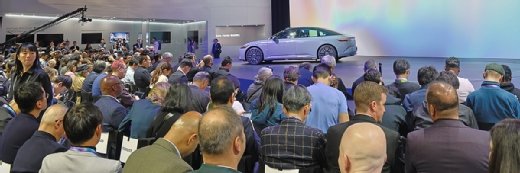
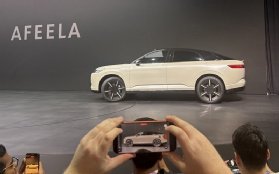
Sony Honda Mobility launches Afeela 1 at CES 2026
LG’s journey has gained significant mileage through partnerships with Zoom and Microsoft Xbox, looking to transform vehicles into what it calls dynamic software-driven experience hubs. In the former case, the intention was to create a new workplace for business users in a changing world of work. The latter, unveiled in 2025, represented the gaming platform’s first integration at scale into the automotive space, and it was all part of the company’s aim to meet players wherever they are, streaming the entire Xbox experience with a compatible controller in the car.
In a similar vein, gaming was a core feature in the debut of a new prototype vehicle, Afeela 1, presented at CES 2026 by Sony Honda Mobility (SHM). Established in 2022, joint venture mobility tech company SHM combines Sony’s technological consumer electronics legacy and Honda’s automotive expertise. Its stated mission is to lead innovation in the industry through joint development and sales of high-value-added mobility services.
SHM said it has been continuously enhancing its ADAS, Afeela Intelligent Drive, while evolving it into an end-to-end AI model that integrates a Vision-Language Model (VLM). Starting with Level 2+ driver assistance that supports travel from the departure point to the destination, the company aims to achieve Level 4-equivalent capabilities in the future, transforming the in-vehicle space into a “drive-less” environment.
And very much part of this new space are Sony’s gaming products. SHM is drawing on Sony’s PlayStation division to support gaming within Afeela, with the ability to use Sony Remote Play to stream games from a PlayStation console within a car through the Afeela in-built entertainment system.
Safe travels
Like Sony, Google used CES to offer a clear view of its “strong commitment” to the connected vehicle sector. With its partners, Google has been attempting to establish a unified reference platform aimed at addressing accelerated development cycles, strengthening quality assurance and streamlining production for vehicle manufacturers. The intended result is to allow automakers to create next-generation vehicles that use agentic AI to better anticipate, react and adapt to driver needs.
Specifically at CES, Google and colleagues showed how to simplify the deployment of next-generation AI agents with its Gemini Enterprise platform. This is an evolution of the Automotive AI Agent announced at the IAA Mobility show in Munich in 2025. By aligning its AAOS roadmaps with the Qualcomm Snapdragon Cockpit Platform, Google believes it is creating a foundation for next-generation software-defined vehicles (SDVs) and in-vehicle infotainment systems.
The intelligent mobility technology has been redefined for the GenAI era, connecting vehicles to the cloud using an architecture that blends on-device and cloud models. This approach is designed to enable real-time personalisation for drivers and help speed up the roll-out of new features such as advanced voice-based assistants.
For drivers, the benefits claimed from such technology include smarter, safer and more adaptive vehicles, with dynamic personalisation and multimodal interfaces that offer always-on AI-driven features to enhance convenience and safety.
In addition to its core software, Google was joined at CES by parent Alphabet-owned autonomous vehicle producer Waymo. While the Waymo presence at the show was somewhat understated compared with the big guns in the car market, the company was able to show the next parts of its growing fleet, with a rebrand of its core range and expansions of its fleet’s reach.
Waymo currently serves a number of markets in the US, with more in the pipeline. Just weeks after the show ended, Waymo announced that by September 2026 it hopes to operate a robotaxi service in London.
Heading for autonomy
While Waymo vehicles have been traditionally made by the likes of Jaguar and Hyundai, CES saw a new Waymo minivan, which will carry the Ojai brand. The all-electric vehicle, made in partnership with Chinese vehicle firm Zeekr, comes with the latest version of its Waymo Driver autonomous driving technology.
Waymo says it has already acquired vast amounts of driving knowledge through millions of miles’ worth of automotive experiences on public roads, and billions more in simulation. As such, it claims that the volume of driving data it has acquired will allow it to take autonomous driving technology further than anyone else, already allowing it to reduce traffic injuries and fatalities.
Before a Waymo Driver begins operating in a new area, the company first maps out the intended territory, from lane markers to stop signs to curbs and pedestrian crossings. Instead of relying solely on external data such as GPS, which the firm says can lose signal strength, Waymo Driver can use custom maps matched with real-time sensor data – from sources including LiDAR, radar, cameras – and AI to determine its exact road location.
The company said that through various sensors and AI, its vehicles can decipher what’s around them – distinguishing pedestrians, cyclists, vehicles and other objects – and then use AI to plan the best subsequent action or route to take. Waymo Driver determines the exact trajectory, speed, lane and steering necessary to allow the vehicle to behave safely throughout a journey.
IoT expansion
Among other key automotive tech launches, NXP Semiconductors unveiled the S32N7 super-integration processor series for the intelligent vehicle core, designed to enable automakers to differentiate their fleets, as well as control and evolve the vehicle platform throughout its lifecycle. The role of the S32N7 processor goes beyond infotainment and autonomy and into the core vehicle functions.
IoT is not just about the connection itself. Customers are now starting to really value the insights that come from devices connected with IoT
Erik Brenneis, Vodafone IoT
NXP said the new series will deliver “safe” modular computing with hardware-enforced function isolation, enabling manufacturers to consolidate securely multiple vehicle core functions, including body, motion, chassis control and vehicle dynamics. Engineering and technology company Bosch was announced as the first to deploy the system in its vehicle integration platform.
The show gave a feeling of a shift in the internet of things (IoT) industry. What is a connected car but a mobile IoT device? What is an industrial robot? For Erik Brenneis, CEO of Vodafone IoT, the hype stage in the IoT lifecycle is gone, and businesses have become comfortable and confident enough to digitise their business around IoT.
He believes there will be three key drivers. One, satellite technology will bring IoT coverage to highly remote areas, acting as a reliable backup for terrestrial networks, but also an additional layer of resilience. Two, 5G standalone networks will bring ultra-low latency, greater efficiency and network slicing to IoT. And three, cyber security will continue to drive innovation in IoT to ensure devices that remain in the field for many years are secured, especially when used in mission-critical applications. As devices use the latest network infrastructure, through more demanding and mission-critical IoT applications, quality of service will become more crucial.
Brenneis noted: “IoT doesn’t have to prove itself as a concept, and we know this from how globally accessible IoT connectivity is, not to mention the range of options that exist for connecting IoT devices specifically, such as low-power networks. There are also tons of use cases now that demonstrate IoT is an accepted way of working. But IoT is not just about the connection itself. The other driver is that customers are now starting to really value the insights that come from devices connected with IoT.
“While we see connection numbers growing steadily, what is more revealing is the exponential growth in data usage. That’s a much more telling sign that IoT is creating genuine value for many customers, and as such, they’re consuming more and more of the service through data. One of the great things about IoT is that it is continually evolving as new networks and technologies are deployed. These new developments make IoT more relevant, opening up even more use cases.”
Add in the advances in edge computing, and IoT is ready to enter into a new phase where AI will help make devices a lot smarter, more precise and more flexible. This was shown very clearly at CES. Is it a car show, a robotics show or an IoT event? The key to everything will be connectivity.
New PCs, laptops and unique form factors at CES 2026: At CES 2026, the annual consumer electronics show, Dell, HP and Lenovo unveiled announcements in enterprise PCs, creative monitors and new device form factors.
Toyota enhances SUV range with added infotainment: New version of RAV4 now available with Snapdragon Digital Chassis for personalisation and immersive infotainment, as well as advanced safety, convenience and real-time connected features.