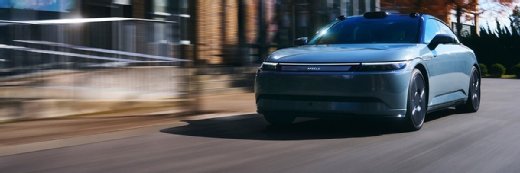
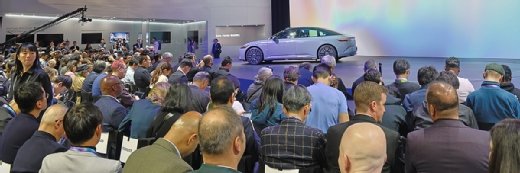
Sony Honda Mobility (SHM) presented a pre-production model of its Afeela 1 vehicle (pictured above) and debuted a new prototype, the Afeela Prototype 2026, at the CES 2026 technology show.
Established by Sony Group Corporation and Honda Motor Co in 2022, joint venture mobility tech company SHM combines Sony’s technological consumer electronics legacy and Honda’s automotive expertise. Its mission is to lead innovation in the industry through joint development and sales of high-value-added mobility and to provide mobility services.
SHM said Afeela represents “the fusion of intelligence and emotion in motion”, with mobility that senses the driver and that the driver can feel. It added that at its core, Afeela “brings to life a next-generation driving experience built on advanced sensing, interactive technology and human-centred design”.
At CES 2026, in addition to presenting the new vehicle, SHM confirmed the adoption of solutions from Qualcomm Technologies’ Snapdragon Digital Chassis within SHM’s next-generation electrical/electronic architecture and the implementation of the Afeela Co-Creation Programme to provide creators with access to development documentation for Afeela in-vehicle entertainment content. It also announced the development of a new open, on-chain mobility service platform using a token-based incentive model.
SHM said it has been continuously enhancing its advanced driver assistance system (ADAS), Afeela Intelligent Drive, while evolving it into an end-to-end AI model that integrates Vision-Language Model (VLM). Starting with Level 2+ driver assistance that supports travel from the departure point to the destination, the company aims to achieve Level 4-equivalent capabilities in the future, transforming the in-vehicle space into a “drive-less” environment.
The Afeela Personal Agent, an interactive conversational artificial intelligence (AI) agent, uses Microsoft Azure OpenAI Service to deliver highly personalised, natural dialogue experiences tailored to individual users, making the relationship between people and mobility more personal.
The Afeela Co-Creation Program will see SHM collaborate with creators and developers to expand the possibilities of mobility by providing access to information necessary for developing in-vehicle entertainment, including in-car themes and apps. The company is also building cloud application programming interfaces (APIs) and the development environment for Android applications on in-vehicle infotainment (IVI) to enable developers to create entirely new mobility applications that will further transform the in-cabin experience.
Kicking off the CES launch, Izumi Kawanishi, representative director, president and chief operating officer of SHM, presented the new car under the theme “mobility as a creative entertainment space”, affirming the company’s long-term technology vision of how partnerships across technology, entertainment and creation are shaping its roadmap.
We are bringing innovation to how people move. Being in a car will no longer be about driving – it will be about making the most of your time and space
Izumi Kawanishi, Sony Honda Mobility
“In the three years since we established Sony Honda Mobility, the automotive industry has seen diverse evolution and growth, and at SHM, we are evolving mobility into an interactive experience. Our brand, Afeela, is built on the vision to redefine the relationship between people and mobility,” he said.
“We are bringing innovation to how people move. Being in a car will no longer be about driving – it will be about making the most of your time and space while your car understands the passenger preferences and feelings. The relationship will become an interactive dialogue,” he added.
Kawanishi stressed that the key to realising mobility as a creative entertainment space would be in harnessing the power of AI, specifically advanced vehicle AI, which will deliver user experiences and two-way communication that goes beyond the traditional mode of interfacing while in the autonomous driving domain. This, he argued, would allow SHM to create experiences that “truly foster a more symbiotic relationship with the driver”.
“We are advancing the development of our intelligent drive [model] ... constantly reviewing setting devices in the [software] layer, further improving computing power and making our end-to-end driving AI stronger. As a result, the cabin will evolve into a driverless environment, reducing the task of manual driving and providing more freedom to relax and enjoy the entertainment,” he said.
“Our conversational agent enhances mobility interaction through personalised natural language dialogue. This elevates the relationship between people and mobility into something more awesome and long-lasting. In other words, mobility will [create] experiences that understand every user.”
Kawanishi expressed confidence that by maximising the cabin space, Afeela could challenge the traditional concepts of in-car entertainment, creating and supporting content through panoramic screens, dynamic wallpaper, a rich instrument cluster and entertainment systems to transform the very experience of mobility into a “richer, more enjoyable time”.
Notably, SHM is drawing on Sony’s PlayStation division to support gaming within Afeela, with the ability to use Sony Remote Play to stream games from a PlayStation console within a car for the first time through the Afeela entertainment system.
“Afeela becomes another way you can pick up and play the games you love, just like every other remote play experience,” said Sony Interactive Entertainment’s business and product senior vice-president, Eric Lempel.
“This is the console ... for those moments when you have some downtime in your car, like when you’re waiting to pick someone up, or if you want to keep passengers entertained on a very long road trip. For us, this is a meaningful example of how the PlayStation experience can extend beyond the living room in ways that feel natural and useful for gaming fans.”
Commenting on what he believes his company could contribute to the Afeela environment, Nakul Duggal, automotive and industrial and embedded internet of things executive vice-president and group general manager at Qualcomm Technologies, remarked that, in his opinion, Afeela represented “a bold step forward in redefining mobility”, and that going forward, Qualcomm had the simple expectation that Afeela would set a new benchmark for what an intelligent car could be “where technology elevates every moment of the drive”.
He added: “Our collaboration with Sony Honda Mobility reflects a shared vision. Together, we are building not just technology, we are creating smarter, safer and more engaging journeys … The car becomes a dynamic digital space with tailored content, natural interactions and seamless integration across devices, advanced travel assistance systems designed for safety and automation, combining high performance, efficiency and AI-driven intelligence to enable smooth, confident driving and a comprehensive, cloud-connected architecture that ensures vehicles stay updated, secure and always connected. AI has become a foundational element, from adaptive in-cabin systems that learn driver preferences to safety and automation through ADAS.”
The first production model, Afeela 1, is scheduled for deliveries in California by late 2026, with expansion to Arizona planned in 2027. CES also saw the world premiere of the Afeela Prototype 2026 vehicle, for which the US market launch of a production model is expected by 2028. This latter car builds on the core concept of Afeela 1 while offering greater spatial flexibility and accessibility.
Read more about software-defined vehicles
LG looks to accelerate in-vehicle experience with Xbox, Zoom: CE giant continues its drive into automotive, claiming to redefine software-defined vehicle era through partnerships offering in-car gaming and meetings delivered over standard content platform.
Software-defined vehicles drive next-gen auto architectures: Research highlights trend in automotive industry towards software-defined vehicles where functionality, user experience and monetisation opportunities are governed increasingly by software rather than hardware.
Arm teams with Nvidia to boost software-defined vehicles: Leading processor and AI graphics processing unit provider join forces to advance processing and connectivity in sector where GenAI applications are becoming paramount.