


NTT DATA: GreenOps & FinOps: From cost discipline to cloud sustainability strategy

This is a guest post written by Joe Cupano, global CTO, strategy & innovation, NTT DATA Inc.
Cupano writes in full as follows…
Today’s enterprises are faced with a dual challenge – balancing enterprise cloud spend with environmental, social and governance (ESG) frameworks and activities.
Cloud usage and spend are on the rise due to the demand for AI solutions. In fact, IDC projects the AI infrastructure market to reach $758 billion by 2029, driven by accelerating investments in compute and storage for AI deployments.
Cloud financial operations (FinOps) are charged with optimising the economic performance of enterprises. It influences how cloud platforms are designed and operated, with architectural decisions favouring elastic, event-driven and consumption-based services that minimise idle capacity.
Carbon-aware scheduling
Meanwhile, Gartner has also stated that close to 50% of enterprises will implement sustainability monitoring solutions to understand cloud energy consumption and the resulting impact on their carbon footprints.
This ESG framework, otherwise known as GreenOps, integrates sustainability practices into cloud and IT operations. Workloads are optimised not only for performance and cost, but also for carbon intensity. This introduces new optimisation levers such as carbon-aware scheduling, regional workload placement and automated shutdown of non-production environments. These changes are driven by investor pressures and developing regulatory reforms related to carbon neutrality movements.
Enterprises that integrate GreenOps into their existing FinOps practices improve unit economics, sustainability posture and governance. The goal is to create a comprehensive operating model for cloud consumption. Those that adopt it early will achieve lower unit costs, reduced environmental impact, stronger regulatory readiness and better control over cloud sprawl. Those that do not risk rising costs, unmanaged emissions and governance gaps that scale with cloud adoption.
GreenOps & FinOps policies for success
For GreenOps and FinOps to succeed at scale, enterprises must move beyond retrospective reporting toward policy-driven governance. These six strategies assist enterprises in building a solid, integrated foundation.
- Mandatory tagging and attribution – All cloud resources must include standardised tags for owner, application, environment, cost centre and sustainability domain. Untagged assets should be flagged automatically. Without attribution, cost and carbon accountability are not possible.
- Provisioning guardrails – New resources should comply with predefined costs and carbon thresholds. High-cost or high-carbon services require explicit business justification. Default provisioning should favour auto-scaling and consumption-based services to minimise idle capacity.
- Idle resource and lifecycle management – Non-production environments should automatically shut down outside approved operating windows. Orphaned resources without an identified owner must be decommissioned after a defined grace period. These controls directly reduce waste and Scope 3 emissions from public cloud usage.
- Carbon-aware workload placement – Where technically feasible, batch and flexible workloads should be scheduled in areas with lower carbon intensity. Latency-sensitive workloads may be exempt, but optimisation opportunities must be continuously reviewed.
- Workload governance – Workloads must have metrics tied directly to business value and AI just happens to be the one workload with the most complexity. Priority workloads are those with metrics tied directly to business value. GreenOps is a currency measured as part of FinOps and not something standalone. Its implementation is akin to how cybersecurity is best implemented as a transparent component.
- Executive scorecards – Quarterly executive reporting must include cloud expenditure, cost allocation maturity and carbon metrics. Embedding these metrics at the board level institutionalises accountability.
Looking to a green financial future
In a market where mission-critical workloads are accelerating infrastructure demand and sustainability is entering executive scorecards, cost optimisation alone is no longer enough. AI is magnifying energy and cost volatility as enterprises scale model training and inference workloads.
Energy supply chain constraints and regional grid capacity will become material risk factors. Workload placement decisions will increasingly incorporate carbon intensity and energy availability as architectural criteria.
This leads to cloud providers competing for energy transparency. Enterprises will be smart to write strict requirements into their provider contracts for meeting carbon-intensive requirements and location-based emissions disclosures. It puts the onus on the cloud provider to ensure that operations are compliant or face strict penalties.
When enterprises integrate GreenOps metrics into their FinOps program, it will result in cross-functional economics, sustainability and better governance over costs and energy estimates. Whereas other workloads already have a quantified business value, AI is still on a business monetisation journey.
The convergence of GreenOps and FinOps is not a passing trend. Enterprises that institutionalise cost-and-carbon governance now will achieve stronger unit economics, reduced environmental impact and improved regulatory readiness, thus reducing the risk of scaling inefficiency alongside their cloud adoption.
The future belongs to enterprises that can manage both the balance sheet and the carbon ledger with equal precision.
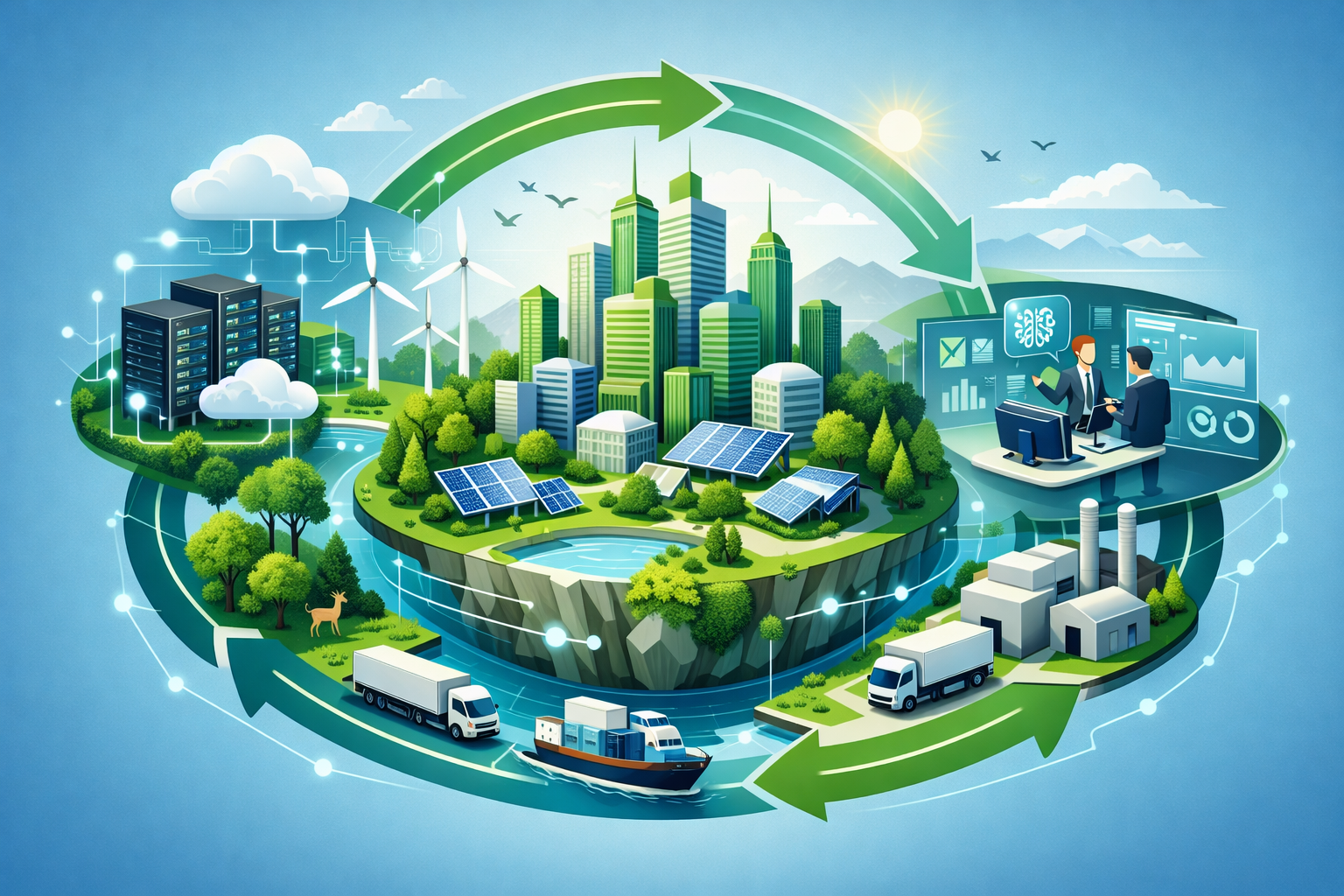
Image: ChatGPT