SAS tools up industry-grade AI agents & models

The rise of agentic AI services is far outstripping the previous generations of predictive and generative AI that had us momentarily gripped not so very long ago, as the enterprise technology industry looked to apply those functions to modern stacks and business workflows.
Pre-agentic functions still exist, of course, although many are now subsumed into the substrate of wider and more complex services that are spearheaded with agentic front ends – and those are front ends being engineered to enable robotic work buddies to sit alongside their human counterparts in increasingly automated roles from high finance to the factory floor.
Sector-specific AI, specifically
What may be missing then is the bridge to not just applied intelligence at a general industry level, but more industry-specific AI services where agents and models are built and aligned to more dedicated datasets and more defined (sometimes deterministic, some more random) operational business outcomes.
Data and AI platform company SAS says that it’s also a question of budget and time constraints, all of which can lead to a “move fast and break things” mentality that lets necessary governance go by the wayside. That fail fast & fail often mindset works well with Agile software application development in its purest sense, but in the fragile quantum state that is generative AI, it’s not always suitable.
On a mission to provide some answers in this space, SAS says it is working to equip customers with industry accelerators with AI agents and models to solve every industry’s toughest challenges.
Supply and ops planning (S&OP)
Among its newest services is SAS Supply Chain Agent, a technology designed to streamline supply and operations planning (S&OP), a process retailers and manufacturers use to manage supply chains as markets and material availability ebb and flow.
According to professionals who analyse this space, S&OP is a “multi-day taxing process” (taxing as in hard work, not as in working to address nation and state levy charges for taxes and tariffs – although actually yes, that too), requiring professionals across multiple departments to work in spreadsheets predicting and making decisions about dispensing the next six to 12 months of inventory. The sheer scale of managing thousands of supply chains via numerous complicated procedures is a longstanding problem. It’s also meant that most organisations could only expend the resources and time to run S&OP once a month.
“SAS Supply Chain Agent runs continuously to balance demand, supply and operations,” states SAS. “Users can optimise supply chains in periods of high demand, forecast future needs based on usage patterns and reduce waste and over-ordering. Plus, users can maintain ongoing, near real-time visibility into supply chain operations, allowing them to continuously tap their data to make smarter decisions, inside or outside of a typical planning window.”
Following commercially-driven curiosity
Business users can interact with the agent via a chat experience that allows them to follow their commercially driven curiosity and problem-solve whenever they’d like.
For instance, a user could ask the agent to run a scenario (say, a 15% drop in demand) and explore possible outcomes, receiving explanations along the way on how the agent arrived at its decisions for transparency and trustworthiness.
“Current pre-packaged agents tend to tackle basic processes; with Supply Chain Agent, SAS is compressing a very complex process, which could deliver significant value,” said Kathy Lange, research director at IDC’s AI, data and automation software practice. “This offering positions SAS to bring its longstanding supply chain knowledge to a new generation of agentic AI solutions.”
First debuted at SAS Innovate 2025, SAS used its SAS Innovate 2026 user and practitioner conference to explain how its platform enables users to create digital twins of customers’ industrial environments in Epic Games’ Unreal Engine (UE). These fully virtual facility replicas allow customers to simulate scenarios, creating a proving ground for customers to ask “what if” and work out how to act.
As a working example, in hospital rooms, surgical teams can’t perform lifesaving operations if their full set of necessary medical devices (scalpels, clamps etc.) are not sterilised and safe to use on patients. A major provider of medical device sterilisation is collaborating with SAS to build a digital twin of their facility, allowing them to explore and test scenarios that could prevent or slow delivery of their vital services and optimise how they run.
This customer believed that trays of medical tools were getting stuck in a buffer lift that lined the trays up for cleaning, bottlenecking the entire process. By rendering their facilities into digital twins and exploring further, they discovered that, in fact, the trays were, in fact, getting delayed because the buffer lift acted as a central distribution point. By making targeted adjustments, the bottleneck was broken and production pace picked up.
SAS state of enterprise AI
Speaking during the media briefing session at SAS Innovate 2026, company CTO Bryan Harris asked the press to consider what “durable value” means in the era of AI. As cloud providers have used open source to commoditise a good proportion of the infrastructure that developers use to build enterprise applications, that shift was a major development… but an even greater and more impactful shift is now underway.
“But AI has fundamentally re-shifted the economics of build vs. buy,” said Harris. “As we now work to create durable value, it comes down to governance, agentic AI, digital twins and quantum AI as these forces all come together.”
Welcoming Reggie Townsend, VP of ethics, governance and social impact at SAS to the stage, Harris questioned Townsend on the currency of trust in the era of AI. Pointing to the work SAS has done with its AI Navigator service, the pair explained how this new service works.
“We wanted to address the idea that governance is the path of most resistance,” said Townsend. “So we wanted to make governance irresistible, accessible, intuitive and action-oriented. We want to make it clear that AI governance is a growth driver. Instead of fears of shadow AI putting the organisation at risk, AI governance empowers people to push the limits of AI within a structured, transparent and secure environment.”
SAS AI Navigator offers a unified view of whatever models and tools a team is already using, including LLMs, AI agents and open source or SAS models. It supports the journey from experimentation to deployment through retirement, providing a unified view of all governed assets, whether built in-house or purchased from third parties.
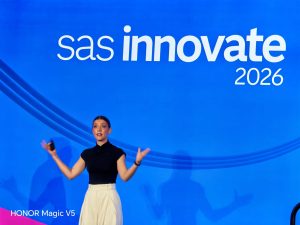
SAS’ Profi: We’re at the point of workinig with AI that ‘acts’ in tools, systems and workflows.
Jared Peterson, SVP of global engineering, took over the extended section of the SAS Innovate media session. Inviting a number of guest speakers on stage, including Marinela Profi in her role as global market strategy lead for AI agents and gen-AI at SAS, Profi talked about agents are now taking actions across tools, systems and workflows.
“It’s what I call ‘AI that acts’ today,” said Profi. “We know that users are not necessarily challenged by models themselves, they’re challenged by everything that happens ‘around’ language [and image, and other] models as they start to apply agents to a point of actionable influence on an organisation’s data… and that’s when enterprises need to start to decide to what degree that will put agents in control to make decisions and, crucially, where they put their human-in-the-loop.”
Safeguarding with synthetic data
Looking wider into other toolsets, SAS Worker Safety enables organisations to address workplace risks using digital twins, synthetic data and computer vision.
With this offering, customers use digital twins to create realistic footage for training computer vision models on high-risk scenarios. This approach allows for virtually unlimited variation in simulated environments, capturing crucial details like the shape of protective eyewear, equipment colour and how different lighting conditions can affect an accident.
“Synthetic data and computer vision also make it possible to model rare but plausible events for which real footage may not exist, like forklift collisions. By using fully simulated worker personas, organisations can repeatedly test specific sequences of actions without involving real employees or exposing any personally identifiable information,” explained SAS, in a technical briefing document.
Once trained, these models can be deployed across cameras within a facility to provide real‑time alerts, helping ensure workers are wearing protective equipment correctly and maintaining a safe environment. On a factory floor, this might mean verifying proper helmet positioning, or, in medical settings, detecting a slipped mask or glove before a lab or operating room is compromised.
SNAP struggles
In administering Supplemental Nutrition Assistance Program (SNAP) benefits, American states often struggle to keep pace with evolving regulations, heavy caseloads and managing time-consuming manual tech tasks. Now, new federal regulation can directly fine state budgets for exceeding the threshold for payment error rates: the percentage of benefits that are over- or under-awarded because of eligibility miscalculations, outdated case data or undetected fraud. These compounding errors can cost states millions in federal funding. And, most importantly, families who need vital assistance may not be receiving all the benefits they qualify for.
Multiple states in the US are using SAS Payment Integrity for Food Assistance to confront this problem and better serve their constituents.
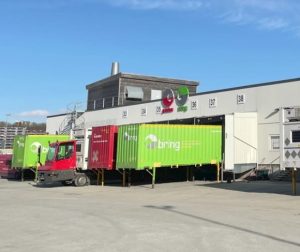
Posten Bring used SAS Viya and SAS SingleStore to underpin its high-demand environment where its systems run continuously, 24/7, to support real-time parcel tracking, route optimisation and customer communications..
GLOBAL NOTE: Although this (above) part of the SAS story is undeniably US-centric, the company did use its SAS Innovate 2026 keynote mainstage session to illustrate customer stories currently playing out around the world, particularly in Europe with Posten Bring (a logistics and delivery provider in the Nordics) as a case in point.
“When organisations are left stitching together ad-hoc AI frameworks and experiments, they often fail to achieve the competitive edge they’re looking for when they invest in AI,” said Manisha Khanna, global market strategy lead for applied AI at SAS. “We’re engineering industry accelerators with purpose: to solve defined, real industry problems in highly regulated environments. With production-ready agents and models that work on data they already have, our customers across industries can and are achieving extraordinary outcomes.”
SAS’ models have been trained on patterns from a broad dataset contributed via consortium by major global financial institutions. The company says its SAS industry accelerators are rigorously tested and designed for their designated functions. Plus, by integrating with an organisation’s existing workflows, industry vertical specialists can use SAS’ portfolio to extend their analytics and AI capabilities with their existing data.
50 years – and then AI
What is perhaps most interesting about the work currently being carried out at SAS is the age of the company. This is an organisation that is this year celebrating its 50-year anniversary – and there are precious few technology organisations that have evidenced this level of longevity. There are even fewer tech firms of any shape that are working with neural networks, modern governance issues, synthetic data and all manifestations of agentic AI services.
The SAS of today is obviously a significant progression if we look back at the organisation’s roots – what started as a government-funded data project at North Carolina State University to analyse massive amounts of agricultural data has pervaded, pivoted and positioned itself as a company built for the data science age that is now ready to straddle the post-cloud impact of agentic AI at every industry application point.