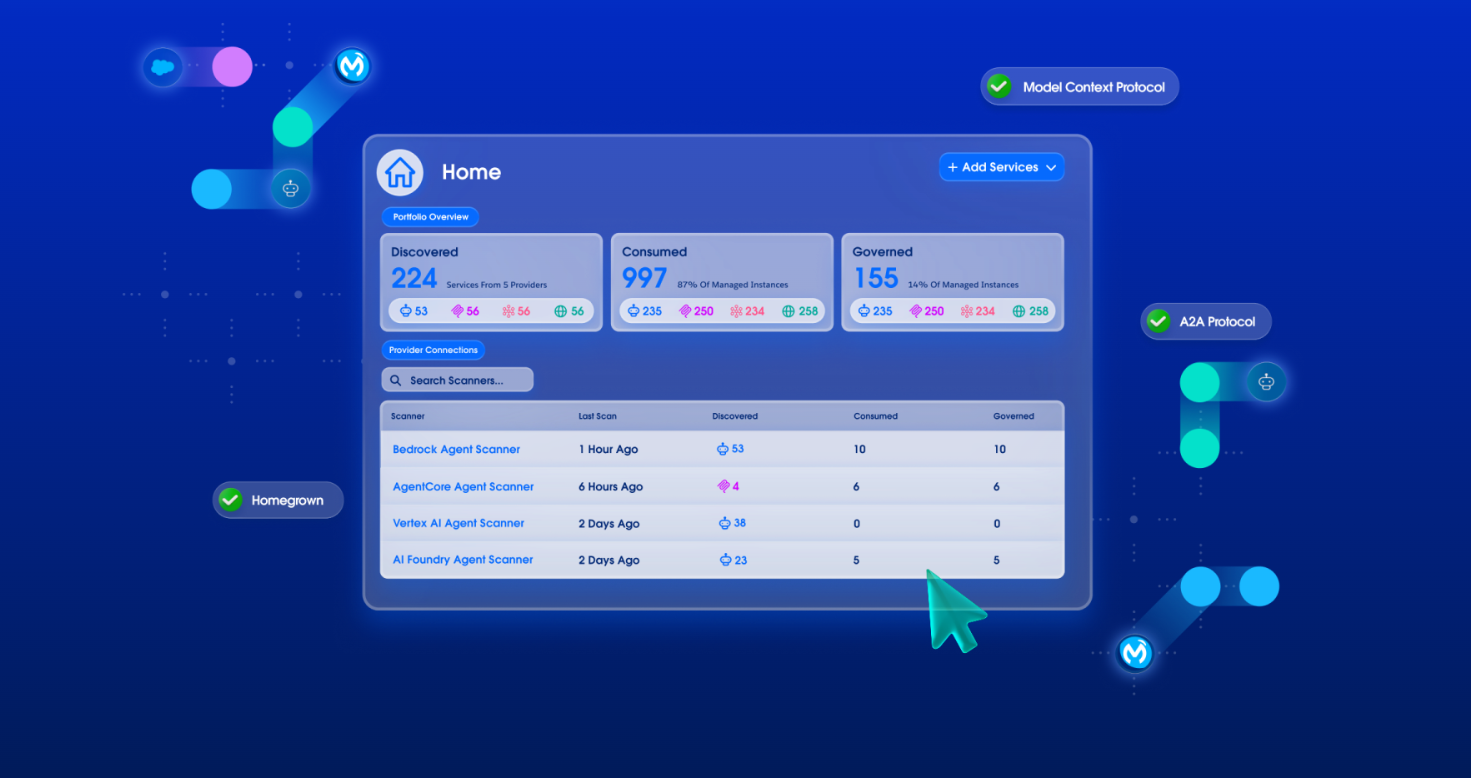
MuleSoft Omni Gateway offers route to agentic visibility & consistent governance

Software application development that gravitates in, around, through, under and over the new and emerging agentic AI services, models and toolkits being laid down every day continues apace.
But the conversion is changing.
The “how much” of “if at all” AI factor is now being replaced by the “which agents… and with what contextual underpinning layers and corresponding levels of AI infrastructure provisioning” today.
Infrastructure and governance are suddenly the most compelling (if not always the sexiest) part of the AI conversation.
This, says MuleSoft is why it has this month launched Omni Gateway to address this need for unified governance and visibility that spans API, LLM and agent traffic from a single place, cross-platform, across the gateways and assets already in production.
According to Salesforce product marketing manager Aston Whiteling, Omni Gateway is an evolution of MuleSoft’s service for API Management, extended now to help lead in the agent age.
Enforcement & visibility
For platform engineers, IT architects and AI Ops teams now responsible for what agents do in production, it’s an enforcement and visibility layer.
The founding premise of MuleSoft Omni Gateway is that consistent governance is what makes it possible to go faster, not slower.
“Enterprises have years of API investment already in production: hundreds or thousands of endpoints, across gateways and platforms that were never designed with autonomous agents in mind,” wrote Whiteling, on a MuleSoft product blog. “That existing layer is the foundation AI agents need to fast-track operating across enterprise systems safely. The catch is that it wasn’t built to be governed the way AI traffic demands and the gap between what’s running and what’s governed is widening faster than most teams realise.”
He notes that token costs accumulate without visibility into where they’re coming from.
We also need to realise that security policies that held for human-initiated API calls don’t translate cleanly to LLM interactions.
All this leads us to a point where new agent workflows go into live production on infrastructure that the platform team never reviewed, because there’s no shared enforcement layer to require it. So when something behaves unexpectedly in production, the audit trail to understand isn’t there by default.
“The instinct is to patch those gaps with more tools: a standalone AI gateway here, a custom policy layer there. But each addition introduces its own enforcement model, its own visibility surface and its own integration requirements. The coordination overhead compounds with every layer added and the gaps tend to move rather than close,” wrote Whiteling.
What’s actually working looks different, he says.
The enterprises getting AI to production fastest aren’t rebuilding governance from scratch for every new surface. They’re extending the disciplines that already work across APIs and applying them consistently to everything agents touch.
MuleSoft Omni Gateway
The MuleSoft team say that API management was built for a world where humans exclusively wrote and managed integrations. MuleSoft Omni Gateway extends this governance infrastructure that developers have already built to cover the full AI stack – every LLM call, every agent tool, every MCP – without the need to start all over again.
From a single catalogue, federated policy enforcement reaches across MuleSoft and third-party gateways such as Kong, Apigee and AWS without requiring a migration project to get there. Policy applies once and travels consistently, regardless of which underlying gateway is handling the traffic.
“REST APIs become agent-ready in minutes. Authentication and compliance controls are inherited automatically from the source API, so every MCP tool arrives in production safely without a separate review cycle,” said Whiteling.
He also points to token consumption, LLM routing and cost controls in one shared layer. IT and AI engineering teams see the same familiar user interface by default, making joint accountability practical rather than something each team assembles separately.
It’s what the team calls “a single thread” through every agent interaction.
Correlation IDs carry across API calls, tool invocations and agent delegations.
“Compliance policies, including identity propagation and prompt safety, are embedded at design and are enforced at runtime across every gateway in scope,” concluded Whiteling. “For teams that have spent years building and maintaining API programs, the value here isn’t starting over. It’s that the infrastructure already in production becomes the governance foundation the AI program needs, extended rather than replaced. What you’ve already built is worth more in the agentic era than most governance strategies currently give it credit for.”