Salesforce counters agent sprawl with MuleSoft Agent Fabric

Rather like cloud computing, simply ‘turning on’ agentic AI services (spoiler alert: there is no actual switch to flip) without a thorough set of provisioning and management controls is not necessarily a good idea.
In the cloud, the industry somehow assumed that security would be there… when it wasn’t. That’s an overstatement, but early cloud lacked the secure-by-design and shared responsibility model (security OF the cloud, provided by hyperscalers + security IN the cloud, overseen by organisations themselves) that we know today.
Moving forward to the era of the agentic enterprise, software engineering teams are experimenting with agents at an unprecedented rate. In the first half of 2025 alone, AI agent creation surged by 119%, and IDC projects the number of actively deployed AI agents to exceed 1 billion worldwide by 2029 – 40x more than 2025.
But all of this activity has created a new challenge that’s somewhat redolent of our initial foray into cloud: agent sprawl.
What is agent sprawl?
There is no standardised industry definition of agent sprawl, but we can reasonably define it as the uncontrolled proliferation of autonomous (some semi-autonomous also) AI agents across an organisation’s workflows and operational systems. The use of uncoordinated and unsanctioned agents working in silos is argued to result in redundant workflows and duplicated functionality; the lack of visibility caused by agent sprawl and shadow AI in general leads to flaky governance, unnecessary costs and security vulnerabilities, not to mention conflicting outputs, AI bias and hallucination. Scalability in these scenarios is tough i.e the sprawl makes it hard to understand not only what agents are operating in an organisation, but also how they reason, what they act on and the business or data fabric level outcomes they are intended drive.
Salesforce is on a mission to counter the spectre of agent sprawl with MuleSoft Agent Fabric, a technology designed to bridge and simplify fragmented enterprise technology landscapes into a governed and cohesive agent network.
Agents, tools & metadata
The company says that software teams will now find it is easier to know what is being created across platforms with a single control plane for all AI agents, tools and metadata.
Agent Scanners automatically detect and catalogue AI agents across enterprise technology ecosystems, such as (no surprise to see what’s first on the list here) Salesforce Agentforce… but also Amazon Bedrock, Google Vertex AI and other agent platforms.
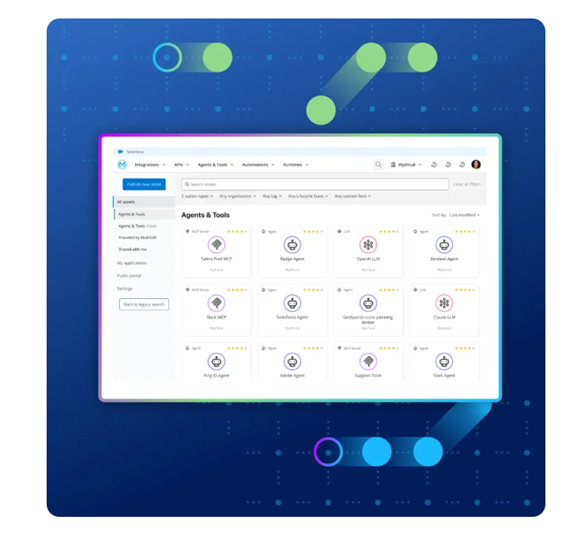
With simplified registration for MCP servers and bespoke agents, users get one single governed view. By streamlining the integration of any agent or MCP server, regardless of vendor, Salesforce says it is delivering a trusted, open, and interoperable platform.
“The most successful organisations of the next decade will be those that harness the full diversity of the multi-cloud AI landscape. The expanded capabilities of MuleSoft Agent Fabric give you the freedom to innovate across any platform while maintaining the unified visibility and control needed to scale,” said Andrew Comstock, SVP and GM of MuleSoft, Salesforce.
Comstock provides a working example. Let’s imagine that now, an AI engineer won’t have to work alone to audit and scour cloud environments for agents built across inventory, logistics and customer service teams. Instead, Agent Scanners automatically find an inventory forecasting agent in Google Vertex AI and then register it alongside a customer support agent built in Agentforce, for governance and management.
There is no manual data entry, no visibility gaps and (in theory if not in practice) no surprises.
How it works
MuleSoft breaks down the functionality contained within this service by explaining that it is engineering controls to manage a continuous multi-agent ecosystem for agent discovery.
The company’s Agent Scanners are capable of linking different environments where agents exist. The scanners then constantly patrol these ecosystems to spot new or updated agents, identify their endpoints and understand what they’re designed to do. Through deep metadata extraction, scanners go beyond the surface of an agent and automatically extract its specific capabilities (e.g. querying a database or processing a refund), the Large Language Models (LLMs) powering it and what data it has permission to access, where available.
They then normalise and map the metadata to standard Agent-to-Agent (A2A) card specifications.
Everything that Agent Scanners find is continuously synced to MuleSoft Agent Registry, a central catalogue where agents, MCP servers and AI tools can be registered and made discoverable by developers or other agents. It’s an always-on approach to cataloguing agents that ensures security teams are always looking at real-time data, not a snapshot from three months ago.
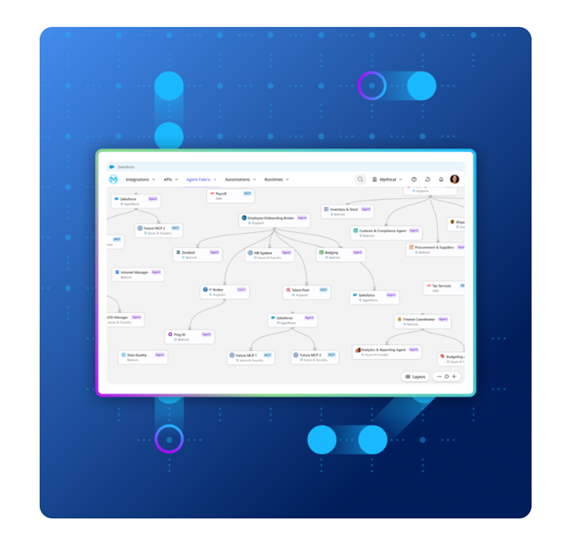
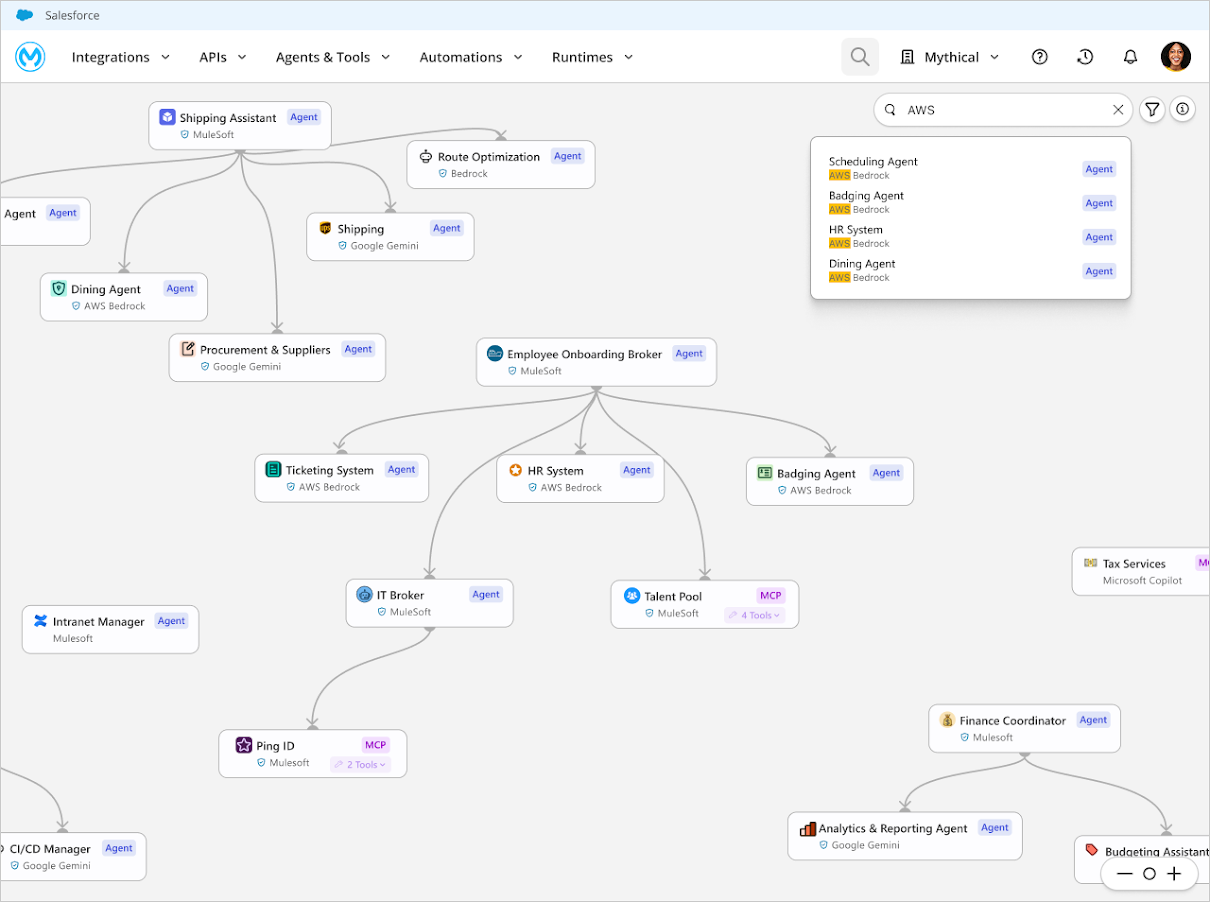
“It’s not just AI agents on major platforms that can be automatically discovered. To help ensure no AI asset is left behind, MuleSoft Agent Fabric also includes flexible registration for homegrown agents and MCP servers via URL, plus a curated list of public MCP servers from the Official MCP Registry. Bringing all of your agents and tools together enables you to optimize and control them with ease. MuleSoft Agent Visualizer gives you a view of your entire AI footprint and provides advanced filtering and search capabilities. Want to see every agent running on Amazon Bedrock versus those on Google Vertex AI? It’s now just a couple of clicks away,” notes MuleSoft, in a product statement.
Data scientists in logistics are often building powerful internal tools, like MCP servers for proprietary databases. Instead of those tools staying hidden, a team can now bring them into the fold by pasting a URL into the registry. This makes your custom logistics or optimisation data discoverable and reusable for the rest of the company – while keeping it firmly under your security policies.
Burden of manual oversight
MuleSoft Agent Fabric aims to replace the “burden of manual oversight” with automated visibility, allowing every team to eliminate operational silos and helping to ensure that every agent is accountable and productive.
“Amazon Bedrock empowers customers to build secure, scalable agents and sophisticated multi-agent workflows. Through our collaboration with Salesforce and MuleSoft, we’re giving customers the unified visibility and governance they need to confidently scale their AI investments across their entire agentic enterprise,” said Chris Grusz, managing director of technology partnerships, AWS.
“By mapping metadata to the Agent2Agent (A2A) protocol, we are enabling Vertex AI agents to be instantly discoverable and interoperable within MuleSoft Agent Fabric. This provides businesses with the unified visibility and governance needed to more easily manage these agents as a secure, cohesive ecosystem,” said Rao Surapaneni, VP & GM, business application platform, Google Cloud.
All of which leads us to what? Well, less agent sprawl, obviously, a cleaner and more accurate inventory of agents in the workplace (and a knowledge of what they are doing and what information they are touching) and – the bottom line here is in fact that business bottom line – a more consolidated approach to reducing redundant costs and optimising AI spend.