Patronus AI generative simulators are ‘practice worlds’ for agents

Agents have gone to work.
Software application development in the artificial intelligence space has delivered a new cohort of digital workers for in the form of agentic AI services, which now dovetail (we hope) beautifully with the predictive and generative AI layers which have already been laid down inside the current decade.
But that dovetailing and ability to actually perform useful tasks is not a given; even in the always-on digital world of continuous real-time data streams, agents still need training, practice and an opportunity to cut their teeth before we even think about putting up human-in-the-loop guardrails and methods to ensure governance and compliance.
New research has described how AI simulations can generate fresh tasks, rules and grading to enable rich, adaptive reinforcement learning (RL) environments for today’s agents.
San Francisco-based Patronus AI thinks it has a solid hand to play in this arena.
The company this month announced what it calls generative simulators, adaptive simulation environments that can continually create new tasks and scenarios, update the rules of the world in a simulation environment and evaluate an agent’s actions as it learns.
According to Anand Kannappan, CEO and co-founder of Patronus AI, for agents to perform tasks at human-comparable levels, they need to learn the way humans do i.e through dynamic, feedback-driven experience that captures real-world nuance.
Multi-step multiplicity
Kannappan reminds us that as AI systems increasingly shift from answering questions to carrying out multi-step work, a key challenge has emerged: the static tests and training data we’ve used for years often don’t reflect the dynamic and interactive nature of real-world systems.
“Agents that look strong on static benchmarks can stumble when requirements change mid-task, when they must use tools correctly, or when they need to stay on track over longer periods of time. Additionally, as agents improve, they can ‘saturate’ fixed environments – causing learning to plateau – whereas generative simulation aims to keep pace by producing new scenarios instead of enumerating them by hand,” noted Kannappan and team.
He suggests that generative simulators conceptually solve for this.
How gen-simulators work
 The simulator itself can generate the “assignment”, the surrounding conditions and the oversight/checking process, then adapt those based on how the agent behaves. What this means is that , instead of a fixed set of test questions, it’s a living practice world that can keep producing new, relevant challenges and feedback.
Patronus AI also introduced a new concept called Open Recursive Self-Improvement (ORSI): environments where an agent can improve through interaction and feedback over time, without needing a full retraining cycle between attempts.
“When a coding agent can decompose a complex task, handle distractions mid-implementation, coordinate with teammates on priorities, and verify its work – not just solve Leetcode problems – that’s when we’re seeing true value in engineering. Our RL Environments give foundation model labs and enterprises the training infrastructure to develop agents that don’t just perform well on predefined tests, but actually work in the real world,” said Rebecca Qian, CTO and Co-founder of Patronus AI.
Qian explains that generative simulators underpin Patronus AI’s reinforcement learning environments offerings.
Ecologically valid training grounds
“These environments are ecologically valid training grounds where agents learn through trial and error in settings that mirror human workflows. Each environment incorporates domain-specific rules, best practices and verifiable rewards that guide agents toward optimal performance while exposing them to realistic interruptions and multi-step reasoning challenges,” she said.
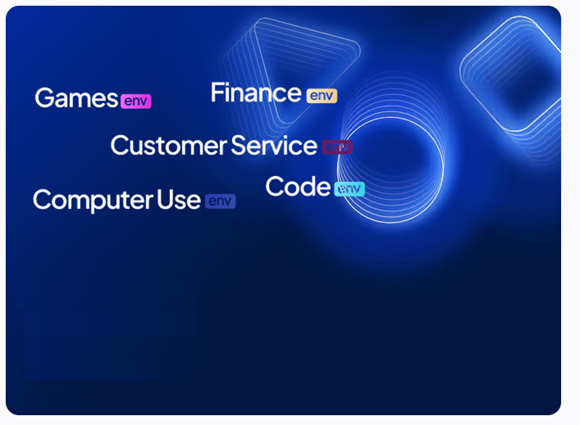
Patronus AI RL Environments are designed for foundation model labs and companies building agents in target domains.