Confluent drives ‘production-ready’ AI apps with agent-powered workflows

Data streaming company Confluent (now an IBM company) has laid down new capabilities in Confluent Intelligence and Confluent Cloud.
The updates are designed to streamline how real-time AI apps are built and secured.
The new capabilities are said to remove barriers to production-ready AI applications with agent-powered workflows, automated data protection, and private cloud connectivity
Confluent says it unifies the AI life cycle with tools that developers already live in, integrating Apache Flink pipelines with dbt and introducing a fully managed Model Context Protocol (MCP) server and Agent Skills that let AI manage streaming operations.
With automated personally identifiable information (PII) redaction and private connectivity to external models via Azure Private Link, Confluent embeds enterprise-grade governance directly into the data streams.
“Most AI projects fail before they reach a single customer because the data layer breaks down,” said Sean Falconer, head of AI at Confluent. “Teams have the models and the mandate, but security risks and fragmented data stop them from shipping. We’re fixing that by making the streaming layer the foundation for secure, production-ready AI.”
The problem is widespread, according to a McKinsey report that says, “… eight in ten companies cite data limitations as a roadblock to scaling agentic AI.”
Root of data limitations
Root causes are often tied to security teams blocking data from entering AI pipelines due to exposure risks and developers losing hours to tool-switching to inspect and manage the data streams their AI depends on. The resulting slow, manual process turns what should be a fast iteration cycle into a bottleneck.
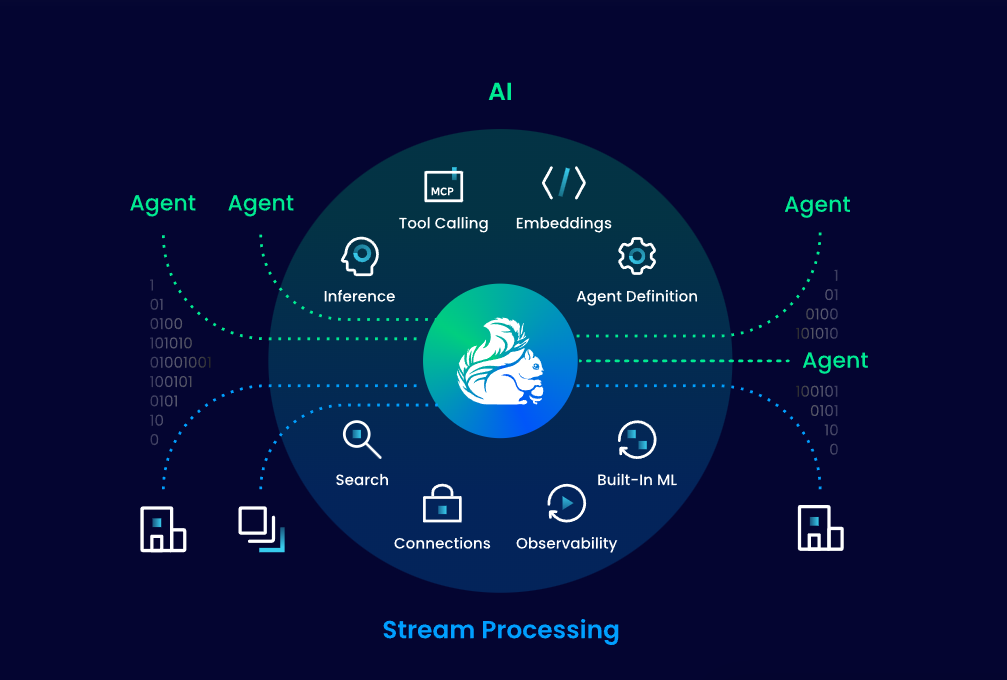
The company suggests that Confluent Cloud and Confluent Intelligence form the data streaming foundation for production-ready AI that continuously processes historic and real-time data and delivers it as trusted context into AI applications.
Developers can use Confluent MCP as a control plane, allowing AI to build, manage, and debug streaming operations using natural language. Agent Skills add a second layer, encoding best practices and workflows so those operations are executed consistently and in line with organisational standards.
Together, they enable developers to create and continuously improve real-time applications using AI-powered tools, bringing streaming into modern, agent-driven development workflows. Generally available for Confluent Cloud.
Automated data privacy
A new built-in ML function for PII detection and redaction protects sensitive information directly in Flink SQL, without custom code, external services, or moving data to a warehouse first.
This unlocks more AI use cases across highly regulated industries such as financial services, healthcare, and insurance. Available in early access for Confluent Intelligence.
Support for Azure Private Link ensures that AI workloads stay off the public Internet with secure, private paths to calling external models and querying external tables. Now, Flink jobs can securely connect to Azure-hosted services such as Azure OpenAI, Azure SQL, and Cosmos DB over Microsoft’s private backbone. Generally available on Confluent Cloud.
Unified engineering workflows
The free open source dbt adapter brings Flink SQL on Confluent Cloud into dbt, the industry-standard framework data that engineers use to build and manage data pipelines.
Teams can immediately define, test, and deploy streaming pipelines using the same dbt commands and project structure they rely on today.
This lowers the barrier to Flink adoption and makes it easier to extend existing data workflows into real-time use cases. Generally available on Confluent Cloud.
Confluent supports TimesFM models for robust anomaly detection as well as Anthropic and Fireworks AI models, which developers can directly use in Flink stream processing workflows to build sophisticated real-time AI applications.