Autonomy domine: SAP builds the autonomous enterprise

Pink Floyd used the term domine in Astronomy Domine to denote the term lord and master, with the word itself being derived from the Latin dominus (master of a household), originating from the Proto-Indo-European root *dem- (to build).
The parallel might be stretching it a little, but the overseeing (and indeed building) master control analogy rather suits the way autonomous intelligence must now be brought to the fore in modern enterprise software stacks.
SAP presented its own take on this during the SAP Sapphire user conference in Orlando this week – the company introduced a platform and toolset dubbed the Autonomous Enterprise, designed to tackle critical business workflows, so that humans and AI operate in harmony.
SAP Business AI Platform
Integral to the total scope of its platform announcements here are developments which note that the company has created the SAP Business AI Platform as a new foundation for building and deploying enterprise AI grounded in real-world business context.
According to research from MIT Project NANDA’s State of AI in Business 2025 report, 95 percent of all enterprise AI projects fail due to a lack of business context.
SAP Business AI Platform unifies the following into a single, governed environment:
SAP Business Technology Platform – SAP BTP is a cloud platform integrating automation services, data analytics, AI and application development with a central mission focused on optimising and extending enterprise processes.
SAP Business Data Cloud – a managed SaaS product designed to govern all SAP data and connect with third-party data.
SAP’s Business AI – Responsible intelligence embedded within applications to automate complex processes and make data-driven decisions.
At the core of SAP Business AI Platform is the SAP Knowledge Graph, which gives AI agents a structured map of every business entity, process and relationship across a customer’s SAP landscape.
Energy workshop: Joule Studio
Joule Studio is SAP’s new service for building, deploying and managing AI agents. Developers can build in the language and framework of their choice, from Python to Claude Code to Cursor, and deploy to a managed runtime with no infrastructure management required.
All SAP customers and partners can currently sign up for free design-time access for 12 months.
Developers can dive in here and use Custom Joule agents that understand context, orchestrate workflows (they request human validation as and when needed ensuring execution stays reliable and transparent) and work with the platform to take advantage of agents that can reference existing business documents as trusted knowledge sources – this service runs by Retrieval Augmented Generation (RAG).
“For the mission-critical processes of our customers, ‘almost right’ just isn’t good enough,” said Christian Klein, CEO of SAP SE. “By uniting the SAP Business AI Platform with the SAP Autonomous Suite, we anchor AI agents in the business processes, data, and governance so they deliver accurate, compliant, and secure outcomes, unlocking new sources of revenue and meaningful cost-savings.”
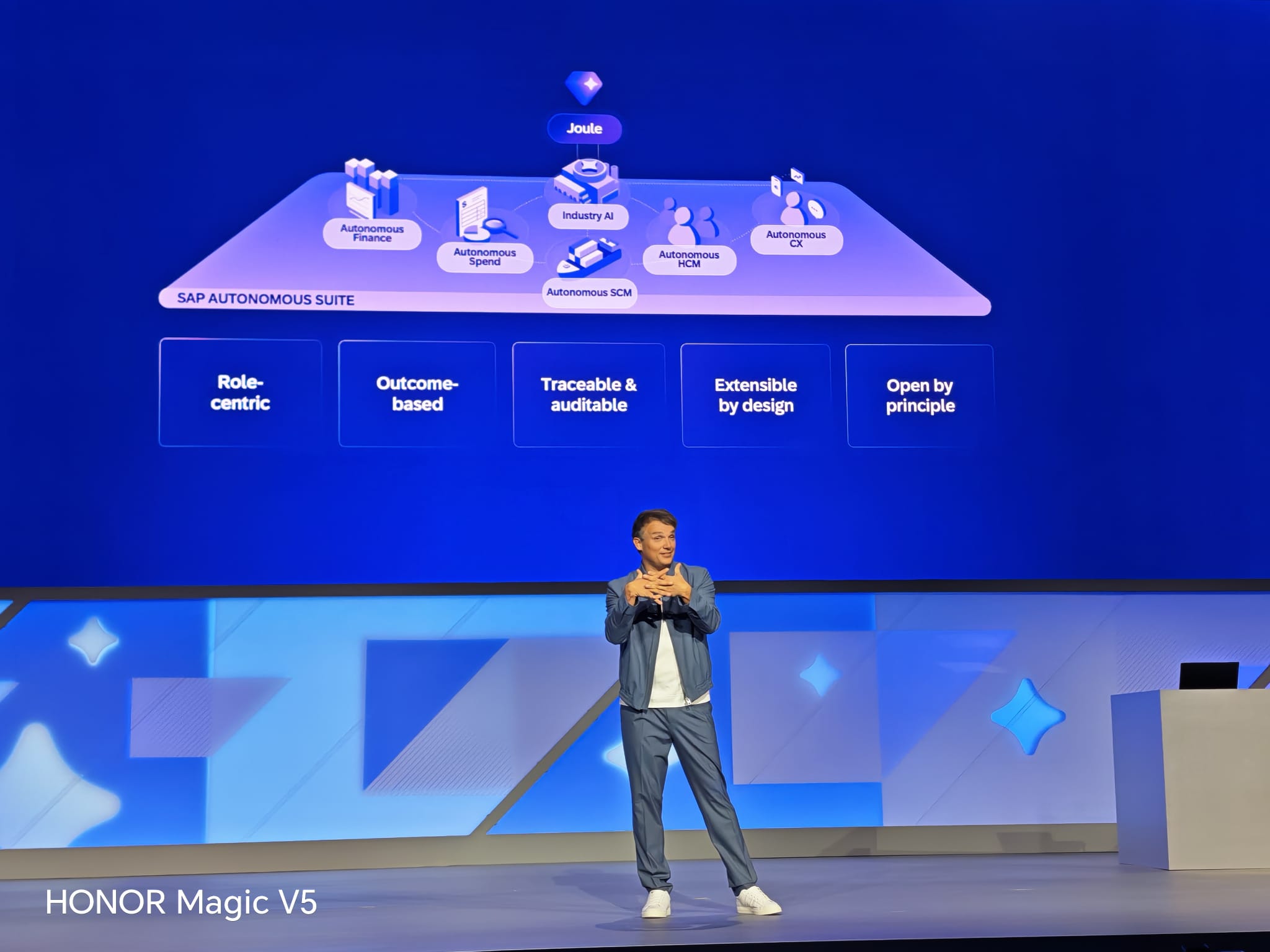
The SAP Autonomous Suite deploys more than 50 domain-specific Joule assistants across finance, supply chain, procurement, human capital management and customer engagement.
Specialised agents, sub-agentic substrate
These assistants automate end-to-end processes by orchestrating a subset of over 200 specialised agents to execute precise tasks. For example, the new Autonomous Close Assistant can compress the financial close process from weeks to days by automating journal entries, reconciliation, and error resolution across the entire process.
SAP stops and defines the lines here for those of us that want to ask: what is the difference between a skill and an agent?
- A skill executes single, repetitive operations that have predefined input and outputs and do not require reasoning (e.g., retrieving warehouse stock levels).
- AI agents are more suited for complex, multistep problems that require human-like reasoning, reflection,and adaptability (e.g. predicting inventory shortages and suggesting reordering strategies).
SAP Industry AI
SAP also launched Industry AI, expanding its industry portfolio through eight autonomous solutions that execute start-to-finish industry processes and embed sector-specific logic, data models, and regulatory requirements. Without being too blunt and mentioning another three-letter acronym (TLA) ERP company well-known for its industry-specific alignment and so-called industrial AI approach, this may be SAP reflecting the moves of the market in wider terms… although it’s somewhat of a moot point as to which organisation laid down industry specificity first.
Moving into other product areas… with SAP’s Autonomous Asset Management also brought into live deployment scenarios, AI agents analyse data from thousands of past incidents, identify the likely root cause and generate prefilled work orders with the right tools and proven fixes from other sites.
Autonomous User Experience
The company also revealed Joule Work, redefining how users engage with SAP software. Instead of navigating individual applications and entering data across several screens, users will now interact directly with the functions on offer.
“By describing a desired business outcome, Joule will orchestrate the right combination of workflows, data, and agents to get it done. Joule Work goes beyond conversation, proactively surfacing relevant insights and automating routine tasks behind the scenes so work moves forward even when humans aren’t actively steering it. It will be available on desktop, mobile, and voice across SAP and non-SAP systems,” noted the company, in a press statement.
SAP also updated its RISE with SAP and SAP GROW offerings to accelerate customer AI adoption. Each RISE customer will have three Joule assistants activated within the first year, while GROW customers receive access to the full portfolio of assistants upon onboarding.
The new (agentic) SAP
Lastly, SAP also introduced agent-led transformation tooling that reduces ERP migration efforts by approximately 35 percent, driving faster and more predictable projects by automating system analysis, code remediation, configuration, and testing at scale. Even after go-live, it continues delivering value by handling ongoing code optimisation, data quality, and change management.
In a breakout post-keynote Q&A session with press and analysts, Klein was joined by key members of his team who now openly talk about the “new SAP” to suggest that a major level of migration has happened within the company, which (unsuprisingly) sees it embrace, enable and underpin the use of agentic AI services inside ERP systems and even throughout non-SAP systems that connect with the company’s central technology proposition.
Nobody is calling it ERPAI yet, but that time may yet come.