
Vision 26: Motive gears up to drive improved fleet safety and productivity
AI is changing behaviours and reducing accidents within fleet operations, helping teams deliver personalised feedback across safety, fuel and compliance, while engaging drivers

Recognising that fleet leaders are increasingly focused on building safer, more productive and more profitable operations, physical artificial intelligence (AI) operations platform provider Motive has announced a major expansion of its Workforce Management solution.
A range of products and services – including the new Driver Rewards programme and enhancements to its AI Coach and Performance Hub – were announced at the company’s Vision 26 summit. The event highlighted the mounting real-world challenges that fleet IT leaders face – in particular, gaining and generating insights from fleet operations and using AI-based software to improve safety and efficiency.
As the conference began, Motive claimed that over the past three years, it had helped customers prevent 170,000 accidents and saved fleet teams an average of 20 hours per week on reporting and administrative tasks. This was said to be the equivalent of nearly 1,000 hours per year that could be spent elsewhere on operations. The bottom line was that for a 1,000-vehicle fleet, there could be annual savings of $3.4m on accidents, insurance and fuel-related costs.
Integration and automation lead the drive
Addressing the conference, company co-founder and chief executive officer Shoaib Makani said that in meeting its more than 1,000 customers operating more than two million vehicles and assets across the US, Mexico, Canada and the UK, his company had gained a deeper understanding of the problems customers faced in their operations.
He added that despite the range of industries its customers work in – such as trucking, construction, oil and gas, passenger transit and waste collection – two common themes come up in almost every conversation. First, there is too much fragmentation in the tools used, which he said leads to operational complexity. And second, there is too much manual work, which hinders productivity. The solution to these two universal challenges, Makani emphasised, is integration and automation – with AI dominating every technology conversation.
Makani referred to integration and automation as “north stars” in building technology. “How can we build products that work together to break down data silos and give you one integrated view of your operations, and how can we automate the manual workflows so that you can focus on the things that matter most? I want to start with integration,” he said.
“What started as a simple fleet management solution has evolved into an integrated operations platform. Six products, each of which can be used standalone, but the magic happens when you use them together for driver safety, fleet management, equipment monitoring, spend management, workforce management and AI vision,” Makani added.
“This year, we took integration beyond software into the world of hardware. The standard paradigm in this industry has been a telematics device for fleet management and a dashcam for driver safety. That made sense in a world where dashcams were optional, but today they are essential. This is why we built AI Dashcam Plus.”
The product was seen as not just another dashcam, but a new platform enabling “a next leap” in driver safety, allowing companies to tackle the hardest problems on the road, such as making split-second decisions on safety.
Pointing out one key drawback with existing camera-based safety systems, vice-president of product Nihar Gupta said most cameras currently rely on a single road-facing lens, which sees the world as flat.
By contrast, the wide lens of the road-facing cameras on AI Dashcam Plus (pictured above) captures a full scene, including everything in a driver’s periphery, with a zoom lens taking details further down the road. The combination meant that they could offer a view of the world in depth. They detected objects, but struggled to estimate distance, speed and motion. Critically, the compute side was limited, compromising the ability to offer safety advice in split seconds. Compute on the AI Dashcam Plus is based on a Qualcomm AI processor built for the edge, with enough horsepower to model the physics of an entire scene in real time on the device.
“Yesterday’s [compute tech] can’t run today’s AI. Forward closer warning has served our industry well for years, but the systems on the road today run on rules: distance, speed, time to hit, calculated frame by frame. An alert only fires once the vehicle is already locked in front of the driver. By the time the threat is confirmed, your driver has already lost the seconds that matter most. AI Dashcam Plus enables a fundamentally different approach. To do this, we need the right input streams and serious compute.”
From reactive to proactive fleet management
Motive’s chief product officer, Hemant Banavar, concurred, adding that there has been a shift in the technology space, so things that weren’t possible only in the recent past in computing are now feasible. “If you think about the industry that we serve, there’s a lot that has changed in terms of going from being very reactive – looking in the rearview mirror – to looking at data from telematics [gaining insight] and then coaching [drivers] to be more proactive,” he said.
“What Qualcomm has done with data connectivity … the way it is almost omnipresent, means we are at a point where we have a really capable edge processor that can run multiple models at the same time. You can do things in real time, so you’re kind of going from a completely reactive way of managing your fleet to proactive interventions. [These] are more valuable for [fleets] to be able to change behaviour. That’s the shift that we're seeing … these chips actually meet the power constraints of the operating environment and can run multiple models in that environment.”
Such capability also brings out an issue that has grown in importance throughout the automotive industry as a whole, not just fleets: that is, using edge- and/or cloud-based data systems to enrich the overall driving experience.
For example, assessing the move towards in-vehicle on-device AI and processing data at the edge rather than in the cloud, it is generally recognised as imperative that applications such as advanced driver assistance systems (ADAS) have to perform processing with minimum latency and that there was a defined technological threshold for processing the billions of parameters in AI models as seen by the number of trillions of operations (TOPS) processed by edge or cloud hardware. This has meant that while AI inference will be done at the edge, model training will remain in the cloud, due mainly to its current complexity.
Banavar revealed at the conference that the way Motive approached this issue was to start in the cloud and minify models to fit on edge processors. The large model and Motive-developed AI stack is first trained to make sure the company can detect the appropriate behaviour in an application, and then go on to look at deploying on the edge.
He said: “For a lot of time, what we do is start with an off-the-shelf model, deploy it, and we immediately start getting events [insights]. These go through an event validation engine, which is in the cloud. This essentially allows us to very quickly start building a truth set from the events that are coming in, and we have a ‘human-in-the-loop’ annotation of these events coming in. This quickly allows us to start getting a signal on where we need to improve this model. That becomes the basis of a feedback loop for us to start optimising that off-the-shelf model into something more custom.”
In terms of how things can evolve quickly, Banavar revealed that the company can start with an off-the-shelf AI model and, in a matter of weeks, go from around 80-85% precision to almost the high 90s very rapidly, because of the human judgement in the system. That means software developers can very quickly tweak the weights of the model to reach high precision. This loop continues until a point is reached when the need for a human to annotate every single time goes away.
This effectively creates the event validation engine, and the practical net result of such actions is a dashcam that can see the road with depth and reason about motion in real time. Motive believes that this unlocks “something entirely new”.
Very much among the entirely new is enhanced collision avoidance. The event model principle is central to this, with the system looking at confidence levels for potential collisions. Instead of measuring distance frame by frame, the application models while every object is moving through space. The camera sees an object such as a vehicle, and the AI sees multiple possible future trajectories in real time. The system then reasons which trajectory puts a driver at risk and sends an alert in seconds while there’s still time to act, not after.
The system “reasons” vehicles, cyclists, animals and pedestrians, offering the ability to predict a possible object movement, most notably one where an object’s predicted path crosses the driver’s. Even with advances in the model, the key, said Banavar, is not about replacing the driver, but about making not only the driver better, but vehicles safer.
That is as well as creating a halo around the cab and around the driver with current tools, Motive plans to extend this halo to around the vehicle, with success measured by a “north star of zero harm”, that is, the ability to reduce unsafe behaviour which directly correlates with accidents on the road.
Engaging drivers to keep them on the road
Looking at the products added to the driver safety portfolio, Driver Rewards is designed to help organisations engage, incentivise and retain drivers at scale, while new AI Coach capabilities extend AI-powered driver coaching beyond safety to fuel usage, compliance and equipment health. Coaching Score delivers actionable intelligence to measure programme effectiveness.
At the heart of the launches is the need to address the issue of driver retention, which Motive says has become a critical challenge across the physical economy. Citing data from fleet management and compliance platform Zerity, it noted that large fleets in the UK in particular were seeing annual turnover as high as 60% and that losing a single driver costs organisations an average of £6,300. That means, for a fleet with 1,000 drivers, turnover costs could add up to nearly £4m annually. On top of that, the UK is facing a projected HGV driver shortage of 200,000 by 2030, which threatens the 82% of domestic goods in the UK that are moved by road freight.
Yet Motive warned that in many fleets, coaching still focused on mistakes, while recognition remained manual, inconsistent and difficult to scale. The result is disengaged drivers more likely to turnover and challenges in recruiting new talent.
Building on Motive’s Workforce Management solution, which brings workforce operations into a centralised, AI-powered platform, Driver Rewards is intended to turn everyday performance into automated incentives. Fleet managers can create data-driven challenges tied to key metrics, while the platform scores performance and updates points, badges and leaderboards in real time.
Drivers track progress in the Driver App, and teams can run multiple programmes with tailored rules, point systems and incentives aligned to goals such as safe driving, fuel efficiency, compliance and spend.
By connecting drivers, vehicles and operational data in one place, Motive ensures that the net result is automated coaching, streamlined compliance, the ability to see risks surfacing earlier, and reduced manual processes so teams can focus on higher-value work. Future enhancements will look to expand rewards to additional behaviours such as idling and compliance, introduce new redemption options, and enable real-time “spot recognition” for exceptional performance.
Commenting on how his firm is using Driver Rewards, Rodney Fetters, fleet director at fuel management systems provider Spatco Energy Solutions, said it has replaced manual tracking with automated, data-driven challenges that score and track performance in real time. “Recognition is now consistent and scaled. We started with the obvious top performers that drive high mileage and are most at risk, but now we are using the platform to improve engagement, strengthen safety and have reduced the time our team spends managing rewards,” he said.
While Driver Rewards reinforces positive behaviour, AI Coach is built to automate intervention and improve performance by identifying risks, creating tailored coaching plans, and then delivering real-time guidance to drivers. Drivers who actively review their AI Coach sessions are said to be able to see eight times more safety score improvement and a 50% drop in total events, with critical risks like phone use dropping to zero, according to Motive.
The automated, consistent feedback is attributed with transforming organisations’ performance cultures and introducing a new way for fleets to operate. Enhancements to AI Coach now extend coaching beyond safety to fuel usage, compliance and equipment health.
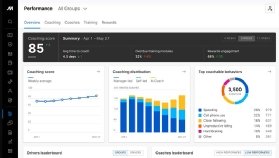
Motive is also introducing Coaching Score as part of Performance Hub, a unified control tower for managing coaching, training and rewards. Coaching Score automates measurement by tracking behaviour changes following coaching sessions, allowing managers to see exactly where programmes are working and where high-risk behaviours continue. AI-powered recommendations identify high-impact focus areas, while Performance Hub highlights which coaches need support to keep their teams on track.
Read more about fleet information systems
- Ford accelerates fleet data capability with Pro AI: Auto manufacturing giant introduces fleet management software aiming to help organisations manage their fleet operations more effectively and get daily tasks done.
- Connectivity, AI drive fleet safety, productivity and decision-making: Report into state of fleet technology across US reveals three key priorities for the year: increasing productivity, reducing costs and enhancing driver safety – with AI and connected technology serving as engines and usage-based insurance.
- Aftermarket car telematics arena drives past 90 million subscriptions: Study of aftermarket car telematics finds growing value in technology for application areas including stolen vehicle tracking and recovery, vehicle diagnostics, Wi-Fi hotspots and convenience applications.
- Ford Pro advances telematics for fleet management: Auto manufacturing giant updates fleet management software and reaffirms commitment to maintaining standardised software-based data experiences for fleet vehicle informatics.
Read more on Mobile networks
-
![]()
Motive AI Coach connected vehicle tech drives into UK
By: Joe O’Halloran
-
![]()
Vision 26: Motive offers vision of new era of physical AI operations
By: Joe O’Halloran
-
![]()
Cambridge Mobile Telematics lands $350m strategic investment
By: Joe O’Halloran
-
![]()
Ford accelerates fleet data capability with Pro AI
By: Joe O’Halloran