Vision 26: Motive offers vision of new era of physical AI operations
New products aim to shift operational burden from people to technology, automating ‘busy work’ so fleets can prioritise strategic safety, productivity and profitability
With physical operations teams increasingly pressed to solve two large challenges to the way they enable businesses – fragmented tools and time-consuming manual work – Motive has unveiled integrated hardware and artificial intelligence (AI) innovations in a major expansion of its platform for physical AI operations.
Introduced at its Vision 26 summit, the innovations are designed to offer new capabilities to consolidate data into a single view and automate complex workflows with AI that takes action, enabling teams in the UK to focus on what matters most and unlock new levels of safety and productivity.
“Every operations leader we talk to describes a common set of problems – their systems are too fragmented and their workflows are too manual. The answer is integration and automation,” commented the company’s CEO and co-founder, Shoaib Makani. “Motive has spent years breaking down the data silos. Now we’re helping our customers leverage AI to surface critical insights and automate interventions so they can run safer and more productive operations.”
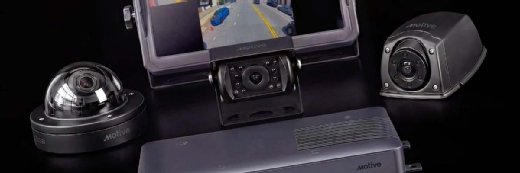
At the centre of the new lines is AI Omnicam Plus (pictured above), Motive’s new automotive camera system that delivers AI-based 360-degree visibility around a vehicle. Built on the company’s AI Dashcam Plus platform, which was launched earlier in 2026, and powered by the Qualcomm Dragonwing QCS6490 processor, it is designed to run more than 30 AI models simultaneously and is attributed with qualities such as being able to detect more road hazards in real time with high accuracy and low latency.
Through an in-cab monitor, drivers can see what’s happening around the vehicle in real time from every angle. This 360-degree view, combined with real-time AI alerts, is intended to enable drivers to detect and respond to risks, such as pedestrians, cyclists and vehicles, to prevent incidents.
The company has also upgraded the core combined vehicle AI Dashcam Plus product to detect more risks and prevent more collisions. The intention is to produce an AI dashcam that combines telematics and cameras in a unified device and allows advanced AI to detect unsafe behaviour and alert drivers in real time, so that teams can see more, act faster and prevent more collisions.
Among the latter’s key new capabilities are collision avoidance, automatic licence plate recognition (ALPR), AI-powered speed sign detection and live two-way calling.
Every operations leader we talk to describes a common set of problems – their systems are too fragmented and their workflows are too manual. The answer is integration and automation
Shoaib Makani, Motive
Two road-facing lenses and a Qualcomm AI processor are intended to make AI Dashcam Plus “see” as a human does. It tracks all objects on the road, from cars and bikes to people and animals, and predicts where they are heading. By calculating if someone is about to cross the driver’s path, it is said to be able to deliver earlier, more accurate alerts that give drivers the seconds they need to act fast and prevent collisions.
A 1440p zoom lens with a narrow field of view captures licence plates while a vehicle is in motion. This could deliver essential evidence for hit‑and‑runs, road rage, theft and other incidents, to speed investigations and exonerate drivers.
Furthermore, advanced computer vision reads speed limit signs directly off the road instead of relying on often outdated map databases. Tracking signs in real time, it ensures drivers are only alerted when they are actually speeding. This is designed to eliminate false alerts, build driver trust and enable more effective coaching.
Another of the key launches is the Atlas AI assistant, designed to allow UK customers to have one place to ask questions, analyse data and take action. Powered by Motive AI, it surfaces vehicle insights from across the platform, with the aim of reducing the need to search across systems or rely on static reports. Applications include checking vehicle health, reviewing safety events and resolving compliance issues.
The net result, according to Motive, is that what once took hours now “happens in seconds”, producing “faster, more confident” decisions while reducing manual work.
Using Motive’s Model Context Protocol integration, Atlas is built to extend beyond the Motive Dashboard into third-party AI tools, such as Claude and ChatGPT. By connecting its data with other internal and third-party data sources, Motive said Atlas can automate complex strategic tasks, such as benchmarking insurance rates and generating data-backed renegotiation proposals, in seconds.
Atlas also works with the Motive Voice Assistant, which takes intelligence directly to drivers on the road and enables safer operations and faster response in critical moments. With voice commands such as “Hey Motive, call dispatch” or “Hey Motive, record video”, drivers can get help, capture critical information and stay connected without taking their eyes off the road.
Recognising that critical work currently depends on manual monitoring, which slows response and allows issues to escalate, Motive has also launched Automations to allow organisations in the UK to move from insight to action instantly. Automations trigger immediate action based on real-time signals, so managers no longer need to catch and respond to every issue themselves.
An example cited is that if a vehicle reports a critical fault code, Motive can contact the driver immediately and instruct them to pull over, before the driver or manager even notices the issue. Managers can apply Automations across safety, maintenance and operations to address time-sensitive and hard-to-monitor tasks.
Key features include the ability to detect excessive idling and prompt drivers to shut off the engine, flag hours-of-service and compliance risks before they become violations, and trigger Atlas to contact drivers when fatigue or critical fault codes are detected. By automating manual and urgent work, Motive was confident that it could help organisations reduce risk, improve productivity and ensure critical actions happen exactly when they are needed.
Boosting its computer vision offer, Motive also introduced new ways that its AI Vision general-purpose computer vision product for physical operations is automating manual tasks for industries across the physical economy.
Explaining the rationale for the enhancements, Motive noted that traditionally, drivers and field workers have had to manually document what they are observing in the field, such as service issues or site hazards. This manual process was slow, prone to error and costly. AI Vision looks to eliminate this so-called “manual burden” by observing the environment and automatically identifying and logging critical data in real time. By translating video into structured, actionable data, AI Vision looks to solve complex operational problems across the physical economy, from public sector infrastructure monitoring to construction site safety.
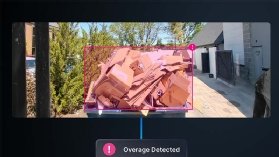
Overage detection could automatically identify overfilled waste containers at the point of service
Highlighting where it feels the product can be applied, Motive noted that for industries like waste services, AI Vision could deliver financial impact through specialised models for overage detection, recycling contamination detection and service verification. Overage detection, for example, could automatically identify overfilled waste containers at the point of service. Such insights could empower organisations to automatically verify work and accurately bill for violations, generating new revenue and right-sizing customer bins without requiring a single manual entry from the driver.
Assessing the impact of the new suite of solutions, Adhish Luitel, research director of ABI Research, said Motive wasn’t just applying AI, it was generating the proprietary data that powers it. “By combining hardware, integrated data and proprietary built AI models, Motive moves beyond insight to real-time action in a way many software platforms cannot. The combination of hardware and well-executed AI improves safety and delivers measurable ROI for its customers,” he remarked.
One user – Wayne Dawkins, fleet manager at VAD Commercials – said Motive had fundamentally shifted how the company safeguards its drivers and manages its fleet. “By integrating real-time detection with immediate action, the platform allows us to operate more safely, productively and profitably every single day. We have moved beyond simply identifying risk to proactively preventing it, and the new capability will help unlock even more as it helps us prevent more collisions and remove manual overhead.”
Read more about fleet information systems
Ford accelerates fleet data capability with Pro AI: Auto manufacturing giant introduces fleet management software aiming to help organisations manage their fleet operations more effectively and get daily tasks done.
Connectivity, AI drive fleet safety, productivity and decision-making: Report into state of fleet technology across US reveals three key priorities for the year: increasing productivity, reducing costs and enhancing driver safety – with AI and connected technology serving as engines and usage-based insurance.
Aftermarket car telematics arena drives past 90 million subscriptions: Study of aftermarket car telematics finds growing value in technology for application areas including stolen vehicle tracking and recovery, vehicle diagnostics, Wi-Fi hotspots and convenience applications.