Summit Art Creations - stock.ado
How Singapore firms are scaling AI initiatives
At AWS Summit Singapore, Certis and Grab showed how they are embedding AI in their business, such as automating finance operations and deploying robots in public safety and security patrols
As ride-hailing bookings plummeted by nearly 80% at the peak of the Covid-19 pandemic, Ken Lek and his finance team at Grab were using a spreadsheet with 47 tabs to build scenario plans should lockdowns continue to persist.
Meanwhile, food deliveries surged but Grab’s internal systems were too fragmented to keep pace. Its finance team pulled numbers from one source and operations from another, forcing teams to spend weeks manually verifying and reconciling data.
“The infrastructure behind those numbers was not where it needed to be,” said Lek, managing director and head of strategic finance and investor relations at Grab, at the AWS Summit Singapore conference today. “We were making existential decisions for the company serving millions of people. That experience left a mark on me – not just the stress of it, but the conviction that it has fundamentally changed how Grab’s finance function operated.”
The harrowing experience led to Project Grabhouse, an effort to rebuild Grab’s entire data foundation on AWS using storage such as Amazon S3 and open table formats like Apache Iceberg. The result was a governed, centralised data lake that acts as a single source of truth for the entire company.
The operational impact was notable. Manual data reconciliation dropped by up to 60%, while cost allocations could be traced to the individual support agent and ticket. This exactness in unit economics – vital in an industry where margins are measured in cents – helped Grab report its first full year of net profit in 2025, reaching $200m while handling hundreds of millions of monthly transactions.
Now, Grab is layering Bricks, its enterprise AI platform, on top of the Grabhouse data lake. This unified foundation allows teams to build automation workflows and deploy artificial intelligence (AI) agents at scale without writing any code.
“For the first time in my career, I can see a path where strategic finance teams spend most of our time on actual strategy and advising leadership, navigating complexity, rather than on extracting and reconciling data,” Lek said. “The first decade of Grab was about scale, the next decade is about intelligence.”
Orchestrating the frontlines
At the event, Ng Tian Beng, president and group CEO at Certis, a security service provider, also showed how AI is being deployed in frontline and physical security operations.
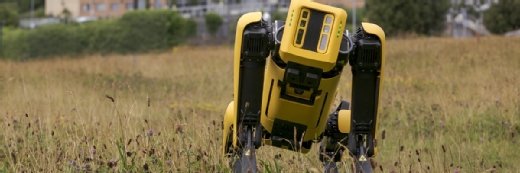
The former Dell executive shared the stage with two different faces of the new workforce: Max, a multi-service autonomous robotic concierge; and Ace, an autonomous robotic dog used for complex security patrols. Both robots are wired into Mozart, a centralised operational platform powered by AI that helps human operators detect anomalies, understand context and orchestrate real-time responses.
“We don’t use AI just to generate insights. We use it to orchestrate decisions in our operations, to coordinate resources and to drive action in the real world,” Ng said. “The question is no longer if AI will transform operations – that’s a given. The real question is, ‘How quickly can we bring together these technologies out of the lab and into the real world so that we can really make a difference?’”
If this integration is done well, the outcomes extend far beyond efficiency, Ng said. By offloading physically demanding and higher-risk tasks to robots, security officers are freed up to focus on work that requires complex judgement, empathy and human interaction.
Crucially, Ng stressed that achieving these outcomes relies on a bedrock of strong cyber security and trust. It is not enough that the system works – the operators on the ground must be able to understand and trust the technology to respond reliably.
Bridging the SME maturity gap
While larger firms such as Grab and Certis are maturing in their AI journey, many of Singapore’s small and medium-sized enterprises (SMEs) are struggling to move past the initial adoption phase.
Research by Strand Partners, commissioned by AWS and released at the summit, revealed that while 75% of financial services SMEs and 61% of healthcare SMEs in Singapore use AI, only a small fraction have progressed to advanced use where AI is integrated across core functions.
“Singapore's SMEs have moved decisively on AI. The next step is making that investment sustainable by integrating AI across functions so it shifts from a point solution to a core part of how the businesses run,” said Priscilla Chong, managing director of AWS Singapore.
Chong noted that the most successful companies employ a dual strategy: a safe environment for open experimentation, paired with strict guardrails for real-world production.
Upskilling workers and students
In his keynote address, Desmond Tan, deputy secretary-general of the National Trades Union Congress (NTUC) and senior minister of state in the prime minister’s office, noted that “AI should not result in jobless growth and productivity gains should never come at the expense of our workers”.
He pointed to NTUC’s Company Training Committees (CTCs), which have already uplifted more than 300,000 workers, and a partnership between NTUC and AWS that aims to support at least 100 companies in their business transformation and expand AI skills access for 10,000 workers.
To secure the talent pipeline needed for an AI-driven economy, AWS also announced a major initiative for Singapore’s institutes of higher learning (IHLs).
Eligible students and adult learners at polytechnics, Institute of Technical Education (ITE) colleges and universities will receive 1,000 complimentary Kiro credits, a 20-fold increase from the standard free tier. Kiro is a professional-grade AI developer tool that focuses on specification-driven development, requiring users to define a project’s scope, scenarios and success criteria before any code is generated.
“Vibe coding is telling a contractor to just start building. Spec-driven development is the blueprint that comes first – and what gets built with the blueprint is something a team, an employer or an SME can actually depend on,” said Elsie Tan, country manager for worldwide public sector Singapore at AWS. “That is the standard we want Singapore’s IHL graduates to meet.”
To close the gap between classroom theory and industry needs, AWS will also launch an AWSome Lab in July 2026. The web-based portal will allow Singapore businesses to submit real-world problem statements, which educators can assign to students. The students will then build and document proof-of-concept AI solutions, turning their coursework into career-ready experience.
Read more about AI in APAC
- Agoda, a digital travel platform, has set its sights on becoming an AI-powered travel companion as it changes how it builds software and moves its tech workforce into a new facility in Bangkok.
- Singtel and Nvidia have teamed up on a multimillion-dollar facility to help organisations scale enterprise AI deployments, tackle extreme datacentre power densities, and prepare for the era of embodied AI.
- The Australian government has struck a five-year volume sourcing agreement with Microsoft to speed up adoption of AI and cloud technologies across the public sector.
- Alibaba Group has unveiled Wukong, an AI-native enterprise platform that brings advanced agentic AI capabilities directly into business workflows.