
Tomasz Zajda - stock.adobe.com
ESA promises smarter flights for ITA Airways through sat comms
Italian airline deploys comms system designed to enable digital, real-time connectivity and offload current ground systems for air traffic management, showing how satellites can complement terrestrial infrastructure

Looking to orbital communications in a bid to allow passengers to fly smarter, greener and with fewer delays, Italian airline ITA Airways has deployed Iris technology from the European Space Agency (ESA) and satellite operator Viasat.
Co-owned by the Ministry of Economy and Finance (59%) and by Deutsche Lufthansa AG (41%), ITA Airways describes itself as Italy’s reference airline, operating both passenger and cargo air transport services. The company claims to use integrated mobility and advanced process digitisation to ensure optimum experience and customisation.
ITA’s fleet comprises 99 aircraft (22 wide body and 77 narrow body), more than 60% of which are said to be next-generation aircraft, optimising the efficiency and quality of the company’s portfolio with leading edge technologies and onboard Wi-Fi. The airline aims to upgrade 90% of its fleet to next-generation aircraft, with the target of becoming the youngest airline in Europe and reducing fuel consumption by 20 to 25%, with a resulting drop in CO2 emissions.
Currently, pilots mostly communicate to air traffic controllers by voice or using ground systems with limited data-sending capacity. This not only makes flight operations inefficient, but these systems have become congested due to increased flights. The Iris system uses satellite communication to send highly secure, high-bandwidth data between aircraft and ground traffic controllers.
Existing air traffic management communications imply that planes have to be kept further apart from one another and follow suboptimal paths instead of taking the most direct route. Iris technology is designed to enable digital, real-time communications, and thereby offloads current ground systems for air traffic management, demonstrating how satellites can complement terrestrial infrastructure.
Having been already implemented in one of the four ITA Airways Airbus A320neo aircraft flying primarily between Milan and Rome, the Iris system helps pilots to identify the shortest routes at the optimum altitudes. Flying more efficiently enables pilots to save time and fuel, while cutting CO2 emissions.
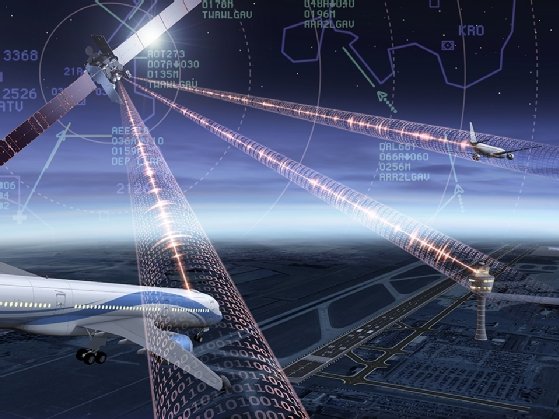
Developed in partnership with UK-based satellite communication company Inmarsat, acquired by Viasat in 2023, Iris is part of the European Commission’s Single European Sky initiative, which aims to improve air traffic management in Europe by improving safety, capacity and cost-efficiency, along with reducing environmental impact.
“With the addition of ITA Airways to the Iris service, another milestone has been achieved in supporting the European Commission’s Single European Sky vision for an efficient and environmentally friendly European airspace,” said Laurent Jaffart, director of connectivity and secure communications at ESA.
“The adoption of Iris is a key milestone for space-based solutions, supporting European air traffic management, which will – in turn – pave the way for global use. By supporting Iris through an ESA public-private partnership, we are delighted to combine our expertise with those of leading aviation actors across the continent and beyond it.”
Joerg Eberhart, CEO and general manager of ITA Airways, added: “The introduction of Iris technology on our aircraft represents a significant step forward in enhancing operational efficiency and environmental sustainability. At ITA Airways, we are deeply committed to supporting the modernisation of European airspace as part of the roadmap toward the Single European Sky, and to playing an active role in the advancement of air traffic management. Through this partnership with Viasat, ESA, and Iris service provider ESSP, we will improve flight punctuality, optimise fuel consumption and further reduce emissions.”
Read more about satellite communications
- IAG aircraft to take off with Wi-Fi Starlink connectivity: Leading airline group announces strategic investment in satellite-based Wi-Fi connectivity for its aircraft starting from early 2026, with speeds claimed to enable fast downloads, smooth streaming and cloud-based work.
- Spacecoin claims pivotal moment with decentralised satellite: Decentralised physical infrastructure network provider goes live with mission to deliver three satellites aboard SpaceX’s Falcon 9, claiming major step in goal of reaching 2.6 billion people globally without affordable connectivity.
- Proximus Global, Starlink expand European direct-to-cell satellite connectivity: Collaboration enables satellite leader to expand its footprint in connecting more European operators with IPX network.
- Orange claims Euro first with satellite direct-to-device SMS service: Telco’s customers in France, England and 35 other countries will be able to use core mobile network to send messages even if they have no mobile or Wi-Fi coverage using direct-to-device satellite technology.