Tricentis delivers agentic AI Testing for SAP Business Transformation

As we collectively build the new era of agentic AI automation services, we will need to constantly and consistently test agents.
That core truth means we need to test agents, so that’s agentic testing.
Agentic testing can become a confusing term if we’re not careful. There’s testing AI agents themselves, and then there’s using AI agents to test the broader software stack. Those are two very different concepts, but they’re often grouped under the same label.
Agentic quality engineering company Tricentis does both, but in the first instance, the organisation talks about how its toolset and platform uses agentic services to perform test cases.
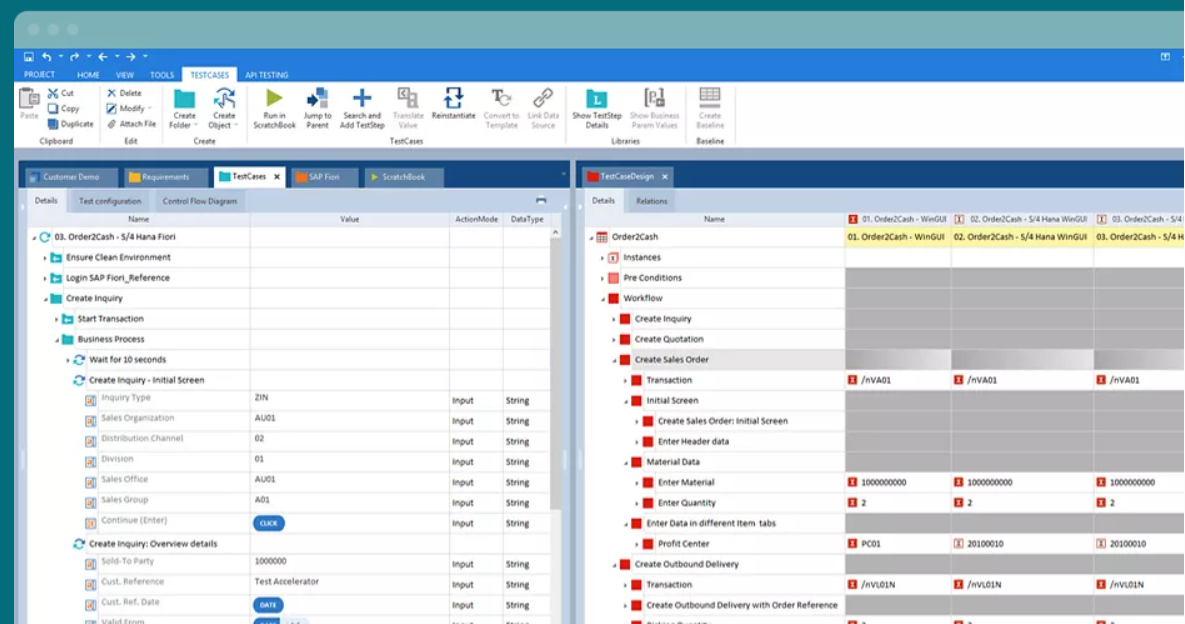
In the aftermath of SAP Sapphire last week, Tricentis has now come forward with its SAP Enterprise Continuous Testing by Tricentis, AI-assisted automated test case generation.
This news marks a milestone for Tricentis’ partnership with SAP, bringing an AI-assisted automated test case generation capability to market through SAP Enterprise Continuous Testing (ECT) by Tricentis, available as an SAP Solution Extension.
Purpose-built for SAP
SAP has a rich history of working with major platforms (both at the software and hardware level) to build services aligned with granular specificity – let’s not forget that SAP HANA was engineered exactly to the Intel chipset to extract maximum levels of efficiency from the processor.
In that vein, then, there is dedicated alignment here as well…
… if we agree that generic AI testing tools are essentially generic, this Tricentis solution is purpose-built for SAP environments, so it can generate automated test cases that are compatible with SAP Enterprise Continuous Testing (ECT) by Tricentis, part of SAP’s agent-led toolchain.
Tricentis says it helps organizations keep pace with continuous transformation while maintaining full confidence in their SAP environments.
SAP ECT A-OKAY
The new AI-powered functionality allows SAP ECT customers to natively consume SAP AI Units to generate automated test cases. By embedding this capability directly into existing SAP workflows, organizations eliminate the need for third-party tooling, extra licensing, or complex integrations which drives higher adoption and accelerates time to value. What previously required extensive human effort and cost, can now be accomplished leveraging the power of AI, enabling reduced timelines and costs.
“AI has introduced a rate of change and industry disruption unlike anything we’ve seen before, and enterprises are now faced with the significant challenge of delivering high-quality software at the speed of AI while also managing an accelerating level of risk,” said Kevin Thompson, CEO of Tricentis. “With over 20 years of leadership in advancing automation and AI, Tricentis is uniquely positioned to help customers thrive in this new wave of technological innovation, and our agentic quality engineering platform helps enterprises to do it all: move faster, manage risk, and reduce costs.”
The new Tricentis AI-powered functionality helps users to:
- Generate complete, end-to-end test cases using natural language prompts
- Leverage AI-assisted capabilities to instantly generate and optimize test scenarios from business descriptions
- Accelerate test creation while maintaining alignment with business processes
- Deploy and scale automated test cases using SAP AI Units
- Reduce test case maintenance with self-healing tests.
Through our collaboration and partnership with Tricentis, we are expanding how AI can be applied to mission-critical quality assurance processes,” said Karl Fahrbach, chief partner officer at SAP.
Fahrbach also says that this innovation helps customers reduce manual effort, accelerate testing cycles and maintain stability while navigating transformation.
SVP Yackel: Welcome to the agentic way
Ryan Yackel, SVP product marketing and strategy at Tricentis spoke to the Computer Weekly Developer Network at SAP Sapphire 2026 for a deeper dive.
“Traditionally, with test automation, you had to scan applications, collect all the elements… and then edit the test case steps before you could automate the test execution. What we’re announcing now is an agentic way of doing that,” explained Yackel. “Instead of recording every process, you can type in natural language and say, ‘This is the business process I want to test,’ and Tricentis builds fully automated, codeless test case for you. That means customers can test faster, validate changes sooner, and move into production with greater confidence.”
Yackel says that one of the biggest shifts here is accessibility.
“Previously, you needed deep SAP business knowledge to understand what test cases to run and how to structure them,” he said. “With this release, a business user can simply describe the process they perform every day in natural language, and the platform generates the test case automatically. You don’t necessarily need to be an expert in test automation anymore. Anyone involved in quality assurance or validating business processes can participate much more directly in the testing workflow.”
Explaining what happens next, the Tricentis SVP says that a major challenge the company is seeing with agentic software development is the rise of false positives in testing.
“In some cases, the AI is effectively rewriting the test so the code passes, rather than ensuring the test is validating the right behaviour. That’s why quality must become part of the entire AI-driven development lifecycle. Our vision and roadmap include intelligent agents that will monitor those development processes,, track what changes are happening, and influence how test cases are updated and executed so organisations maintain trust in what reaches production,” concluded Yackel.
Tricentis Quality Shield
Tricentis also used its appearance at SAP Sapphire Orlando to showcase how modern, risk-based quality assurance can act as a “quality shield” for transformation through the company’s critical role in SAP’s agent-led toolchain.
Key innovations include enhanced integration across the toolchain, allowing customers to reuse business process models from SAP Signavio and connect them through SAP Cloud ALM. This approach aligns testing more closely with business processes, allowing for improvement in both efficiency and confidence in outcomes.
Additionally, Tricentis introduced enhancements to SAP Change Impact Analysis by Tricentis, including a new cloud deployment option powered by SeaLights ABAP. The updated capabilities deliver more precise, code-level impact analysis. This helps organizations to identify affected business processes, prioritize high-risk areas, and reduce unnecessary test execution while maintaining confidence in releases.