


Refactoring the C-Suite: Why leadership needs a ‘full stack’ architecture rewrite

This is a guest post for the Computer Weekly Developer Network written by Lee Whitmore, author, podcast host and leadership coach.
With a thorough understanding of software application development methodologies and principles, Whitmore applies his knowledge to both business and the world of software engineering – he writes in full as follows…
In the world of software development, everyone understands the danger of ‘spaghetti code’, that tangled mess of unstructured paths that makes a system impossible to maintain. We also know the peril of technical debt, where short-term shortcuts compound into long-term paralysis.
Over the past year, whilst interviewing global leaders for the LevelUp podcast and conducting research for my new book, I have observed a worrying trend. Many organisations are introducing what I call ‘organisational technical debt’ at an alarming rate. In our conversations, it becomes clear that leaders are layering powerful AI tools on top of deprecated workflows, hoping for an efficiency miracle.
They are treating AI as a patch rather than an architectural upgrade.
The consensus from these dialogues is that the principles we need for the AI era are not new; they are simply a re-imagining of our core function. Just as a systems architect would never simply slap a modern API onto a broken backend and hope for the best, leaders must stop looking for surface-level efficiencies and start looking at the underlying design of how they lead. We need to refactor leadership itself.
The copy-paste trap
A recurring anti-pattern I encounter in my conversations is the ‘bolted-on’ approach to AI. This occurs when a leader introduces a tool to speed up a specific task without questioning the validity of the task itself.
Consider the weekly status update meeting. For many of the leaders I talked to, this remains a legacy process: a synchronous data dump that consumes valuable hours.
The ‘bolted-on’ approach is to use an AI agent to listen to the meeting, transcribe it and email a summary. On the surface, this looks like innovation because the friction of note-taking is gone.
Automating a redundancy
However, this is merely automating a redundancy. It is the equivalent of writing a script to automate a manual file transfer rather than setting up a proper data pipeline. The ‘rewired’ approach, the architectural shift I advocate for, asks a deeper question: if AI can query our project management tools in real-time, do we need the synchronous meeting at all?.
True enhanced leadership means going back to the blank page. It requires us to design our organisational processes from the ground up, assuming AI is a foundational layer rather than a plugin.
Deprecating the grind
During my interviews, I frequently encountered a pervasive myth: the equation of physical effort with value. I spoke with professionals who wear their long hours like a badge of honour, believing that the sheer volume of ‘graft’ they put into data crunching or report writing is their unique selling point.
In software terms, this is like a developer who insists on manually deploying code to production via FTP because it feels like ‘real work’, rather than trusting a CI/CD pipeline.
It is, quite simply, an inefficient use of a human processor.
My research highlights that graft is not value; it is merely the delivery mechanism. The value is the insight, the strategy and the decision. The graft is merely the compilation time. If AI can reduce the compilation time of a strategic report from ten hours to ten minutes, the leader does not become less valuable; they become free to focus on the runtime environment: the team.
By automating the noise, we reclaim the bandwidth to focus on the high-fidelity signals that only humans can process, such as morale and culture.
Humans as a circuit breaker

Whitmore: Define your ‘human only’ zones so that AI provides the telemetry, but the human makes the call.
The number one fear cited by the leaders I speak to is replacement. However, as we dig deeper, I argue the opposite: AI makes the human element more critical, acting as a form of exception handling.
Algorithms are engines of pure logic. They process variables and historical data to produce a statistically probable outcome. In a standard operating environment, this is incredibly powerful. However, leadership often happens at the edge cases, the moments where the data is correct but the conclusion is morally or culturally wrong.
A machine might look at the metrics of a struggling project and, based on logic, recommend a shutdown. A human leader, however, acts as the circuit breaker. They possess the social and emotional intelligence to read the room. They might know that the project’s failure is due to a temporary external factor, or that the team is on the verge of a breakthrough that the data has not yet registered.
We must, therefore, define our ‘human-only’ zones; these are the critical pathways where we never allow an automated merge.
High-stakes personnel decisions and ethical dilemmas require nuanced judgment that cannot be coded. The AI provides the telemetry; the human makes the call.
The transparency protocol
If there is one lesson that has emerged from my discussions with industry heads, it is that trust is fragile. In the open source community, attribution and transparency are foundational. You acknowledge your dependencies. In the corporate world, however, there is a temptation to ‘black box’ our use of AI, to present AI-generated strategy as our own wisdom.
This is a dangerous path. If we hide our tools, we erode trust. When a leader presents a polished communication that feels slightly synthetic, the team senses it.
The solution is radical transparency. We need a protocol for AI disclosure. If I use AI to help triage my inbox, I should be open about it. If I use it to draft a sensitive message, I must declare it. This is not just about ethics; it is about debugging bias. AI models parrot the data they are fed, often replicating historical biases.
By keeping the human in the loop as a reviewer and gatekeeper, we ensure that we are auditing the code before it ships.
The interface of the future
 We are standing at a junction. One path leads to a future where leaders are ‘synthetic impersonators’, bureaucrats hiding behind algorithmically generated emails. The other path leads to the ‘bionic’ leader.
This leader is not a cyborg in the sci-fi sense but a professional who has optimised their stack. They use technology to handle the I/O operations, the data in and the scheduling out, so they can run their primary application: being human.
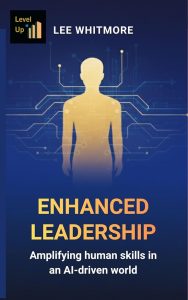
This architectural overhaul is the central thesis of my new book, Enhanced Leadership. Drawing on these global conversations and my own experience, I wrote it as a manual for this specific upgrade. It guides leaders on how to secure their human core before supercharging it with technology. The future of leadership is not about becoming more like a machine; it is about becoming more vividly, unapologetically human, supported by the best architecture we can build.
Whitmore’s website is here.