Iris AWS collaboration widens aperture to semantic-enriched agentic knowledge

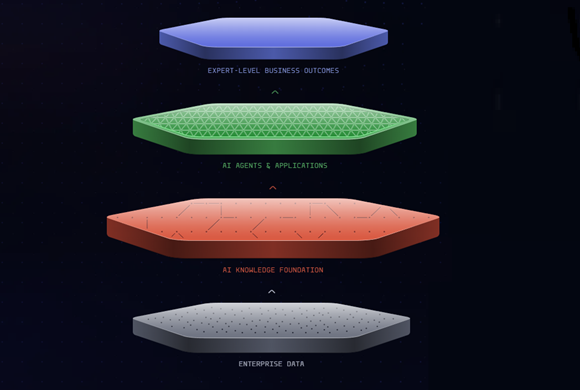
Oslo-based Iris (stylised as Iris.ai) provides what it calls a “semantic-enriched knowledge foundation” for enterprise software stacks building agentic AI services.
To clarify, Iris builds semantic-enriched AI knowledge services to gives models and agents more accurate business context.
The concept is… model choice is good, but model flexibility with the ability to align with semantic-enriched AI knowledge is better.
The company has this month teamed up with Amazon Web Services (AWS) to focus on deployments in regulated industries.
This work focuses on both complex industry-specific and domain-specific data to produce custom-aligned use cases reusable at scale.
The Iris data unification engine, Axion, has processed and contextualised more than 330 million documents across 68 languages, connecting to more than 50 data source types so synthesis across different business units becomes reusable at scale rather than rebuilt for each use case.
Determined determinism
Iris says that for regulated industries in particular, AI output must be deterministic and fully auditable to meet compliance, governance and data sovereignty requirements.
“AWS powers the compute and the models. Iris powers the knowledge those models reason on,” said Victor Botev, co-founder and CTO of Iris. “Most enterprise AI conversations revolve around model choice. That focus isn’t wrong. But the model is only as good as the knowledge it has access to. If the knowledge layer is incomplete, outdated, or poorly structured, the output looks convincing right up until it becomes a production issue. Or a trust issue.”
Companies can’t fully trust AI systems without governance, verification and reliability. AWS provides the enterprise-grade cloud and model stack, while Iris provides the trusted knowledge foundation that lets those models and agents operate with expert-level business context and logic, control and governance.
Iris starts from the contextualisation of data, before working with LLMs.
“Standard enterprise AI implementations fail because 60 to 80 percent of enterprise knowledge sits in formats that most data lakes and business intelligence tools cannot easily ingest and synthesise. Axion has processed and contextualised more than 330 million documents across manufacturing, telecommunications, financial services, healthcare and public sector,” claimed the company, in a press statement.
It has 50+ data source connectors; it extracts and contextualises content at expert-level precision and produces reusable knowledge that AI agents can reason on reliably, delivering 96%+ precision and 4x speed across 68 languages.
Technology ontology
The result is a semantic knowledge layer infused with expert knowledge & ontology that teams build once and deploy across departments, use cases and workflows that scale with trust. Development teams don’t have to rebuild their data pipeline every time, which increases the pace of AI innovation and adoption.
“At AWS, we see customers shift from AI curiosity to AI commitment,” said Matthew Thomson, director EMEA startups of AWS. “That demands partners who can unlock expert-level knowledge buried inside decades of documents, contracts and data sources.”
Thomson suggests the AWS collaboration with Iris brings together the company’s knowledge extraction and contextualization capabilities with the security and agility of AWS.
Iris’s platform runs natively on Amazon OpenSearch, Amazon Bedrock, EC2 GPU and SageMaker instances. On the AI development side, Iris is also fully integrated with Amazon Bedrock AgentCore, giving enterprises enriched context and deterministic control over LLM outputs.
Full integration with Amazon Bedrock and Amazon QuickSight means teams can move from raw enterprise data to production-ready agents without rebuilding the knowledge layer for every new use case.