Alation AIOS: An AI intelligence operating system

As we know, bad AI (and even good AI) is increasingly good at producing confident but quiet failures.
Known for its data intelligence platform that works to provide behavioural analysis, semantic search, active governance, AI curation, collaborative SQL and automated lineage… Alation now self-styles itself as the intelligence operating system company.
In a bid to back up that grandiose moniker, the organisation has this week introduced Alation Intelligence Operating System (AIOS™), an operating system designed to help enterprises govern AI as they build and deploy it across critical business operations.
Because enterprise data requires “dynamic context” to be useful, we can call out three key challenges that now arise:
- Bad data reaches an agent, meaning that it acts on stale or incorrect information with full confidence.
- An agent misreads context (by applying rigid patterns to ambiguous text, missing true human intent), applying the wrong definition or missing business logic that has changed since it was built.
- An agent itself drifts (for example, when static AI instructions, APIs and models fall out of alignment with reality) as instructions, tools, or training fall out of step with the environment it operates in.
What are the consequences of these realities?
As we know, when software breaks, it produces an error – when an agent breaks in one of these ways, it produces a confident, incorrect answer, where most organisations have no system of record to catch it before that answer drives a decision.
Data, context & agents
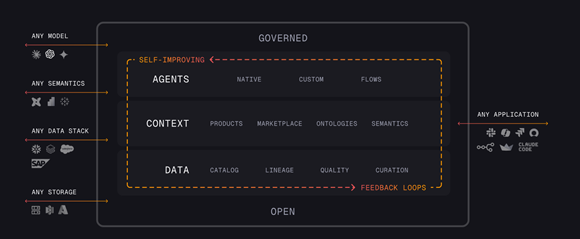
Alation says that AIOS addresses all three failure points by combining data, context and agents into a unified operating system that is open, governed and self-improving.
According to IDC analyst Stewart Bond, enterprises have spent the last two years “bolting AI onto data infrastructure” that wasn’t built for it i.e. building point solutions that don’t talk to each other, with no way to explain why an agent did what it did.
“What’s missing isn’t another AI platform; it’s an operating system that keeps data, context and agents in sync as the environment changes. Alation’s move to unify these into an intelligence operating system is a signal of where this market is headed: away from fragmented tooling, toward a governed foundation enterprises can trust their agents to run on,” said Bond, in an upbeat tone, somewhat reflective of the fact that Alation is variously named a leader in IDC MarketScape for software intelligence platyforms.
AIOS is an open, governed architecture that continuously self-improves across an organisation’s existing data and AI environment.
Data quality, catalogues & lineage
By integrating agents, context, data and governance together in one system, it simplifies AI governance and improves outcomes. Alation uses its heritage in data quality, catalogues and lineage, so organizations don’t have a cold start preparing data to be AI-ready.
According to Satyen Sangani, CEO and co-founder of Alation and team, “most enterprises” cannot afford to get anything wrong in regulatory compliance, data fidelity, or operational outcomes, which is why Alation unified organizational data intelligence into a single system.
“Enterprises need a system to ensure the AI they’re already running can be trusted. No single eval or guardrail is enough to keep AI right,” said Sangani. “AIOS coordinates the data, context and agents inside an enterprise’s existing environment, so every decision an agent makes holds up. That’s the operating system enterprises are missing today and it’s why we rebuilt Alation around it.”
The AIOS platform provides organisations with the ability to:
- Build trusted agents grounded in governed enterprise knowledge, powered by Agent Studio (agentic automation).
- Improve regulatory compliance through governed data and AI workflows, with proof ready on demand (agentic compliance).
- Control context, lineage and access so every AI-driven decision holds up under scrutiny (agentic data governance).
- Ask data questions in plain language and get answers grounded in trusted data (conversational analytics).
- Govern AI by use case, with evidence already assembled (AI governance).
As AI becomes embedded across every business function, organisations require more than data management: they need an intelligent foundation that continuously connects agents, contexts, data and governance to produce reliable business outcomes.