AI afterburn: Why software quality is crashing in the rush for speed

AI is good, but, that ‘goodness’ comes with casualties, complexities and responsibilities.
These caveats are (of course) driven by the need to ensure data provenance – and indeed data handling, wrangling, storage and retrieval – is properly catered for and managed on a continual (sometimes real-time, depending on the level of inference being delivered) basis.
Agentic quality engineering company Tricentis thinks this comes down to an issue of trust in software quality.
The organisation’s latest market study suggests that while software development teams have accelerated delivery through the wider adoption of AI over the past year, many teams are struggling to maintain confidence in software quality as increasing scale and complexity.
The second annual Quality Transformation Report highlights how AI code could introduce new risks into the software development lifecycle (SDLC).
Viewpoints, industry-wide
This year’s market analysis is based on a survey of some 2,500 CEOs, CIOs, CTOs, VPs of engineering, DevOps and quality assurance (QA) leaders and software developers across various industries, including manufacturing, energy and utilities, retail, financial services and the public sector.
What’s the real effect of developers using AI code in live production scenarios then?
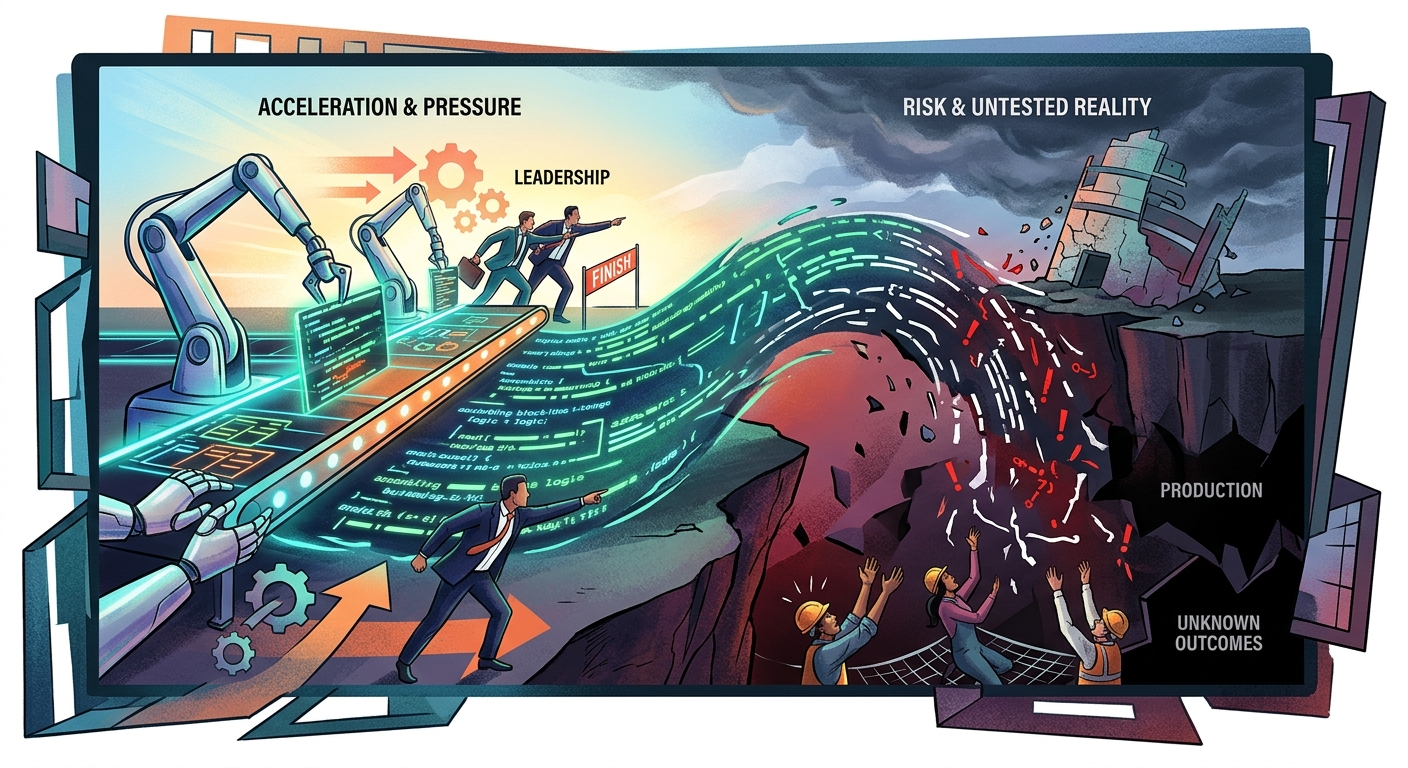
No surprise, organisations continue to prioritise development speed, knowingly pushing swaths of untested code to production.
“Despite significant AI advancements and increased adoption of AI tools, 6 in 10 organisations still report deploying untested code, remaining consistent with 63% in 2025. The difference is that in 2025, organisations largely attributed this to accidental quality slips (40%). Now, organisations admit that they are knowingly deploying untested code: largely driven by leadership pressure to prioritise speed over quality (32%), and the sheer volume of AI-generated code becoming too overwhelming for teams to test fully (30%),” says the Tricentis report.
It also appears that no industry is immune to the pressure to move faster.
More than half of organisations across every major industry surveyed reported deploying untested code to production, with financial services (64%), retailers (63%), and energy and utilities (58%) operating under the greatest strain.
“Accelerating business transformation initiatives is one of the top priorities for today’s C-suite and AI has the potential to help software development teams move faster than ever before,” said Kevin Thompson, CEO of Tricentis.

Tricentis CEO Thompson: Software quality can no longer be treated as just an engineering concern – it must become a boardroom imperative.
Thompson says that although this is unquestionably so, there’s a but to consider i.e. with increased speed comes increased risk. He reminds us that when software quality processes fail to keep pace with development speed, organisations often respond by taking shortcuts that materially degrade or reduce confidence.
“Our research highlights the growing pressure teams are facing to balance speed, quality and control as software development accelerates. As risks like financial performance and customer trust become more visible and measurable, software quality can no longer be treated as just an engineering concern – it must become a boardroom imperative,” added Thompson.
Other findings…
AI adoption is outpacing organisations’ ability to maintain quality and governance: Nearly half of organisations (48%) have fully implemented AI internally, but of those organisations, more than 50% report that their AI tools and processes regularly change.
One-third of teams (33%) cite this tool complexity and sprawl as a key barrier to achieving continuous software quality at scale. Other top barriers include skills gaps (33%), code volume increasing faster than they can manage (28%), and a lack of clear quality and trust metrics (26%).
Executive optimism vs. operational realities
Tricentis states that executive optimism and operational realities are not always aligned i.e. what’s considered AI progress in the boardroom may feel more like operational friction to software teams.
More than four in five CEOs (81%) report high confidence in AI-driven systems and tools, compared to just 56% of QA and DevOps professionals. Similarly, 44% of C-level executives believe their business is very prepared to operationalise, govern, and scale AI agents across the SDLC, compared to just 23% of QA and DevOps professionals.
“Many organisations are still relying on quality processes that weren’t designed for software development in the AI era,” continued CEO Thompson. “As development accelerates, leaders need clearer visibility into software quality risk and stronger alignment between engineering, QA and the broader business. The organisations that succeed will be the ones that can scale speed and control together.”
Organisations say they are ready for agentic AI, but operational challenges suggest otherwise: While 83% of organizations trust agentic AI to make release decisions and 82% say they are prepared to operationalize and govern AI agents at scale, many continue to struggle with untested code (60%), tool sprawl (33%), security concerns (27%), skills gaps (24%), and data quality issues (24%).
Growing financial & operational risk
Poor software quality is a growing financial and operational risk.
One in five organisations (20%) report losing more than $1 million annually due to poor software quality, driven primarily by security and compliance failures (30%) and technical debt and rework (28%). Nearly half (45%) estimate losses between $500,000 and $1 million.
Tricentis’ 2026 Quality Transformation Report highlights an evolution from last year: the challenge is no longer whether organisations can adopt AI, but whether they can maintain trust, control and confidence in what they release at scale.