Nader Khouri Photography
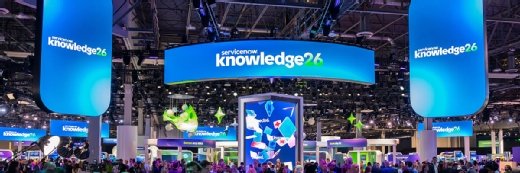
ServiceNow Knowledge 2026: McDermott proclaims fully automated cyber defence
Chief executive’s conference keynote launches agentic artificial intelligence cyber security features for enterprise software player’s centralised platform

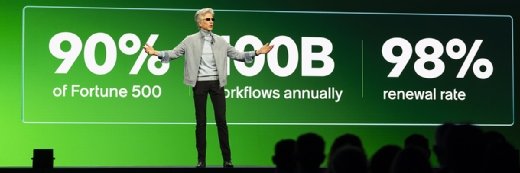
ServiceNow CEO Bill McDermott set the mood music for this year’s Knowledge conference in Las Vegas by banging the drum for the dawn of agentic cyber security.
Agentic artificial intelligence (AI) was the focal point of the customer relationship management provider’s key announcements on Tuesday, with an army of autonomous capabilities added to its AI Control Tower to perform critical security and governance tasks under human colleagues’ restful supervision.
“What we’re seeing right now is bigger than AI,” said McDermott. “Bigger than software. Bigger than any technology shift we’ve watched across this stage. The world of work is being reimagined.”
With AI advancements increasingly multiplying the workplace’s attack surface, McDermott hailed ServiceNow’s recent acquisitions of cyber security firms Armis and Veza, and described how their products will dovetail to monitor connected assets and act on identity management breaches, respectively.
He enthused about a workforce supplemented by AI specialists equipped to execute complete workflows, flagging potential system breaches and instantaneously providing an option for the user to hit the “kill switch” before generating reports and even running communications of the incident to staff.
According to McDermott, the risks for a business not taking up this kind of offering will only become more stark. “Governance isn’t a feature,” he explained. “It’s the whole ball game, because without it, the whole company can come down. Agents are being deployed with no identity, audit trail or compliance posture…
“Cyber crime is the third-largest economy behind only the United States and China. It’s a trillion-dollar-a-month problem. The more you deploy, the more you expose. Intelligence without rules or rails is a dangerous black spot.”
Read more about ServiceNow
- ServiceNow unveils agentic workforce strategy to orchestrate autonomous AI agents across business processes to help organisations avoid the complexity and problems with managing disconnected applications.
- ServiceNow keeps up its campaign to own AI orchestration, challenges Salesforce with CRM tools as Salesforce claps back with its own ITSM offering.
ServiceNow’s effervescent frontman evangelised the AI workforce as an overwhelming positive for human employees, framing the rise of agentic AI as a welcome support network that will liberate people from repetitive administrative roles and allow them to focus on more ambitious projects.
“The global workforce is ageing, birth rates are declining, and the world will face a labour shortage of up to 50 million workers by 2030. But at this exact moment in time, billions of agents and robots are coming online. They are the ideal partners to complement the human workforce, ensuring that all of you will rise with the AI revolution. This isn’t just a forecast. It’s already happening.”
McDermott went on to unveil Action Fabric, which allows external AI agents, such as Anthropic’s Claude, Microsoft Copilot or an organisation’s own, to join AI Control Tower and independently perform “identity-verified, permission-scoped and fully auditable” actions on a single workflow.
He also rang in Otto, a souped-up chatbot with search and analytic features that brings together ServiceNow’s existing generative AI (GenAI) function and the Moveworks conversational assistant – another recent acquisition – to “complete work across every department and system” for a unified user experience.
Jensen Huang chips in
Adding credence to McDermott’s post-GenAI vision was Nvidia CEO Jensen Huang, who joined him onstage to drive home the case for agentic AI’s comparatively superior potential.
“If you look at the last couple of years, the first time I came on the stage, the world had just introduced generative AI – the ability for us, for AI to be able to generate output – text to text, images to text, text to images, images to video … But the thing that really teed up today was the ability for the AIs to generate thoughts, so that it can think; it can reason; it can plan; come up with the ability to use tools,” he said.
“Generative AI generates information, but ultimately what we all want to do is to do work,” added Huang. “What has happened in the last several months is that agentic AI has arrived. We now have the ability to be able to understand … intent; understand context, what’s happening; what the bug is, what the problem is; reason about what the solution will be; use tools to solve it; and then do the work.”
Read more on Artificial intelligence, automation and robotics
-
![]()
ServiceNow Knowledge 2026: Agentic AI propelled ‘from concept to a movement’
-
![]()
ServiceNow Knowledge 2026: FedEx digital chief unpacks agentic AI’s potential
-
![]()
Fast followers will fall behind in the AI race, warns ServiceNow
By: Stephen Withers
-
![]()
Rimini Street CEO sounds death knell on ERP software
By: Aaron Tan