Tonic gins up agentic Mobilisation Coordinator

A new “decision-and-execution” has been detailed by Israel-based Tonic Security.
The company’s platform continuously prioritises vulnerabilities and orchestrates remediation to create what its makers promise is measurable risk reduction.
In real terms, this is an agentic workflow that autonomously orchestrates and verifies remediation campaigns.
The Mobilization Coordinator agent is part of Tonic’s Agentic Exposure Management Platform, an operating layer for security teams designed to transform fragmented exposure data into risk decisions and remediation.
Tonic replaces the static scoring and manual workflows traditionally used in cyber-focused software application development teams with an AI-native decision and execution engine that is powered by its proprietary (branded) Security Data Fabric technology.
The company’s agents reason across business, operational and adversarial context to mobilise remediation (hence the product name, get it?) end-to-end, but with humans firmly in control.
“Most breaches don’t happen because vulnerabilities weren’t found – they happen because teams couldn’t decide and act fast enough,” said Sharon Isaaci, CEO of Tonic Security. “Tonic closes the gap between knowing and doing. Our Mobilization Coordinator continuously determines what actually matters to the business, orchestrates remediation across teams and tools, and validates that risk is truly reduced.”
Tonic’s Agentic Continuous Threat Exposure Management (CTEM) is built on four core capabilities:
- Collect – Agents continuously ingest and reconcile structured and unstructured data across security tools, IT systems, and tribal knowledge (internal knowledge systems and collaboration tools), creating a self-maintaining security data fabric that reflects real operational reality.
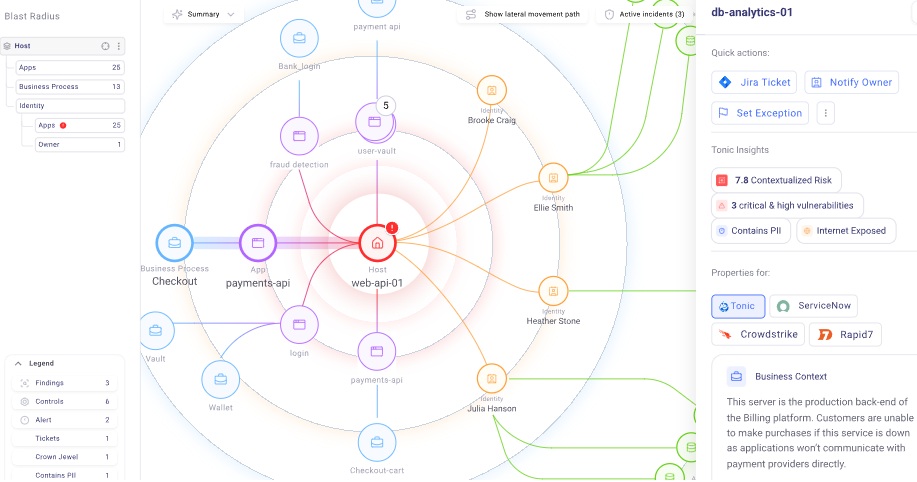
- Contextualise – Agents infer criticality, organisational ownership, reachability, exploitability, business impact and blast radius. This enables teams to immediately understand not just what exists, but what truly threatens the organization.
- Prioritise – Instead of generic severity scores, agents continuously transform millions of findings into a short, explainable queue of business-aligned risk decisions that adapt as environments and threats change.
- Act – The Tonic Mobilization Coordinator orchestrates remediation campaigns end-to-end, routing work to the right owners, injecting precise context and guidance, and validating that risk has actually been reduced. If remediation is not feasible or would introduce operational risk, the Mobilization Coordinator proposes mitigating controls or formal risk acceptance in alignment with the organisation’s risk appetite.
The result, claims Isaaci, is preemptive exposure reduction, at scale, not just better dashboards.
Governable agentic execution
Every recommendation and action within Tonic is fully explainable, evidence-backed, and policy-controlled. Human teams maintain oversight while agents handle investigation, coordination and follow-through.
Tonic automatically validates remediation through rescanning, configuration verification, and system-of-record confirmation, delivering executive-ready visibility into real risk reduction over time.
Market analysis summary
What may set Tonic Security above some of its competitors is the very hands-on-the-app way it’s technology operates i.e. many of what we might defines as the traditional security scanners out there operate with an output that delibvers a high/medium/low rish score that applies in a relatively generic way to an organisation’s software and data stack, Tonic takes a more practical approach and maps vulnerabilities to actual business processes… and this means that the system alert would read something more like “This bug could compromise and wreck your human resources or finanical procurement system”… and thus its customers have said that the company isn’t just tackling the security noise problem – it is anticipating tomorrow’s need for intelligent, integrated and autonomous defence.