Salesforce analysis: the road to multi-agents is paved with connected orchestration

Developers are set for acceleration… the new wave of agentic AI services will, in and of themselves, create a supercharged programming landscape that sees software engineers propelled forward into a vortex of additional code creation and subsequent deployment.
What’s wrong with this statement? Most of it.
The problem with code production isn’t down to fingers on keyboards. As developer advocate extraordinaire Matt Asay highlighted this month, software development has rarely been constrained by typing speed.
“The bottleneck is almost always everything except typing: deciding what to build, aligning on an approach, integrating it into an ecosystem that already exists, getting it through security and compliance, and then operating what you shipped,” wrote Asay, on his regular column,
Salesforce agrees with him.
The cloud-centric CRM company now known for its wider data platform and services says that as agent adoption hits critical mass, its studies show that 96% of IT leaders say AI agent success depends on integration across systems.
Connectivity Benchmark Report
A number of suggested trends have no emerged in Salesforce’s 11th annual Connectivity Benchmark Report: The Road to Multi-Agents… and we see the company telling us that (on average) organisations currently use around 12 agents, with the number projected to climb 67% within two years.
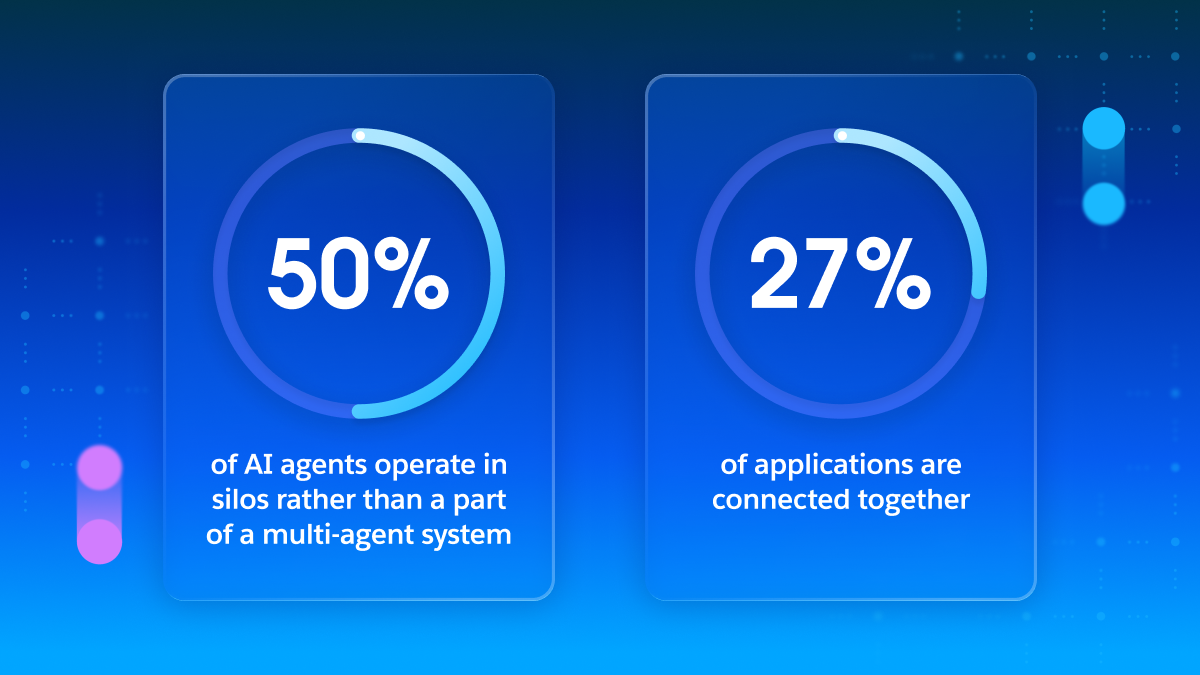
“[Despite the adoption], IT leaders face looming orchestration and governance challenges: 50% of agents currently operate in isolated silos versus part of a multi-agent system, resulting in disconnected workflows, redundant automations and the potential risk of shadow AI,” noted Salesforce.
To address these issues, the research (which is based on a survey of 1,050 enterprise IT leaders) also suggested that respondents are turning to API-driven architectures as a unified foundation to connect, orchestrate and govern multi-agents and drive AI success.
High hopes, slippery slopes
Other findings from Salesforce note high expectations: 96% of IT leaders say agents already have improved or that they expect them to improve employee experiences and 95% believe they will free developers to focus on higher-value work.
On average, organisations report that their existing AI agents were developed through various methods, split across: prebuilt SaaS agents (36%), embedded agents within enterprise platforms (34%), custom-built in-house (30%).
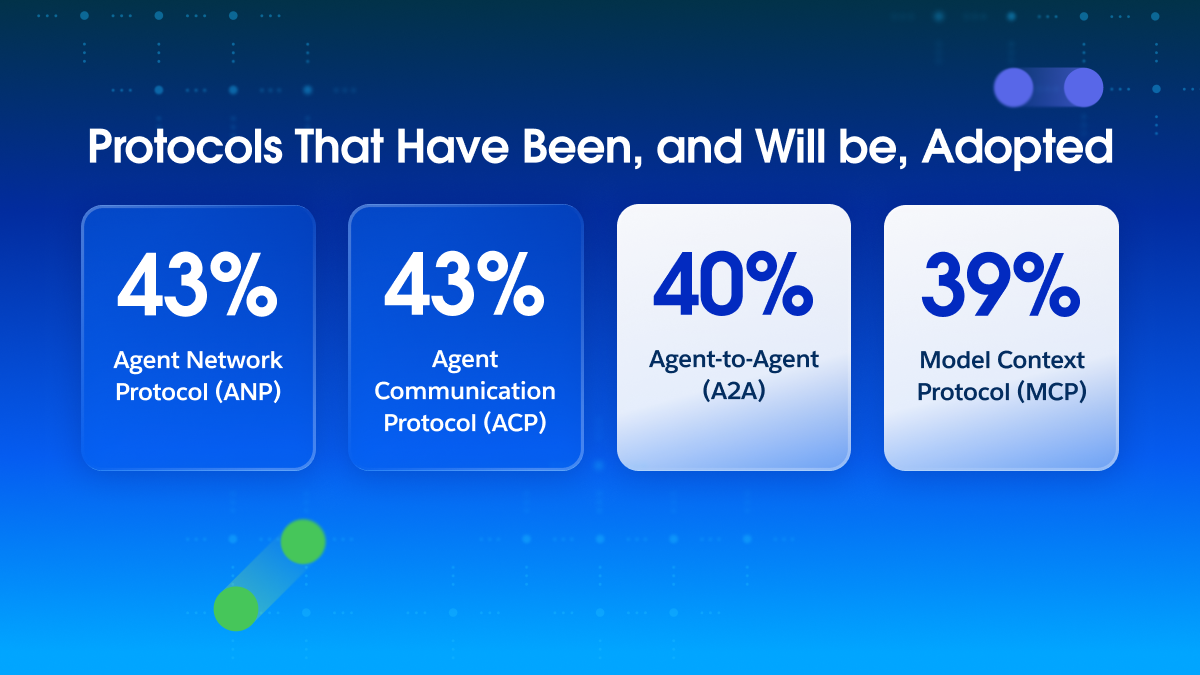
Protocol adoption is also important i..e as organisations deploy AI agents, they are actively supporting, or planning to support, a range of standards or protocols to manage and connect them, with high levels of interest in:
- Agent Network Protocol (43%)
- Agent Communication Protocol (43%)
- Agent-to-Agent Protocol (40%)
- Model Context Protocol (39%)
- Universal Tool Calling Protocol (34%)
Orchestration & governance gap
Salesforce tells us that a “critical orchestration and governance gap” is emerging as enterprises race to deploy AI agents everywhere. While adoption is high, the infrastructure supporting it needs to be more integrated to support a multi-agent workforce that can collaborate and securely leverage data from across an organisation.
“The true success of an agentic enterprise isn’t found in the sheer number of agents deployed but the overall effectiveness of those agents,” stated Andrew Comstock, SVP and GM, MuleSoft, Salesforce. “We need to think about how [agents] are discovered, governed and orchestrated to work together. As we move into this multi-agent era, the role of IT is evolving from managing silos to building a unified foundation as the central control plane that allows multi-agent systems to be safe, reliable and scalable.”
To bridge the integration gaps, Salesforce (with a perhaps obvious lean towards its MuleSoft competencies) suggests that IT leaders are moving toward a unified foundation. The company says that by using APIs as the connective tissue, organisations can transform fragmented AI tools into a cohesive, multi-agent system where agents can safely communicate, share data context and execute tasks across an entire IT estate.
A critical inflexion point
According to Kurt Anderson, managing director and API transformation leader at Deloitte Consulting LLP, this year’s Salesforce and Deloitte Digital research findings highlight a critical inflexion point where organisations must move from simply deploying agents to operationalising them at scale.
“Success requires reimagining integration strategies to build a foundation that is sustainable and secure. By establishing API-driven guardrails, enterprises can ensure their agentic transformation is ready for the demands of the modern enterprise,” said Anderson.
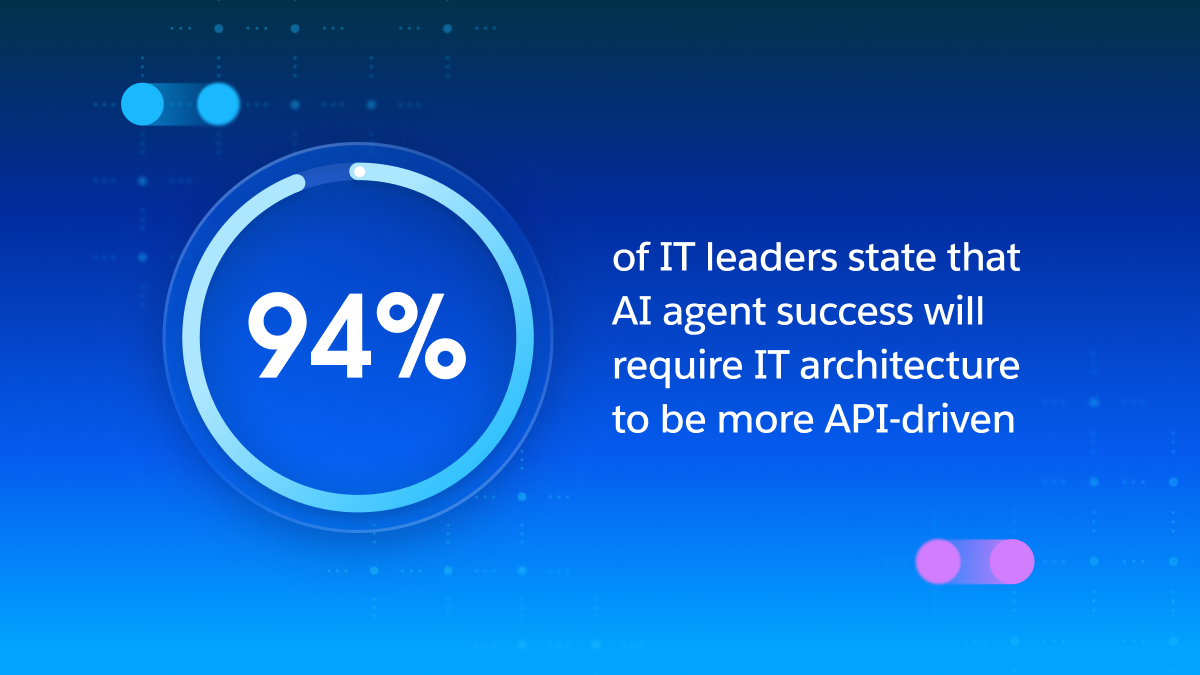
Other analysis here may allow us to witness an architecture shift i.e. 94% of IT leaders agree that AI agent success will require IT architecture to become more API-driven, where APIs are fundamental building blocks for connecting applications, data, and AI across an enterprise.
App & agent sprawl
When it comes to app and agent sprawl, the number of apps in enterprises grew from 897 to 957 year over year, with only 27% of them integrated together. With integration challenges and agent silos, 86% of IT leaders are concerned that agents will introduce more complexity than value without proper integration.
The primary challenges currently hamper agentic transformation: risk management, compliance/security and/or legal implications (42%); lack of internal expertise in AI/agent design (41%); legacy infrastructure or system incompatibility (37%); and integrating siloed apps and data (35%).
“Nearly half (49%) of organisations cite cross-application data governance as a top integration challenge. An estimated 27% of APIs are currently ungoverned, on average, and only 54% of organisations have a centralised governance framework with formal oversight for their agentic capabilities,” noted the Salesforce report.
The agentic developer’s North Star?
Have we found the key to agentic additions, augemntations and accelerators in the software application development universe then?
Perhaps we have.
It’s not about the amount of code that agents can produce, it’s not about the sheer number of agents deployed, it’s not even about the number of tangential integration points inside a given IT stack that we can fuse and graft agents onto… it’s down to the way we govern, connect and orchestrate the overall effectiveness of those agents.