Andrii Yalanskyi - stock.adobe.c
Digital devolution and taking back control
Why Andy Burnham's vision needs data cooperatives to deliver a transformation in digital public services
Andy Burnham's recent vision for a "No. 10 North" is about far more than relocating civil servants from Whitehall to Manchester - it is an argument that economic renewal depends on rewiring how the UK is governed.
His call for power to flow outwards - to mayors, communities and places - is rooted in a simple proposition: decisions are better made closer to the people they affect. He describes a future built on place-based collaboration, long-term thinking and a more streamlined state focused on growth and regeneration.
It is a compelling vision.
But if the UK is about to embark on its biggest programme of devolution for generations, one fundamental question remains unanswered - who will provide the trusted local data infrastructure that turns devolution into better outcomes for citizens?
Building the digital foundations for local services
History tells us that institutional reform only succeeds when it is matched by new infrastructure. The railways underpinned the Industrial Revolution. The NHS created a universal healthcare infrastructure. More recently, open banking transformed financial services - not by creating a national bank, but by establishing common rules that allowed trusted information to move securely between organisations while customers retained control.
The UK's devolution agenda now needs its own digital equivalent.
It’s widely accepted that the mechanisms of the state are not working or fit for the digital age. Today, local authorities, NHS organisations, community organisations, housing associations, colleges, employers and charities frequently support the same individuals, yet each operates separate systems. Citizens repeatedly prove who they are, complete similar forms and explain the same circumstances to different organisations.
While artificial intelligence (AI) will undoubtedly improve productivity, it will not be able overcome fragmented public services on its own. Intelligent systems are only as effective as the information they can safely access. Fragmented data simply produces fragmented decisions.
To date, much of the government's response to digitising public service delivery has centred on proposals for a new national digital identity. While digital identity undoubtedly has a role to play, the debate has become focused on the credential itself rather than the transformation it is intended to enable.
Further, while creating a central identity database for the UK is particularly unattractive for some, particularly those within marginalised or vulnerable groups, the new credential will still not be available until 2030 at the earliest – too late for people to feel the benefit of a Burnham government.
There needs to be another way. How can devolved government provide a personalised holistic service to the individual that helps them live their lives well?
Devolution requires its own digital infrastructure
The devolution agenda creates the opportunity for an alternative and popular approach - one that empowers local communities, gives citizens genuine ownership of their personal data and ensures that the economic value created through digitisation remains within local communities.
The good news is that we already have three of the four ingredients make this possible.
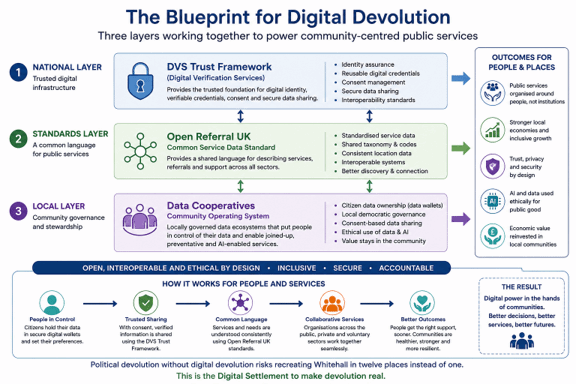
First is the Digital Verification Services (DVS) Trust Framework. More than an identity framework, it provides the trusted national infrastructure that enables individuals to collect, control and securely reuse their verified information. Together with the forthcoming Information Gateway Code of Practice, it will enable verified information from public authorities to be stored and re-shared in personal data wallets, under the individual’s control, making public services simpler, faster and more trustworthy.
Second are common data standards. Trusted identities alone are insufficient if organisations describe services in different ways. Standards such as Open Referral UK provide a common language for describing community services, allowing councils, charities, NHS organisations and technology providers to discover, connect and orchestrate services consistently. As open banking standardised financial data, Open Referral UK can standardise community service information.
Third is local community governance. Local digital infrastructure should not be governed by Whitehall or global technology companies. If devolution is truly about taking back control, communities themselves must shape how local data ecosystems operate, how value is shared and how trust is maintained. This is where data cooperatives, acting as data intermediaries, can play a role.
The missing fourth ingredient is political will. Fortunately, the ancient traditions and recent experience in Manchester also offers a solution for this too – and the devolution agenda provides the opportunity to transform and digitise public service delivery without the need to create a new centralised digital identity.
Data cooperatives - a new model for public service and community delivery data
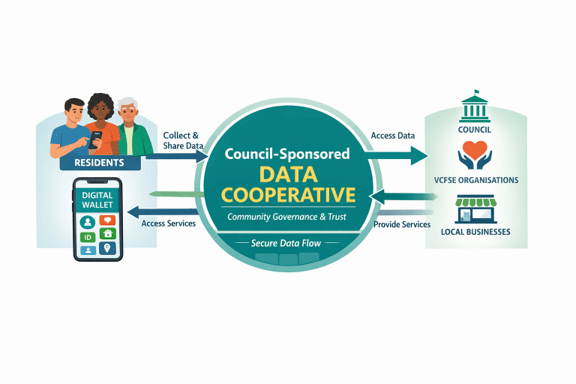
Data cooperatives can provide a decentralised model for new democratic utilities - purpose-built data intermediaries for the digital age. A network of locally governed data cooperatives, set up by each local authority, can combine the enduring values of public service - trust, accountability and inclusion - with the creativity, pace and user-focused innovation of local communities.
Built on the foundations of the DVS Trust Framework, Open Referral common data standards and local democratic governance, they enable communities to empower new thinking to co-design services around the needs of individuals rather than the structures of each legacy organisation.
Instead of asking citizens to navigate fragmented public services, data cooperatives can use personal data wallets and ethical AI to connect individuals with the support they need, regardless of whether it is provided by the public, voluntary or private sector.
They also create the conditions for a new culture of self-help and community enterprise to flourish. Free from the constraints of legacy systems and processes, they enable local government and community groups to become more agile, responsive and innovative.
Also, as cooperatives, individuals do not simply control their data - they collectively own the digital infrastructure that manages it. This is their community’s technology company. Following cooperative principles, the economic value created through trusted data is reinvested locally rather than extracted by global technology platforms.
The result is a more preventative, personalised and collaborative model of public service delivery that helps people live healthier, more independent and more prosperous lives while strengthening local economies and communities.
Lessons from elsewhere
Co-operatives are a well-understood mechanism for shared ownership and control across the world. Globally, it is estimated that 12% of the human population is part of more than three million co-operatives in existence.
Since 2015, the Swiss Midata Co-operative in Europe has been enabling citizens to control and share health data with research organisations to develop healthcare innovations for the common good. In Barcelona, the Salus Cooperative similarly enables members to give and withdraw consent for their data to be used for health and social care research.
With data cooperatives being recognised as data intermediaries in the EU Data Governance Act (2022), it is expected that the use of data cooperatives as a mechanism for member data control will grow.
This model extends beyond Europe, however, with data cooperatives emerging across the Global South to serve different communities and purposes. India, with its long tradition of cooperatives, has seen the development of data cooperatives to help female agricultural workers access finance, markets and resources. The Megha Mandli co-operative in Gujarat helps women who would otherwise be unable to access finance. Members collectively use their data to develop their livelihoods.
The concept of using data as a collective resource to empower people who have traditionally been unseen, exploited or ignored is a powerful one. In the US, Drivers Seat enabled ride-share workers to pool data on surge pricing, demand patterns and earnings, allowing drivers to optimise their work across platforms while also selling aggregated data to municipal authorities for urban planning.
Similarly, taxi driver collectives in cities like São Paulo have developed safety platforms where workers collectively govern data on violence and dangerous areas to protect their members. These examples demonstrate how data cooperatives extend beyond health and agriculture to protect gig workers and inform public policy.
Taking back control
The lesson from elsewhere is clear and needs to be brought back home.
Data cooperatives can act as the new democratic utilities that enable public, private and voluntary services to organise around people rather than organisational boundaries. More than digitising existing institutions, data cooperatives provide the governance and operating model needed to redesign public services for the digital age at a local level. They are the missing institutional layer that allows devolution to move beyond the transfer of powers towards the transformation of services. They can provide the foundations for a new generation of integrated, citizen-centred public services.
In this model, central government provides the national vision, trust architecture, standards and shared infrastructure, while regional and local government provide leadership, democratic accountability and community governance. Citizens remain in control of their own data, choosing when and how it is shared and retaining the freedom to move between data cooperatives, creating an ecosystem built on trust, portability and choice.
Crucially, the social and economic value created through trusted community data remains within local economies rather than being extracted by global technology platforms. It is reinvested in stronger communities, better public services and more inclusive local growth.
Andy Burnham is right that political power should move closer to communities. But political power alone is not enough. Communities also need digital power.
If the ambition is to rewire Britain, data cooperatives provide the operating system to make devolution work.
David Crack is chair of CDD Services, leading data cooperative pilot programmes in Wigan and Wirral to develop trusted digital identity and community data-sharing models. He is also chair of the Association of Digital Verification Professionals (ADVP) and writes here in a personal capacity.
Julian Tait is CEO and co-founder of Open Data Manchester CIC, championing responsible data use to improve communities. He leads the Data Cooperative Working Group and advises governments and international organisations on open data strategy, data maturity and digital transformation, supporting local authorities across the UK and Europe.
Read more about digital identity
- How digital identity will empower people and drive economic growth - The government has finally plotted out the future of digital identity in the UK in a way that makes sense for private sector, public sector, and citizens. Now let's make it happen.
- Building the foundations: A national roadmap for digital identity and sovereign data - Now the UK government has offered some clarity on the future of private and public sector digital identity services, it's time to work together to put the essential foundations in place to make digital ID work.
- Digital ID must not deepen exclusion - UK government plans for a national digital identity scheme risk embedding further inequalities and barriers to public services for the 19 million people currently experiencing digital exclusion.
Read more on IT for government and public sector
-
![]()
Blackpool Council preps datacentre planning application for tech-focused town regeneration bid
By: Caroline Donnelly
-
![]()
Local council devolution: Could it accelerate the pace of local government cloud adoption?
By: Caroline Donnelly
-
![]()
Neos Networks leads £1.2m UK Midlands broadband project
By: Joe O’Halloran
-
![]()
UK government announces 5G Innovation Regions fund
By: Joe O’Halloran