
Fotolia
Data dive: Mapping the UK public sector’s hyperscale dependence
UK government and local authorities have built critical infrastructure amid a web of US hyperscaler cloud and other providers, which brings risks of exposure to a narrow set of non-UK suppliers

The UK public sector’s mailbox and cloud gateway infrastructure is thoroughly entangled with US hyperscalers and other US providers.
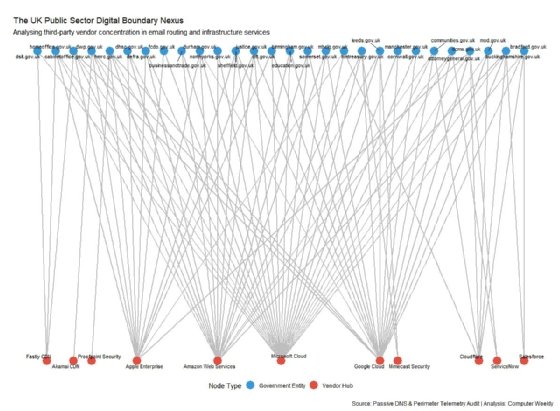
A survey of email mailbox and gateway records for 19 government departments and 10 local councils in the UK reveals a concentration of critical infrastructure that potentially exposes them to risks of single-supplier dependency, dependence on supplier gateways that are a “black box” to internal IT staff, and exposure to US insider snooping.
Research by Computer Weekly built a picture of mailbox and cloud gateway connections for government departments and local councils from Domain Name System (DNS) records and owner registration information retrieved via the Registration Data Access Protocol (RDAP) and IP sources.
While the UK government’s “cloud-first” policy was intended to use public cloud platforms before considering other options, it was also meant to avoid supplier lock-in.
By mapping the digital perimeter of the UK public sector, we can see a clear pattern of dominance by US providers. The digital front door of UK national and local government is hosted on a thin slice of global infrastructure, and raises questions of single points of failure, lack of control of critical infrastructure and exposure to foreign state snooping.
The investigative pipeline
To map these digital boundaries, Computer Weekly used a four-stage passive reconnaissance data pipeline that gathered architectural data without touching internal servers.
The first stage utilised a custom DNS reconnaissance gatherer to iterate through 29 major entities. By performing queries for A, AAAA, MX, TXT and NS records, the tool mapped the public-facing perimeter of these organisations (see “research methodology” below). These records provide a “Who’s Who” of the digital supply chain. MX records identify the “mailrooms” (email gateways), TXT records reveal authorised software-as-a-service (SaaS) senders, and A/AAAA records define the “property lines” – the specific IP addresses where government services reside.
This was supplemented by Certificate Transparency (CT) logs, a public registry of every security certificate issued on the internet. These logs often reveal “hidden” subdomains or internal testing portals that standard DNS queries might miss and provide a more granular view of third-party integration.
The subsequent stages processed this raw data through an RDAP ownership resolver to identify the physical network blocks behind the IP addresses. Finally, an interpretive classifier used heuristic pattern-matching to tag infrastructure with specific suppliers and jurisdictions to calculate an “entanglement score” to quantify the concentration of third-party risk.
The hyperscale triopoly
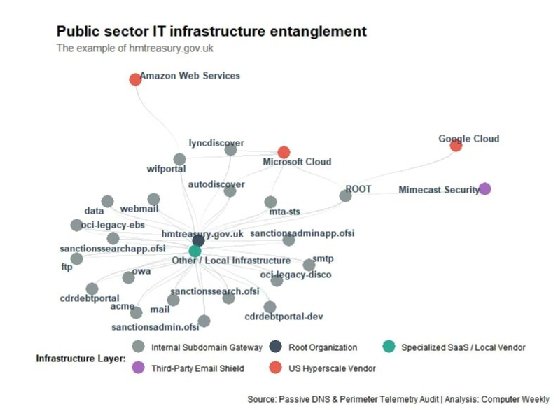
Our analysis uncovered a total of 2,823 infrastructure connections across the public sector sample. The results confirm dependence on a narrow corridor of hyperscale environments. The digital footprint is dominated by just three providers: Microsoft Cloud (466 connections), Google Cloud (264), and Amazon Web Services (137).
The big three hyperscalers are not interchangeable commodities. The research indicates a distinct functional split. So, while Microsoft acts as a “full-stack” partner – anchoring public-facing transit (DNS and routing) and internal identity management – other providers have other specialised roles.
For example, Google’s footprint is heavily weighted towards the identity and application layer that handles domain verification and secure authentication, rather than acting as a primary traffic gateway.
That means government departments don’t merely use these clouds; they are structurally embedded into specific, non-interchangeable levels of their operational stack. That means resilience is rarely achieved by simply mixing suppliers, as each provider controls a separate, unique link in the infrastructure chain, creating “silos of failure” rather than true redundancy.
Beyond the “big three”, the research identified a secondary layer of specialised technology providers that handle critical operational tasks:
-
Content delivery and performance: Infrastructure from Cloudflare (present in 14 entities surveyed), Akamai (7), and Fastly (7) acts as a distributed “caching layer”, absorbing incoming traffic and protecting against distributed denial of service (DDoS) attacks.
-
Ecosystem integration: Apple Enterprise (16) provides the underlying infrastructure for mobile device management and ecosystem services.
-
SaaS operations: Critical business workflows are managed through Salesforce (7) and ServiceNow (5).
-
Cyber security gateways: Specialised email inspectors like Mimecast (4) and Proofpoint (2) act as the primary defence against phishing and malware before data reaches the internal server.
Only one of these companies – Mimecast – is not headquartered in the US.
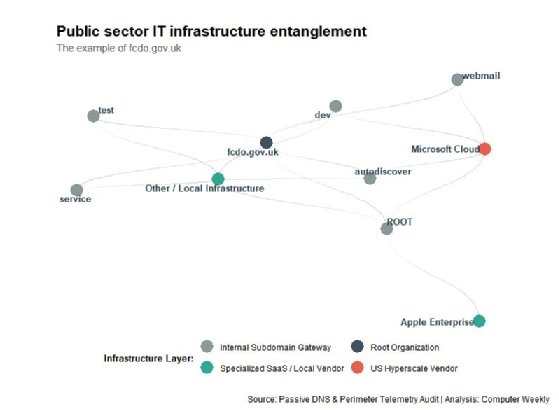
While individual departments gain efficiency, the aggregate view potentially presents a picture of operational fragility. When hundreds of independent government functions share the same underlying physical infrastructure, traditional concepts of redundancy can be nullified.
Security consultant’s view: US dependency
Owen Sayers of Secon Solutions, an enterprise architect with more than 20 years’ experience in delivering national policing systems, said:
“This is the first such analysis I have seen presented and explained in the public domain, but it reflects a situation many technologists have known and understood to be true for many years. Despite the prime minister’s assertions to the contrary, the UK is a taker, not a maker, when it comes to digital technology and, more than any other Western country, is dependent on US-based hyperscaler technologies for the operation of its core national public services.
“This opens us up to data interception and service interruption risks we cannot domestically manage, and suggests that achieving digital sovereignty will be much harder for the UK public sector than the relatively rapid changes we are seeing across Europe.”
The sovereign core
The data also identified 1,894 connections attributed to internal or localised government infrastructure. These represent the core of physical servers, private circuits and authoritative name servers that government departments still own directly, often hosted in datacentres such as Crown Hosting.
But entanglement with US hyperscalers and other providers means this core is vulnerable. Government and local authorities hold the keys to the rooms in their digital house, but have outsourced the front door, letterbox and lighting to commercial landlords. Should a hyperscaler suffer an application programming interface (API) failure or a regional outage, for example, the internal infrastructure could become cut off from the public.
Security consultant’s view: A tangled web
On the subject of entanglement, Sayers said:
“Entanglement is exactly the term to apply here, since the interconnectivity and dependencies of our systems with these services, and worse still, their own interconnected dependent hierarchy of services, is quite impossible to unpick.
“What we now have is a digital gordian knot of global proportions, and even if we knew how to cut it, we could not do so because of the impact this would have on our everyday life. The only way to resolve this is to painstakingly unpick it, but I don’t see anyone lining themselves up to do so.”
The attack surface of convenience
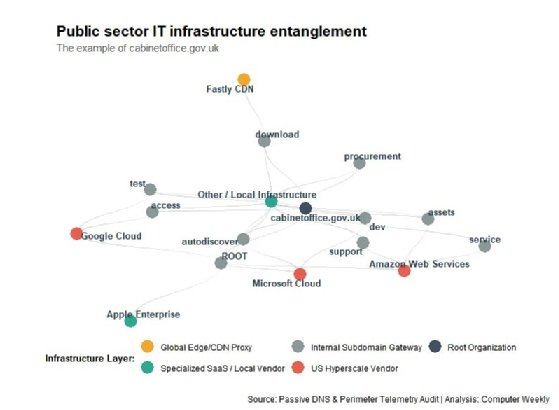
By aggregating services into hyperscaler nodes, the public sector has created a so-called “attack surface of convenience”. This introduces four primary structural risks identified by our architectural analysis:
- Single point of failure: Centralisation in routing means that if a single supplier like Cloudflare or Microsoft experiences a significant outage, an entity’s ability to resolve its own domain names or receive emails can be completely severed.
- The visibility gap: If internal teams treat commercial gateways as “black boxes” and these external providers are compromised – as seen in supply chain attacks like that of SolarWinds – the attackers potentially gain a “golden key” to communication streams that can be invisible to internal monitoring tools.
- Configuration brittleness: Secure architecture requires redundancy. The data shows departments using a single supplier for both email security (eg, Mimecast) and DNS hosting. This creates a situation where an attacker that gains administrative access to one can potentially hijack the entire domain identity.
- The jurisdictional trap: Our research indicates that 96.55% of surveyed entities are subject to US jurisdictional risk. Because they rely on suppliers subject to the US Clarifying Lawful Overseas Use of Data (Cloud) Act and Foreign Intelligence Surveillance Act (FISA) section 702, their data – and access logs that show who viewed that data – reside in a foreign legal jurisdiction. US agencies could theoretically issue a secret warrant to access these communication gateways without UK authorities ever being notified.
Security consultant’s view: Operating on eggshells
On the attack surface of convenience, Sayers said: “When each local authority, government department or critical blue light service operated distinct separate services, it is absolutely correct that we struggled to achieve efficiency and cost reduction.
“However, that service landscape was intrinsically resilient. There was no single point of critical failure, and if one organisation did lose their service, we had processes in place that ensured the impact on the public was minimised. Today, all our digital eggs are in one or two big baskets, and whilst that may bring benefits in cost reduction or service re-use, it also means we are always close to a catastrophic cascade of service failures.”
A tale of two models
The degree of “entanglement” varies significantly across the sample. The Department for Transport, for example, is one of the least entangled, with 79% of its identified digital footprint within a single supplier’s ecosystem (Google Cloud). While this provides seamless integration and a single control plane, a single supplier dispute or technical failure could paralyse the entire department.
In contrast, other entities follow a hybrid model that provides resilience by way of diversification. While this reduces the risk of a single point of failure, it introduces “integration debt” – a more complex environment that is harder to secure and audit across multiple distinct security policies.
One of the leanest footprints identified was the Department for Energy Security and Net Zero (DESNZ). This could be a clean slate advantage. As a relatively new department, DESNZ has not yet accumulated the legacy debt seen in older organisations – the archived websites, forgotten subdomains and abandoned third-party integrations that inflate the digital footprint of more established departments.
The strategic crossroads
As departments move beyond simple storage and into integrated as-a-service models, the technical gravity of major providers increases. The cost of exit – in terms of financial spend and technical debt – becomes prohibitive.
The risk is that without meaningful diversification of the digital boundary, the resilience the cloud was intended to provide may become a casualty. The UK risks a future where its essential services operate at the mercy of a global infrastructure triopoly, bound by foreign laws and shielded by commercial black boxes.
Security consultant’s view: An unstable boat
On the issue of becoming a cloud casualty, Sayers said: “I don’t think we risk that at all – I think it’s already here, we just haven’t had the single event yet that makes the situation clear.
“The real question is not ‘is this a risk?’ – it very clearly is. The question is whether we have already tipped over from potential risk to live issue, and there is plenty of evidence to suggest this is the case. We’ve observed these events elsewhere but have not yet realised that we are in the same boat, and our boat is both smaller and more overloaded than virtually every other Western democracy.”
Research methodology
To map the digital boundaries of the UK public sector, Computer Weekly used a data extraction pipeline built for passive reconnaissance. The primary dataset was built by identifying registered domains for 19 government departments and 10 local councils.
Analysis stages
-
DNS data gathering: Iterated through target entities to perform DNS queries (A, AAAA, MX, TXT, NS records) that mapped the perimeter and identified authorised mail routers and SaaS providers.
-
RDAP ownership queries: Processed raw DNS data to identify physical network blocks (IP ranges) behind the domains, to determine which organisations actually own those network segments.
-
Interpretive classifier: Used pattern-matching to interpret technical data into business categories, to identify suppliers and assess legal jurisdictions.
-
Dependency tree generator: Transformed enriched data into a visualisation of the relationship between root organisations, subdomains and external suppliers.
Key definitions
-
MX records: Direct email to responsible mail servers.
-
TXT/SPF records: List authorised third-party suppliers allowed to send email on behalf of the domain.
-
A/AAAA records: Map domains to physical server locations (IPv4/IPv6).
-
NS records: Identify the authoritative name servers in charge of the domain’s records.
-
Entanglement score: A metric of digital risk calculated by dividing unique supplier connections by the total infrastructure footprint.
Read more about cloud infrastructure
- Cloud and data sovereignty caught in a paradox: We asked the hyperscalers how they would respond to US court-ordered eavesdropping on foreign citizen data – and got responses that highlight a paradoxical situation.
- The rise of the splinternet? Data sovereignty risks and responses: We look at the political, legal and economic risks around data sovereignty, the fears for digital dependency and massive hyperscaler penetration in the UK public sector.
- Breaking the stranglehold – responses to data sovereignty risk: We look at the political and government responses to risks around data sovereignty and massive dependence on the three US hyperscalers – AWS, Azure and GCP – in the UK and Europe.
Read more on Network routing and switching
-
![]()
Cisco advances path to quantum network with universal switch
By: Joe O’Halloran
-
![]()
Breaking the stranglehold: Responses to data sovereignty risk
By: Antony Adshead
-
![]()
Flaws in government procurement show in HMRC £473m AWS award
By: Antony Adshead
-
![]()
The rise of the splinternet? Data sovereignty risks and responses
By: Antony Adshead