Companies that pay ransom demands to cyber criminals in the hope of restoring their IT systems may be at risk of greater negative publicity than those that refuse.
An initial analysis of data seized by the National Crime Agency (NCA) in the takedown of the LockBit ransomware group suggests that the best way to avoid bad publicity may be to refuse to pay up.
Max Smeets, author of the book Ransom War, was given supervised access to data on LockBit 3.0 seized by the NCA during Operation Cronos, which took down the LockBit ransomware operation, and examined leaked data from LockBit 4.0.
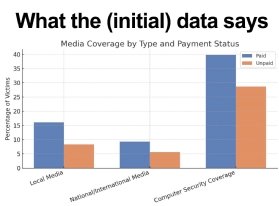
Smeets compared press reporting of 100 companies that paid ransomware with reporting on 100 companies that refused to pay.
“It turns out that you are more likely to have a story written about you if you have paid than if you have not paid,” he said in an interview with Computer Weekly.
Smeets’ conclusions fly in the face of claims by criminal ransomware gangs that companies that pay up can avoid bad publicity. He calls it the Streisand effect, whereby in paying a ransom to avoid publicity, companies end up attracting the very publicity they are trying to avoid.
You are more likely to have a story written about you if you have paid [a ransom] than if you have not paid
Max Smeets, ransomware expert
Law enforcement has long argued that companies should not pay ransom fees because it supports the ransomware ecosystem and there is no guarantee that they will get their data back.
“What the data also suggests is that you also shouldn’t pay if you are afraid of public exposure,” said Smeets, speaking to Computer Weekly at the Black Hat security conference in London.
The art of the bad deal
Smeets’ analysis also revealed just how ill-prepared many organisations were when negotiating ransomware payments with LockBit’s criminal affiliates.
Some companies told crime gangs upfront that they were desperate to get their data back as they had no backups, putting them instantly on the back foot in negotiations.
Others tried unsuccessfully to win sympathy with the hackers by claiming that they couldn’t afford to pay the ransom, or that they served the local community.
Smeets also found that some victims had sent ransomware gangs copies of their insurance documents to show how much they could afford to pay.
Ransomware victims that pay up are more likely to hit the headlines than those that refuse
His findings show that companies need to be better prepared for ransomware negotiations if the worst happens.
“There is a major opportunity, especially for small and medium-sized enterprises, to become better in understanding how to engage with these criminals without making extreme and obvious mistakes,” he said.
LockBit’s criminal affiliates follow a standard playbook for negotiating ransom payments, which typically involves demanding an initial ransom, offering to decrypt two files for free, and threatening to leak data if organisations don’t pay up.
Smeets found that the criminal groups have so many victims that they don’t spend time analysing the data they capture to look for compromising material that could push up the value of a ransom demand – they are more interested in the next victim.
If companies don’t pay up within a few weeks, affiliates may be inclined to assume that their victim’s lack of desperation may mean their ransomware attack did not cause much damage. They may be willing to accept smaller payments in return for an agreement not to publish the hacked data.
The trust paradox
Ransomware groups like LockBit deceive and steal, but somehow have to convince victims that they are trustworthy enough to restore their data in return for a ransomware payment, so reputation matters.
Operation Chronos not only destroyed the infrastructure of LockBit, but also destroyed its reputation, Smeets’ research shows.
In February 2024, the international police operation seized LockBit’s servers, its administrative hub, its public-facing website and its internal communications.
“The NCA not only went after their technical infrastructure, but also tarnished their reputation by disclosing their lies,” he said.
For example, the group said it would ban the affiliates that hit a children’s hospital in Toronto – it didn’t, said Smeets. LockBit also promised to delete victims’ data from its servers if they agreed to pay, but often didn’t.
When criminal gangs attempted to revive LockBit in December 2024, its reputation had been irretrievably damaged.
Before Operation Chronos, between May 2022 and February 2022, 80 affiliates of LockBit 3.0 received ransomware payments.
LockBit 4.0, an attempt to resurrect the ransomware operation after the police take-down, only received eight ransomware payments between December 2024 and April 2025, according to Smeets’ research.
“LockBit is so tarnished that even if it can put up its infrastructure again, it’s a shadow of its former self,” he said.
Operation Chronos could form a blueprint for future ransomware takedowns by destroying not just the infrastructure but also the reputations of ransomware gangs.
Smeets hopes to conduct further research into the relationship between paying ransoms and negative press coverage to test his initial findings.
Read more about LockBit
Ransomware: What the LockBit 3.0 data leak reveals: An administration interface instance for the ransomware franchise’s affiliates was attacked on 29 April. Data from its SQL database has been extracted and disclosed.
Unmasked: The Evil Corp cyber gangster who worked for LockBit:The NCA has named and shamed a prominent member of the Evil Corp cyber crime collective who also worked as an affiliate of the LockBit ransomware gang, as the UK unveils new sanctions against 16 Russian cyber criminals.
Cops take down LockBit ransomware gang: The notorious LockBit ransomware crew has been disrupted in an international law enforcement sting led by the UK’s National Crime Agency.