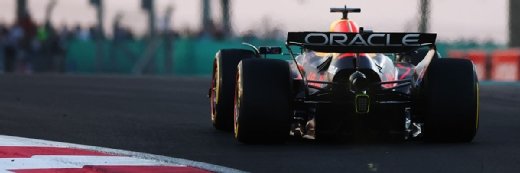
Red Bull Racing
How Oracle Red Bull Racing is driving Formula 1 into the future with cloud, AI and data
Access to the F1 team’s garage in Abu Dhabi reveals how Monte Carlo simulations, artificial intelligence and Oracle Cloud Infrastructure power split-second decisions, strategy and championship-winning performance

Formula 1 has always been a sport defined by extremes, where milliseconds separate victory from defeat and human skill is pushed to its limits. But behind the roar of engines and the spectacle of pit stops lies a quieter, invisible force that increasingly defines success in the sport: technology. At Oracle Red Bull Racing, data, artificial intelligence (AI) and cloud computing have become as important as tyres, aerodynamics and horsepower.
Before the final race of the season in Abu Dhabi, Computer Weekly visited Oracle Red Bull Racing’s garage to observe how human expertise and technological innovation come together to drive one of the most dominant teams on the grid. Jack Harington, partnership group lead at Oracle Red Bull Racing, explained how the team uses technology to make decisions that can mean the difference between winning a world championship and falling short.
“Oracle provides us with performance on-circuit and off-circuit,” says Harington. “Every pit stop call, every strategy decision that has allowed Max Verstappen to win world championships since 2021, has been made on Oracle Cloud Infrastructure [OCI].”
At the core of Oracle Red Bull Racing’s strategy is data. Each car generates up to 2TB (terabytes) of telemetry data per session, feeding into a network of real-time sensors, cameras and engine monitoring systems. Tyre temperatures are tracked down to the degree, and engine performance is measured across hundreds of variables. This known data is combined with unknowns, such as safety cars, red flags, slow pit stops, or unexpected overtakes, creating a massive, constantly evolving picture of race conditions.
To process this complexity, the team relies heavily on Monte Carlo simulations, a method borrowed from the financial world. “Ahead of a race weekend, we run close to four billion Monte Carlo simulations,” says Harington. “Then, after practice sessions, we rerun billions of simulations, integrating the latest telemetry. This allows us to prepare for nearly every scenario we might face on track. When the unexpected happens, we’ve likely already modelled it.”
AI and decision-making
Artificial intelligence plays a pivotal role in helping engineers process this data and make informed decisions in real time. The team has developed AI-driven models that scan sporting regulations and historical race outcomes to provide guidance and support.
“It doesn’t decide for us, it informs the human decision,” says Harington. “In Formula 1, the most important sensor is the driver. Technology amplifies human judgement, but it doesn’t replace it.”
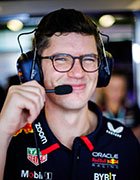
“AI doesn’t decide for us, it informs the human decision. In Formula 1, the most important sensor is the driver. Technology amplifies human judgement, but it doesn’t replace it”
Jack Harington, Oracle Red Bull Racing
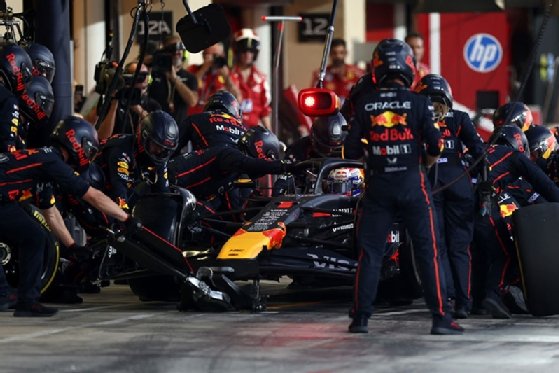
This synergy between AI and human expertise was evident during the Abu Dhabi Grand Prix. During a critical safety car period, data from the cars and live simulations were transmitted to OCI in real time. The team quickly evaluated multiple “what-if” scenarios and made a split-second decision to pit, maximising track position while minimising time loss. Moments later, the decision paid off, illustrating how AI informs strategy without overriding the human instinct that remains central to racing.
The driver in the loop
Oracle Red Bull Racing also leverages driver-in-the-loop simulators, which Harington describes as “the coolest computer game in the world”. These simulators allow drivers to experience the car virtually, testing handling characteristics, g-forces and aerodynamic setups before stepping on the track.
The data collected from these sessions is directly fed into the car configuration for the race weekend. This continuous feedback loop between driver and simulation ensures that theoretical performance matches what a human can execute.
Beyond car performance, Oracle Red Bull Racing uses AI to identify future driving talent. Historically, teams relied on a handful of junior formula series to spot emerging stars. AI allows the team to cast a much wider net, analysing data from karting competitions and small international racing series that would otherwise go unnoticed.
“AI helps us find the next Max Verstappen before anyone else,” says Harington. “We evaluate performance indicators like wet-weather skill or equipment limitations and make predictions no human could process alone.”
Off-track operations
Technology also underpins business and operational efficiency. Payroll, HR and financial planning systems are integrated into Oracle Cloud, with AI streamlining processes and enabling resources to be directed to performance-critical areas. AI is applied to cost-cap management, allowing the team to optimise every investment in pursuit of speed and reliability.
Perhaps the most ambitious application of technology at Oracle Red Bull Racing is in its engine programme for 2026. With new regulations, every engine on the grid will be entirely new, featuring a 50/50 split between internal combustion and hybrid power. Oracle Red Bull Racing runs complex computational fluid dynamics simulations entirely on Oracle Cloud, modelling combustion, airflow and fuel ignition at 15,000rpm, all before any physical component exists.
“Less than four years ago, we had no facility, no staff, no simulations,” Harington recalls. “Within 12 months, we developed one of the world’s most advanced engine-building programmes. Oracle Cloud allowed us to scale simulations as we expanded our team, running around 20% more iterations than traditional on-premise systems. This lets us explore more designs, optimise performance and commit to manufacture with confidence.”
These simulations are so detailed that the team can model fuel combustion within a cylinder, airflow through turbochargers and energy recovery integration, all digitally, long before a single engine is built. The ability to iterate designs quickly and safely is a major competitive advantage in a sport where milliseconds matter.
Human instinct and technological edge
For Oracle Red Bull Racing, the combination of AI, cloud computing and human expertise is a winning formula. Monte Carlo simulations, AI-informed pit decisions and advanced engine modelling give the team a technological edge, but human instinct remains paramount.
“Technology empowers people,” says Harington. “It allows us to perform at our best, but ultimately, it is the human decisions, the driver and the engineers who make the difference between winning and losing.”
After the Abu Dhabi Grand Prix concluded and the season came to a close, the cars rolled off the track, and the team’s digital heartbeat continued behind the scenes. For Oracle Red Bull Racing, the future is clear: advanced simulations, AI-informed strategy and human instinct form the engine of championship-winning performance.
Read more about tech in Formula 1
- F1 real-time data: In this Computer Weekly Downtime Upload podcast, we speak to AWS and the lead cloud architect at F1 about the immense data processing and analysis that takes place.
- Mercedes-AMG Petronas F1 revs up testing with augmented reality: Formula 1 team switches from paper guides to incorporate AR designs into its workflow and see quickly how parts form car assemblies resulting in gains in team’s operations that add up to improved performance on the racetrack.
Read more on Artificial intelligence, automation and robotics
-
![]()
IAM tools help Oracle Red Bull Racing keep pace with strict F1 regulations
By: Alex Scroxton
-
![]()
e& drives AI-first workforce transformation with Oracle Cloud
By: Andrea Benito
-
![]()
Top 10 information management stories of 2025
By: Brian McKenna
-
![]()
Oracle expects to increase OCI margins by 30-40%
By: Cliff Saran