Computer Weekly looks at the technological backbone in place for global football’s pinnacle event, the FIFA World Cup, and how AI has become a permanent fixture and first on the timesheet
Part of what gives football its global appeal to billions is its simplicity – for well over a hundred years, children from all around the world all have set up goals using jumpers and started a game of football.
At one level, this simplicity still exists even at the top level of the sport, the FIFA World Cup. Yet while the 2026 event was essentially about Lionel Messi, Erling Haaland, Kylian Mbappé, Rodrigo Hernández Cascant and Harry Kane kicking balls around, the tournament was also the most technologically enabled of its kind.
The technical standards achieved will be a permanent fixture for how the game is played, watched, organised and even refereed, with football refereeing legend Pierluigi Collina saying the need for more technology was a necessary step to avoid “being like the Amish”.
The first thing to consider about any World Cup – run by world football governing body FIFA – is the concept of scale. It is the most watched event on Earth. With final detailed figures yet to be released, it is expected that 2026’s event was viewed by more than six billion people worldwide. This compares with around 5.1 billion people for Qatar’s World Cup in 2022.
Yet off the screen, the scale issue looms even larger. The 2026 event featured, for the first time, 48 national football teams, playing 104 games in 16 stadiums in the US, Canada and Mexico. As well as breaking new boundaries in scale, the FIFA World Cup 2026 presented similar-sized challenges to those charged with its operational responsibilities, perhaps none more so than official technology partner Lenovo.
Lenovo’s partnership with FIFA started in October 2024. In addition to this year’s main event, it has supported other FIFA programmes such as under-17 and under-19 tournaments, and it will support the FIFA Women’s World Cup in Brazil in 2027.
The technological commitment spanned a variety of core functions including corporate solutions, event solutions, fan experiences and football technology. Lenovo technology supported digital workplace services, technology observability and IPTV streaming; venue technology implementation, a digital seatbelt and an intelligent command centre; and fan experiences included a smart wayfinding map, holograms and the FIFA creative studio. Meanwhile, specific football technology encompassed the AI Football Pro solution, 3D avatars for VAR and the Referee View AI Stabiliser.
Critical systems supported by AI
At the heart of the technological infrastructure for the World Cup was an international broadcast centre (IBC) in Dallas distributing live match feeds to more than 200 countries working alongside a technical operations centre (TOC) in Miami which formed the IT and networking nexus.
Lenovo director of the sports vertical Santiago Manso explains that the challenges are as much about dealing with people as technology: “This is the biggest event on the planet at this moment, and it has been particularly difficult because it’s happening in three countries and 16 venues for 48 teams for the first time in history.
“But [it also involves] how many people are moving around to make this happen – for example, more than 250,000 staff volunteers are working in Miami to make sure that our hundreds of critical systems are available.”
The critical systems begin with a fully redundant, diverse network connecting the IBC to the TOC and to the 16 stadiums. Three infrastructure providers – Telstra, VIDI and Verizon – provided separate links to and from each venue to ensure full redundancy. As a mark of their confidence in the infrastructure, FIFA’s technical staff in the TOC compared the reliability and robustness of the network to that found in hospitals and military applications.
Among Lenovo’s aims for the World Cup was to show how its hardware, end-to-end technology backbone and “big moment” technical expertise could deliver what was required for the organisers, teams and six-billion fans engaging across the globe. Essential technology delivered encompassed fully redundant cloud and networking infrastructures, the 3D avatars, immersive technologies and artificial intelligence (AI).
Before the event kicked off, Lenovo expressed confidence that fans would be able to enjoy live football like never before through new experiences powered by AI.
“This is the first World Cup where AI has been deployed massively,” says Manso. “Before, it was deployed in certain solutions. But in this World Cup, we have brought AI to many other systems that are core to the World Cup, and it’s a good opportunity [for us] to change [perception].
“Lenovo has been always seen as a hardware company, producing nice laptops, nice equipment. However, we want to be a company that is providing AI, democratising AI in the world and [offering] smarter AI for everybody.”
The technological backbone behind the World Cup
For the event, FIFA and Lenovo worked to develop 12 cloud solutions under four different towers of scope, corporate solutions working to support daily operations in use at the intelligent command centre. To ensure redundancy and reliability, the FIFA cloud apparatus used datacentres based in Western Europe, central Sweden and a location in the centre of the US.
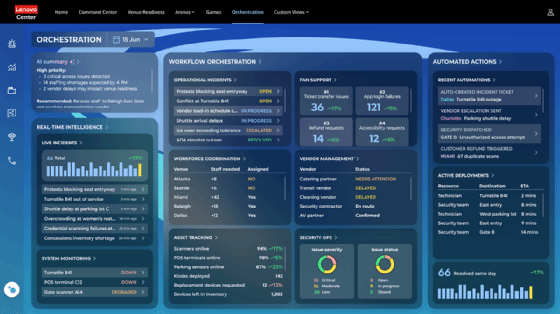
The centres and network provided a backbone helping FIFA to monitor all activities during the tournament and the equipment used in the venues. At the heart of this was a digital cockpit – called Orchestration – showing the state of the various networks and technology in use at all the sites within the event footprint, indicating uptime and whether systems were working within optimal performance tolerances. This footprint stretched to around as many as 600 sites across the US, Mexican and Canada, encompassing not only football stadia but also the likes of airports, hotels, hospitals and medical centres, training grounds and other facilities.
Lenovo’s Orchestration system uses AI to help staff to quickly and efficiently address problems that arise leading up to and during matches.
The other key system displayed within the dashboard was cyber security, with services provided by Palo Alto Networks. FIFA says that the event’s systems were facing as many as 300-500 million cyber attacks each day by the first week of July. While this figure was higher than at Qatar 2022 – which attracted 11 billion attacks – the FIFA technical team was used to dealing with the scale of attacks on an event that had such geopolitical significance.
While ensuring operational capability was the primary task for the technology, the public face of how well the tech worked was how the action on on the pitch and fan experience was perceived. As regards the latter, Lenovo says its aim was to bring new “fun” experiences to fans, designed to help FIFA engage those watching at home, in the stadium or on the go, giving them new opportunities to enjoy the FIFA events in a different way.
More significant were the core football technology systems that were used to help FIFA improve how it can both support tournaments and those that are competing there. In all, FIFA gave Lenovo unprecedented access to data and analytics, with the technology provider noting that there has never been this much data been available and meaningful to so many.
For example, AI Football Pro was described by Lenovo as “something revolutionary” – a specialised football interaction tool orchestrating multiple AI agents based on millions of data points, analysing more than 2,000 different metrics and delivering insights via multiple outputs, including immersive animations.
The technology also allowed national teams, the governing body and its officials to access the millions of data points that FIFA generated in each match. This helped FIFA analysts and the teams’ analysts to understand team performance in real time, allowing them to make tactical changes, and help to guide national teams – in particular coaches – to prepare for games. Another facet was allowing broadcasters to capture billions of pieces of football-related data and representing this as insight for viewers.
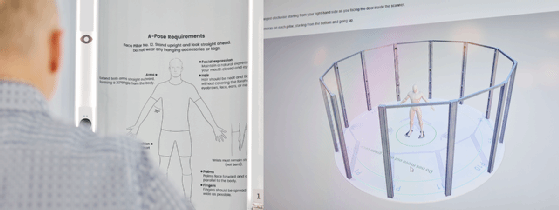
The other key tool was the 3D avatars. For these, Lenovo created a digital twin of every football player who participated into the World Cup. These were used to provide greater context and understanding to the video assistant referee (VAR), semi-automated offside technology (SOAT) and goal-line technology (GLT) offered by fellow FIFA technical partner Hawk-Eye.
FIFA World Cup 2026 football players had their likeness captured by Lenovo tech to create their 3D Avatars.
“The avatar is a good way to enhance the reality of a situation,” says Manso. “Before, this solution had regular avatars with the same shape and same face. Now we [put a] real reproduction of the players, helping fans gain a realistic view of what was happening.”
As part of its official role, Lenovo built and managed the 3D player models with “millimetric accuracy”, scanning each of the 1,248 participating players. It also undertook the process of quality checks and asset management – a challenge given creating realistic, scalable 3D content has traditionally been time-consuming and expensive. Moreover, 3D models have previously lacked the accuracy needed for high-quality analytics, simulation and digital experiences.
How Formula 1 helped inform Referee View AI
The last core part of the football technology was the Referee View AI Stabiliser, which provided a technological boost to the footage generated by cameras carried by officials. The primary use was to help on-pitch decision-making, but the technology also offered a referee’s perspective of action in high clarity and consistency.
Producing this was no easy task. Given that referees are constantly in motion, there was the danger of producing poor video quality that could limit situational awareness for broadcast teams. The stabilisation tech has seen Ref Cam footage move from the professional domain of decision-making to being compelling, complementary fan content.
For the World Cup, the video enhancements were made through real-time visual intelligence, Al-powered computer vision and network edge inferencing and analytics technology which could stabilise and enhance video as it was captured.
Speaking with Computer Weekly, Manso reveals that developing stabilisation technology began in earnest in Formula 1 racing, where Lenovo’s technology was used to improve the content created by the cameras attached to cars mobbing somewhat faster than referees: “Whenever there were changes in light in the ride – for example, getting into the Monte Carlo tunnel – they had to adjust the colour, contrast and brightness manually.”
From this arduous environment, and taking these issues in mind, the Referee View Al Stabilizer in its recognisable form was first developed and tested in 2025 at the FIFA Club World Cup, where the partners found that tweaks needed to be made.
“We realised that when the referee was running, the experience for the spectator watching the TV was [suboptimal] because of the balancing and shaking due to the running,” says Manso. “So, we decided to work with FIFA to put in software that transformed [output], reducing the jitter, but also giving a good consistency of the quality of the images in terms of colour, light and brightness. This [new] solution monitors the different kind of frames, contrasts and all the different parameters, adjusting automatically.”
Getting the correct technology within the referees’ cameras was not just a matter of software. Having AI-based stabilisation meant avoiding the need for extra hardware in the camera, thus cutting down on weight. But the most important facet was that the camera was a head-mounted device and not a chest-mounted camera. The former meant viewers could follow the eyes of the officials, unlike with a chest-based device, which could likely have produced shakier content from a worse perspective.
Hardware considerations were stressed by Pierluigi Collina in his official capacity as chairman of the FIFA Referees Committee and chief refereeing officer at FIFA. He expressed satisfaction in the device used: “When you are on the field of play, every gramme matters. I asked [FIFA] to reduce [camera weight] as much as possible. Another problem was how comfortable the camera was, which was initially linked to the audio system they had.”
For FIFA, it’s all about seamlessness and being able to turn up and do their job
Myles Spittle, Lenovo
In all, data from Lenovo showed that, compared with previous technology, Referee View Al Stabilizer produced a 60% reduction in video jitter for content at 60 FPS transmitted with less than 2-second latency. Lenovo says this meant up to 70% smoother video trajectories with zero image quality degradation in both colour and sharpness. To the viewer, this has meant interesting and watchable close-quarters content that broadcasters have been keen to show.
On a broader note, Lenovo DWS delivery program lead Myles Spittle points out the extent and scale of the engagement of the World Cup. Mulling on what the tournament means, he says that it shows “planning and a good partnership really works” operationally.
“We wanted to…take great ideas and operationalise them,” he adds. “[We were] embedded across the entire tournament. The avatar piece is a great innovation, hopefully adding a lot of value when it comes to off-site decision making. Our technology, hardware and people were everywhere. All those devices must come ready-made, ready image, so that end-users could hit the ground running.
“For FIFA, it’s all about seamlessness and being able to turn up and do their job. We had over 17,000 pre-image laptops, tablets and a whole host of other equipment. On top of that, we ended up shipping well over 25,000 units with very bespoke requirements.”
‘No going back’ from tech’s involvement
While there were still plenty of arguments about refereeing decisions made during the tournament – such as the infamous “VARgentina” – what could not be disputed was that decision-making was made using more views and insights that ever before.
Collina is an evangelist in the positive effect of technology – even if he says the headcams made referees “look like Robocop” – and that it has been a “very demanding” competition for all involved, including referees: “They’re doing a great job. We get to see how hard [the referees’] job is. We think it’s amazing. We live surrounded and supported by technology.”
From this perspective, Collina suggests that there was no real going back with tech, saying it levels the playing field for teams, viewers and official alike. He adds that the tech arms officials with the same insight as viewers and administrators, for the betterment of the game.
Looking at why it was necessary to decide to provide referees with more technology and deploy systems such as the enhance camera, he says there were two possibilities: “One was to make the football match a sort of protected area like an Amish community in Pennsylvania where they still go without technology – this was not an option.
“The other possibility was to give the same tools to the one who was on the field – and it was obvious to go in this direction. We started with the line technology, because it is impossible for a human being to detect if the ball is over the line or not by an inch or two, and it was very successful. Then we extended to other decisions.”
3D avatars of football players are used in VAR calls to support referee judgements.
Collina stresses how even the best, most prepared officials are still human and so have limits, and tech is there simply to prevent game-changing mistakes from being committed. He also emphasises how the IT solutions in the round have contributed to the referees’ preparations for games.
“We now know what the referee is able to see, and thanks to this vision, understand what could have been done better and if something will go as we were expecting,” he says. “People normally complain when a referee makes a decision, but there is now the possibility to see what you can from the field of play, and maybe that makes you understand that the job referees do on the world field of play is very complicated.”
Collina says he was delighted that the AI Football Pro technology would be implemented for the World Cup 2026, observing that it was not only the 48 football teams who were able to get the benefit from the system. The referees benefited a lot, he says, making a game-changing difference to preparation, and a step change from when he was prepping for World Cup finals more than 20 years ago.
“I was delighted because we have many analysts,” he adds. “The reference preparation means that we can know players and know teams in terms of what they do, their tactics, characteristics and so on. I remember in 2002, I was appointed for the Germany vs Brazil World Cup final. At that time, the way for me to prepare that was to get a VHS video recorder and play these VHS tapes back and forward for a day. Today, I’m very envious that my fellow referees can use a technology like [AI Football Pro] to prepare for the matches.”
What faults remain with AI refereeing?
Despite his strong conviction about the use and utility of technology and how he feels it has made for a stronger tournament, Collina warns that there are still misconceptions about its potential and overall capability – one of which was people thinking that technology can provide an answer to everything in football, which he says it cannot.
“If you take a bicycle race, an inch can be easily seen by technology. Football is a sport of contact and there is no technology that can assess [fully accurately] something like pushing and pulling,” he says. “There are different criteria to be considered to assess this. But we made a great step forward – having technology solves many of those decisions, which in the past created a problem.”
On this point, he highlights the controversy surrounding England’s third and winning goal in the 1966 World Cup final, adding: “We are [still talking about] something that has been discussed for 60 years – but that won’t be the future.”
In addition to misconceptions, he says there remain some challenges, mainly down to people issues. From his perspective, technology is quite binary: it works or it doesn’t. But for people, events such as the World Cup can generate high levels of pressure.
“It’s also making sure that all our teams are built in such a way and supported in such a way that they’re able to deliver and execute without external pressures or stresses,” says Collina. “Unfortunately, I have two guys who work for me, running two stadiums, both who are impacted by the Venezuelan earthquakes. It was sometimes less about the technology, [more about] the people, because it is such a unique environment. You need people operating at the highest level – whether that’s the athletes, the referees or the tech.
You need people operating at the highest level – whether that’s the athletes, the referees or the tech
Pierluigi Collina, FIFA Referee Committee
“We are the users of the technology, and I didn’t see any major challenge during the competition. The challenge I’ve seen is how the answer of the technology is received by people. It’s still a matter of people. So, the objective of using technology is to try to make good, correct decisions on field play. I’m afraid that sometimes there are some who prefer emotions compared to what is fact, and this sometimes is a challenge.”
On a forward-looking note, it is challenging to predict with any great accuracy what new technologies will be around the corner. Collina expresses surprise at how technology develops and concedes that when first thinking in 2014 of how technology could support the game in general, he could not have imagined that referees would be using the likes of AI Football Pro and the camera technology. He says it is difficult to imagine how far the technology could go.
“Technology is able to provide great support to humans, but humans are still those who are entitled to make the final call and the final decision,” says Collina. “We spend a lot of money in technology, developing technology to support the [game], but my goal, my objective, is to get it redundant.
“My goal is to have the referee so good on the field play, so well prepared on the field play, that all their calls are correct, and therefore technology is redundant. But I know that it cannot happen; it cannot be realistic. So, [we need to have] a technology ready to support them, not to replace them. I’m always surprised by what our innovation division within FIFA propose in terms of next steps. We are providing many innovations.”
On the pitch, innovation was provided in great quantity by the winning Spanish team, whose passing and movement seemed to be computer designed. And as the celebrations of the much-deserved victory continued into the long night in New York, Spain and among the Spanish diaspora, it’s worth noting that the focus was on the game, not the technology supporting it. When assessing what lay ahead before a ball was kicked, Lenovo’s Spittle says that, for his company, failure was not an option. Goal in.
Read more about technology in sports
Technology at the 2026 World Cup: The 2026 FIFA World Cup represents an unprecedented convergence of sport and technology. Spanning three nations and attracting millions of fans, this tournament has been described as the "largest entertainment attack surface in history".
Singapore Sports Hub to get Wi-Fi 7 network: The upgrade will provide faster, more reliable connections for visitors during concerts and sporting events, and will help manage crowds and improve services.
Ryder Cup takes its best network shot: The Ryder Cup sets sporting and organisational bar higher than ever, depending on ‘an AI-driven connected intelligence platform’ to gain required real-time insights and intelligence.
Boldyn Networks enhances 5G fan experience at AO Arena: UK neutral host network provider engaged to deliver advanced 5G connectivity at sports arena in Manchester, one of the UK’s busiest entertainment venues and one of the largest indoor sporting homes in Europe.
Read more on Artificial intelligence, automation and robotics