I read recently in the Financial Times, that your team is looking at revamping the UK’s artificial intelligence (AI) strategy, as you prepare to become our new Prime Minister.
This is an area of great importance – and I know from personal experience the strong interest you take in digital issues. I remember with great gratitude during my years in Manchester your stalwart support of The Federation, our ethical co-working space for technology startups and established tech firms who committed to working with shared co-operative values. Indeed, you launched the building itself and your own digital strategy for Manchester in The Federation some months later.
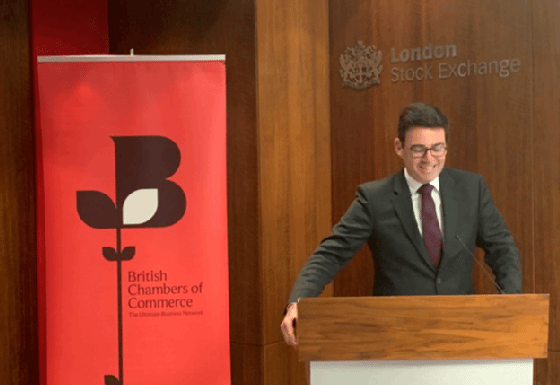
Then mayor of Manchester Andy Burnham at the London Stock Exchange during a British Chambers of Commerce event in 2019
Your support endorsed what we were all trying to do in Manchester to demonstrate a better way forward for technology and a more ethical lens by which to observe how technology could be used to better society - not to look only at the bottom line and growth that benefited a small few, but rather how might a social-enterprise approach benefit Greater Manchester as a whole.
Why was he suggesting the UK needed that? According to the strategy, because “for too long we have allowed blockers to control the public discourse and get in the way of growth in this sector”.
For “growth in this sector,” read Big Tech and their voracious demands for domination. The publication of the strategy followed what had been a frenzy of meetings between Starmer’s government and the tech industry.
According to The Guardian, tech companies’ access to UK ministers dwarfed that of child safety groups, reporting that, “Google, the $4tn California company, had the greatest access, with more than 100 ministerial meetings, according to an analysis of meeting records for the two years to October 2025, which campaigners said showed the tech industry’s ‘capture’ of government. The industry lobbying group TechUK met ministers at the rate of more than once every eight working days.”
As per the FT, your team noted that the current government’s courting of US tech companies had been a “geopolitical failure that hasn’t delivered on its intended aims [and has] also put the Labour government at odds with its voters and the vast majority of the British public.”
Citizens push back
This strongly accords with research on independent regulation from the Ada Lovelace Institute which suggests the real level of pushback by UK citizens against unregulated AI. Key findings of the institute’s research show:
The public supports independent regulation. The UK public do not trust private companies to self-regulate. There is strong public support (89%) for an independent regulator for AI, equipped with enforcement powers.
The public prioritises fairness, positive social impacts and safety. AI is firmly embedded in public consciousness and 91% of the public feel it is important that AI systems are developed and used in ways that treat people fairly. They want this to be prioritised over economic gains, speed of innovation and international competition when presented with trade-offs.
The public feel disenfranchised and excluded from AI decision-making, and mistrust key institutions. Many people feel excluded from government decision-making - 84% fear that, when regulating AI, the government will prioritise its partnerships with large technology companies over the public interest.
The public expects ongoing monitoring and clear lines of accountability. People support mechanisms such as independent standards, transparency reporting and top-down accountability to ensure effective monitoring of AI systems, both before and after they are deployed.
So, Andy, it appears that on taking office as Prime Minister, you may be much more closely aligned on the AI issue with where citizens actually are than where Keir Starmer - and Big Tech - wanted them to be.
More radical
However, one sentence in the FT article made me question whether the steps you and your team are proposing will be radical enough, as it suggests your strategy is based on “making tech work for people,” including ensuring that workers at risk of losing their jobs to AI have access to training so they can reskill.
The inclusion of reskilling for job losses as a result of AI adoption assumes that AI is actually going to generate the kinds of job losses that all of the AI companies have spent the last few years trying to convince us was urgent, imminent and inevitable.
It takes courage to go against the status quo but if anyone has demonstrated the courage to do just that, I would like to think it’s you. In the second of your recent Linkedin posts you say: “I want to do things differently, to put power back in the hands of local communities and build an economy that works for everybody.” You could do no better than to reset the government's relationship with Big Tech.
That starts by no longer passively accepting that AI is inevitable, but by pulling back and in the first instance shutting the door to Big Tech while concentrating efforts on unpicking the hype. You need a laser-like focus on what is real and what is snake oil, what AI can and can’t do and what the potential impact will be for the global and UK economy when this current AI bubble bursts.
Ways forward
As a former senior civil servant in the Government Digital Service, I am more than aware of the pull on the attention, the noise, the urgency, the competing demands that greet any new Prime Minister and their team. To make things a bit easier, here are some possible ways forward and resources that might assist you with the necessary research to reality check where we really are, to inform future strategy.
I wish you well in your endeavours and hope you will be brave, bold and loaded with the sort of moral compass that is tragically missing in all things Big Tech
Emer Coleman
Get a 360-degree perspective - not just the views of Big Tech. As far back as 2019, computer scientist and ethicist Timnit Gebru co-authored a paper entitled: On the dangers of stochastic parrots: Can language models be too big? Her research then holds true today in identifying “a wide variety of costs and risks associated with the rush for ever larger language models (LMs), including: environmental costs, borne typically by those not benefiting from the resulting technology; financial costs, which in turn erect barriers to entry, limiting who can contribute to this research area and which languages can benefit from the most advanced techniques; opportunity cost, as researchers pour effort away from directions requiring less resources; and the risk of substantial harms, including stereotyping, denigration, increases in extremist ideology, and wrongful arrest, should humans encounter seemingly coherent LM output and take it for the words of some person or organisation who has accountability for what is said.”
For the best economic and social analysis, subscribe to Ed Zitron's brilliantly incisive and excoriating calling-out of the whole AI Ponzi scheme in his newsletter, Where's your Ed at. Zitron, regarded as a doomer and naysayer only a few years ago, is gaining increasing traction as an authority across mainstream media channels in the US – for example, as a commentator on the AI industry appearing on a recent CNBC show; and on Scott Galloway's podcast Prof G giving his insight on the future of the AI industry.
Look at how local communities are dealing with the environmental harms of unchecked datacentre roll-outs and how they are organising to push back. Learn how this is becoming a recurring doorstep issue for US politicians in the lead up to the US mid-term elections.
As reported recently by The Guardian, “In just May and June, voters in states including California, Florida, Michigan, Missouri, Oklahoma, Oregon and Texas launched efforts to recall elected officials over their handling of datacentre proposals.” States are also achieving moratoriums on further datacentre development, which shows that community pushback can and is being successful.
Most importantly, learn about the culture, values and use of language by the broligarchy and be forensic in interpreting what they are really saying.
Pause for thought
Already this month, two announcements should give you serious pause for thought about the implications for the AI industry and where the truth lies.
In the first instance, Meta has announced it is moving into the cloud space. Why does this matter? In 2026, Meta platforms were expected to spend $135bn on AI, to build out infrastructure and develop front-end products and services. It doesn't look like the front-end products and services are being developed at all and now we learn they will instead become a cloud service, renting out its - already spare - compute capacity to other companies. If there is spare compute capacity at this stage of the game, that should be a big red flag about the over-promises and under-delivery of this sector.
An even bigger red flag is the recently floated notion by OpenAI that the US government should take a 5% equity stake in the firm to create a wealth fund for the benefit of US citizens. Please read this as a government bailout, offered on the basis that OpenAI is too big to fail.
To believe this is to fall hook, line and sinker for a failed narrative. Look no further than the comprehensive survey by the US National Bureau of Economic Research. Over 6,000 executives across the US, UK, Germany, and Australia were asked how they use AI and its overall impact on the business. Over the last three years, nearly nine in 10 firms said their use of AI had no impact on employment or productivity.
Chilling insights
Don’t take at face value what the leaders of these Big Tech companies tell you. Read Sarah Wynn Williams’ book Careless people for a chilling insight into how bosses like Mark Zuckerberg really view politicians and world leaders and how the real push is - as Zuckerberg put it himself - for “companies not countries”.
Understand their desire to destroy our concept of nation states and ultimately our democracies. Know that he means it when Peter Thiel says “freedom and democracy” are not compatible and watch him build out his “network state” concepts in places like Argentina, where he has now relocated, and Prospero in Honduras where they can build cities run not by mayors but by all powerful tech CEOs. And if anyone should understand the importance and democratic importance of a mayor over a CEO, it's you Andy.
If it quacks like a duck…
And finally watch closely all the time what these broligarchs are actually doing rather than what comes out of their mouths. And know that if they offer you a contract for a dollar remember what they say about ducks - if it looks, walks and quacks like one - it's a duck.
That’s how a one-dollar contract with Palantir led to a contract worth £330m for work with the NHS over seven years. And always, always ask who benefits here - our nation or US tech overlords?
I wish you well in your endeavours and hope you will be brave, bold and loaded with the sort of moral compass that is tragically missing in all things Big Tech.