Police wrongly identified solicitor Fahad Ansari as Hamas member during Schedule 7 phone seizure
A police officer wrongly described a solicitor acting for Hamas in an appeal against its proscribed status in the UK as a Hamas member during Schedule 7 phone seizure
Fahad Ansari, who specialises in national security cases, argues that police unlawfully stopped and questioned him because they wrongly “equated” him acting as a lawyer for Hamas with being a member of the proscribed organisation.
The case is believed to be the first targeted use of Schedule 7 powers against a practising solicitor. Under Schedule 7 legislation, police can stop and question people and seize their electronic devices, without the need for suspicion, to determine whether they appear to be involved in terrorism.
Ansari, an Irish solicitor who is representing Hamas in a legal appeal to have its proscribed status overturned in the UK, was stopped and questioned by police in August 2025 while travelling home with his family from Ireland to Holyhead.
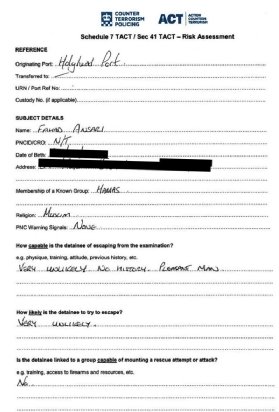
Police risk assessment stated ‘Hamas’ membership
Police risk review identified solicitor Fahad Ansari as a Hamas member
A police officer who completed a risk assessment made a handwritten note under the heading “membership of a known group” stating “Hamas”.
According to a legal submission from Ansari’s barrister for a judicial review – originally due to be held today (6 May 2026), the police officer was “essentially” equating Ansari, who is not a member of Hamas, with his client.
The police officer confirmed in a witness statement that his note was inaccurate. “What I had intended to write was that Mr Ansari worked as a solicitor for Hamas, and not that he was a member of the group,” he said.
The officer added that no other officers involved in the stop or the examination of Ansari’s phone saw the note and that it did not affect any of the decisions made by other officers. “Everyone clearly understood the position that Mr Ansari was the solicitor for Hamas,” he wrote.
Ansari not questioned in earlier stop
It emerged that Ansari had been stopped previously, in 2024, under Schedule 7 of the Terrorism Act, before he represented Hamas, in what appeared to be a random stop.
He identified himself as a solicitor and was not asked any questions about Hamas or Palestine. He did not have his mobile phone seized, downloaded or copied on that first occasion, unlike his later Schedule 7 stop, barrister Hugh Southey KC wrote in a skeleton argument.
He said the significant difference between the two Schedule 7 stops was that Ansari had made an application on behalf of Hamas before the second stop.
The chief constable of North Wales Police has made contradictory statements about the reasons for stopping Ansari in 2025.
In January 2026, she stated that “there was an underlying reason or reason for the stop: it was not random”. The chief constable now states that she has “not confirmed” that the stop was a “targeted stop”.
It appears that the chief constable has approached litigation heard in open court in a “confused, contradictory and less than candid manner”, Southey wrote.
Legally privileged material
The phone seized by North Wales Police contained legally privileged material, including communications with clients, their families, witnesses and experts, along with documents, financial information and internet research related to clients.
Solicitor Fahad Ansari is seeking a judicial review against North Wales Police
A police officer subsequently prepared a list of keywords, including names of UK proscribed organisations and words based on research the officer had conducted into Ansari, to allow an independent counsel to “sift and review” data on the solicitor’s phone.
Ansari argues that the safeguards, including using an independent counsel to assess the contents of the phone, were inadequate to protect legally privileged material, and that he has no way of knowing whether such material was accessed by investigators.
The chief constable wrote to Ansari in March this year, stating that the police had completed their examination of his work phone. Ansari has sought confirmation of whether police officers had inadvertently seen privileged material from the phone.
Lack of rights
The consequence of the approach taken by the chief constable of North Wales Police is that Ansari would be entitled to greater safeguards if he were investigated for having committed an offence, and where there had already been a judicial warrant, Southey wrote in the skeleton argument.
This is not Belfast in the 1980s when such messages were delivered by bullets, but the intention feels uncomfortably similar: represent clients and face consequences
Fahad Ansari, solicitor
Ansari said that the Court of Appeal had recognised that his argument for greater disclosure from the police had merit.
“Previously, the High Court allowed the police to rely on secret evidence. In situations like this, it’s normally expected that at least a summary of the allegations is shared to allow a semblance of a fair hearing,” he wrote in a post on LinkedIn.
The police’s apparent lack of distinction between being a member of Hamas and being a legal representative of Hamas raises “serious concerns” and would deter lawyers from representing proscribed groups, he added.
“This is not Belfast in the 1980s when such messages were delivered by bullets, but the intention feels uncomfortably similar: represent clients and face consequences,” he said.
Phantom Parrot
A document leaked by whistleblower Edward Snowden in 2013 raised concerns that information collected from phones during Schedule 7 searches was being covertly collected at UK borders under GCHQ’s “Phantom Parrot” programme.
Ansari said North Wales Police had declined to say whether information from his phone had been shared with any other organisations.