Joe O'Halloran
ISE 2026: Maxhub unveils partnerships, products to enrich unified collaboration
Provider of integrated commercial display and unified communications takes advantage of enterprise AV expo to announce further collaborations with tech leaders to create enhanced multimedia experiences

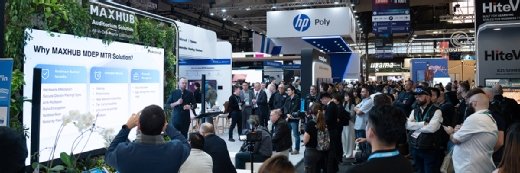
Maxhub has unveiled a series of products focusing on sustainability and ecosystem integration to position its portfolio not as merely screens, but as true unified collaboration systems. In this way, it is seeking to raise the bar in an enterprise media sector where firms are increasingly looking to deploy systems that offer broadcast-quality production capabilities but without prohibitive costs and complexity.
In addition to new products spanning cameras, video bars, collaboration tools, consoles and digital signage, the provider of integrated commercial displays and unified communications announced further collaborations with Microsoft and NDI to create enhanced multimedia experiences in existing and potentially new audiovisual (AV) use cases through IP.
Maxhub is in the midst of a European expansion strategy that started when it established an office in the Netherlands in 2022 and a product warehouse at the beginning of 2023. In the same year, it defined its channel strategy, and a year later, it embarked on its first partnership with Microsoft on a global level. In 2024, the company introduced a collaboration meeting board to the European market, and in 2025, it launched devices compatible with Microsoft Teams Rooms (MTR).
Deployment options include traditional setups using Windows Collaboration Board AIO and Windows Bar AIO. Other configurations include an Express Instal based on an XBar V50 kit and Signature Room and Coordinated Meeting spaces. The latter are based on devices from the company’s Xcore Kit Pro+ range and an MTR Collaboration Board.
Explaining the company’s European setup to Computer Weekly at ISE 2026, Maxhub Europe director Kevin Wang noted that it was important for the company to improve its regional customer support and user experience.
“That’s why we ... have four RMA [return material authorisation] centres in different countries – the UK, Slovakia, Italy and France. We now have local teams in around 12 countries. In those countries, we are able to provide local support from sales, pre-sales, as well as other services to the channels and end users. We also have dedicated service centres in the UK, Italy, France and Slovakia.”
The primary focus of the launch portfolio is the Videobar XBar Series, an all-in-one collaboration solution for Microsoft Teams Rooms. The new XBar W70 Kit is claimed to be the first and only Windows-based Teams Rooms video bar with a 200-megapixel quad-sight lens and a 16 MEMS microphone array. It combines four cameras and a Windows-powered system in a single device. It supports three-in-one installation options to make it suitable for meeting rooms of different sizes.
Assessing how the product will be deployed, Wang said a key aim was to simplify the complexity of older product solutions, hence the adoption and preference for an open platform ecosystem. “[Technologically], Videobar X series is a complicated solution. But for the end users, it’s quite easy to use”
Another part of the evolution of the company and its product line is a move away from traditional HDMI cable-based technology to more efficient infrastructures. Specifically, that is adopting technology that is compatible with the NDI Display standard and part of a local area network (LAN) to boost scalability and maintenance in enterprise environments.
At ISE, Maxhub also highlighted the Digital Signage CMB Series, the world’s first NDI-certified smart display. The CMB Series is purpose-built for business and optimised for MTRs, which, when activated, the display illuminates. Once a meeting concludes, it subsequently deactivates.
Wang outlined the clear benefits of avoiding the “mess” of traditional cabling. “When you step into a meeting room and try to share content on a big screen, probably the first step is to find an HDMI cable or an adapter for the HDMI cable. So it’s a mess at that time, because you just have minutes to join the meeting, and maybe one of your key customers is waiting in the lobby of the video conference. You cannot waste time. The [aim] is to try to solve this problem. We would like to cooperate with leading providers in our industry to build an open ecosystem to bring this kind of high-efficiency solution to end users. With NDI, you don’t need the cable, you just click to connect to the network.”
In addition to being more cost-effective, Wang said this new approach also lends itself to a more secure, managed collaborative environment. He remarked that the partnership with Microsoft made network offerings intrinsically more secure.
Also boosting management is the Pivot+, a web-based platform designed to make device and system management simpler, more efficient and “safer”. Pivot+ provides centralised control of Maxhub devices across up to eight organisational levels. It supports zero-touch deployment, AI-powered alerts and intelligent event detection to ensure optimal performance and minimise downtime.
The zero-touch deployment capabilities allow devices to be automatically grouped post-enrolment, with central management also allowing remote batch control. In addition to multi-device screen control, the system offers multiple ways to update firmware and anomaly incident features encompassing detection, alerts and resolution.
One of the key stated goals of Maxhub is “unlocking the full potential” of Microsoft Teams in any workspace. To this end, Maxhub is additionally partnering with Microsoft to launch The Co-Create 100 coalition to provide 100 fully equipped MTRs to selected users. The aim is to offer measurable productivity or operational improvements that enterprises expect from modern Teams-enabled meeting environments. The scheme will also see Maxhub collaborate with global companies to share success stories and demonstrate how MTR enhances efficiency and creates competitive advantages.
Wang explained some of the benefits of this: “[Even] nowadays, many people don’t know the latest technology in our industry. With this Co-Create 100 programme, we would like to promote our product or tell a lot of people that they can have the opportunity to get some devices or upgrade their facilities. So with that opportunity, they will know how to improve their internal communications and collaboration efficiency.”
The launches at ISE included a touch console for Surface Hub and XBoard, the Maxhub Universal Console. Maxhub’s European business development manager, Mikkel Frederiksen, said: “The Universal Console delivers three things: connect, control and convenience.”
Maxhub also unveiled the XBoard 92 device, which is said to be the first 21:9 collaboration board to achieve MTR certification.
Read more about enterprise audiovisual systems
- Utelogy and Natilik team to enhance managed meeting collaboration spaces: Connected workspaces platform provider teams with digital transformation specialist to expand global reach with proactive monitoring and automation.
- Ascentae and Utelogy unite to enhance collaboration and productivity: Strategic partnership looks to create ‘innovative’ workplace services that enhance collaboration and productivity, providing a unified platform for managing AV and UC environments.
- HP and Google bring Starline collaboration out of lab and into workplace: Tech firms unveil collaboration technology project based on AI and 3D imaging, designed to make co-workers feel like they’re together from any distance.