Schneider Electric
Datacentre dive: AI factory power draw changes the grid calculus
We look at energy as the key driver – and bottleneck – in development, and why water use is less of an issue now datacentres use liquid cooling over air cooling

The power and cooling requirements of graphics processing units (GPUs) in artificial intelligence (AI) processing are set to make direct-to-chip liquid cooling mandatory. As construction of AI factories gathers pace, such facilities place unprecedented demands on the electricity grid – demands that often cannot be met at the speed the industry wants.
So, we risk the proliferation of islands of “behind the meter” sources of electricity generation – gas-powered, nuclear – that could spark a Wild West brawl among the calm of carefully considered carbon budgets.
There are potential environmental upsides, however. Direct-to-chip liquid cooling works on a closed-loop system akin to a car radiator, so there is little ongoing water usage once filled.
These are some of the key takeaways from a recent event held by datacentre equipment provider Schneider Electric, where industry figures discussed the imminent future of the datacentre scene and visited Terawulf’s under-construction 750MW site on the shores of Lake Ontario.
In this four-part set of articles, we look at the rapid pace of construction at the TeraWulf site, how massive leaps in GPU power dictate datacentre design changes, their effects on the power grid and water use, and colour in the picture as rust belt gives way to AI factory.
Grid the gatekeeper of the AI revolution
The digital transformation of the 20th century was built on a foundation in which technology companies designed the software and servers, and public utilities laid the copper and built the power stations to feed them. For decades, this infrastructure playbook worked just fine, with predictable, linear growth. But the explosive rise of generative AI (GenAI) has broken that mechanism.
Today, we face a monumental energy squeeze. On one side, chip suppliers deliver exponentially more powerful, dense and power-hungry GPUs. On the other, the electrical grid hits fundamental limits of capacity, timing and physics.
As datacentre operators and enterprises try to scale out huge AI training clusters, they discover the primary bottleneck is a stark structural mismatch with utility infrastructure.
The timing mismatch
“The challenge is fundamentally a mismatch in timing,” said Anuja Ratnayake, emerging technologies executive at EPRI, a scientific research non-profit organisation.
For the past 20 years, standard datacentres operated comfortably in a scale of 5MW to 100MW. A facility of that size could be built, wired and fully interconnected to the regional grid in a reliable two-year window.
AI has shattered those expectations. Modern AI clusters require gigawatt-scale loads – equivalent to the power consumption of a small city.
“There is no way the grid can accommodate the size of a small city getting interconnected in two years,” said Ratnayake.
Instead, to secure a high-capacity grid, interconnection has lengthened into a seven-to-10-year timeframe. This has forced utility operators to discard long-term planning frameworks. Resource plans that were traditionally updated annually or every three years are now being rewritten in a matter of months as utility load forecasts face massive, unpredictable revisions. The core tension is that the technology sector iterates in months, while electrical transmission infrastructure requires up to a decade to build.
The ‘pulsing’ effect
The physical strain on the grid is further compounded by the unique, erratic electrical appetite of AI factory workloads. Traditional enterprise cloud power draw is relatively steady and predictable. It rises and falls smoothly, based on user traffic. AI workloads are built differently.
During the training phase of a large language model (LLM), thousands of interconnected GPUs calculate mathematical weights in tight, synchronised steps. When the cluster starts a massive computational pass, the power draw spikes instantaneously across the data hall. When that cycle finishes or pauses for checkpoint synchronisation, the load drops off a cliff.
This creates a “pulsing” effect – rapid, high-amplitude oscillations in electrical demand that can destabilise local utility substations. Traditional grid distribution networks are designed for smooth AC stability. Managing these violent power swings requires complex, localised buffer systems and creative grid-flexibility partnerships to protect infrastructure from failure.
Bridging the backlog for gas turbines
Faced with a decade-long wait for utility upgrades, datacentre operators – in the US at least – have taken power generation into their own hands and sparked a revival of technologies that were recently near-extinct.
“Four or five years ago, natural gas turbines were pretty much going the way of the dinosaur,” said Mandar Pandit, chief strategy and growth officer for GE Vermova. “Everything was going to be wind and solar. Now, McKinsey reports there is a seven-year backlog of natural gas turbines.”
Across the manufacturing landscape, the backlog for gas turbines has swollen to a staggering 100GW of capacity. Lead times are so extended that manufacturers cannot confidently guarantee delivery before 2030 or 2031.
To bridge this immediate four-year gap, the industry is increasingly turning to smaller, agile power assets. Tech firms are deploying “aeroderivative” engines – essentially commercial aircraft jet engines modified for stationary industrial power generation. These units offer considerably shorter manufacturing and delivery times than utility-scale turbines and so allow operators to spin up fast on-site power.
In parallel, small modular reactors (SMRs) are widely discussed as the ultimate clean, baseline power source for future mega-clusters.
However, both approaches come with substantial trade-offs. Natural gas turbines offer immediate, dispatchable and highly reliable power but threaten net-zero targets and require massive upfront capital expenditures. They’re framed as a “bridge” solution while awaiting grid connection, but the scale of investment means they must be operated for a long period to amortise costs.
Meanwhile, SMRs promise immense, carbon-free and highly concentrated baseline power, but are hamstrung by regulatory hurdles, unproven commercial deployment timelines and high early-stage capital costs.
Behind the meter, under the radar
There’s a noticeable trend towards behind-the-meter on-site gas generation. It is most advanced in the US, but developers in the UK have reportedly made enquiries too. The worry is that if AI factories can simply decouple from public infrastructure and operate as self-contained energy islands, carbon budgets could be threatened by a gas turbine-led Wild West.
While that could be a concern, the economics are unlikely to support it, according to Steven Carlini, chief advocate for AI and datacentre at Schneider Electric. “In the 20th century, we built the electric grid, and that changed the quality of life and access to opportunities for everybody,” he said. “In the 21st century, the foundational infrastructure layer we are creating is the digital layer ... and powering new load with the grid is the most efficient way to go about it.”
That’s because building isolated datacentres met entirely by their own local resource mix is incredibly financially inefficient. Without the balancing mechanism of a regional grid, an islanded facility must over-provision its generation assets to handle maximum peak loads and the violent pulsing of GPU clusters. That would mean astronomical capital expenditure and vast amounts of wasted energy. True efficiency requires leveraging the existing grid as a shared infrastructure foundation.
As a footnote, industry watchers point to the possibility of hydrogen-powered gas turbines – which are almost categorisable as “clean” – which GE Vermova is involved in but lacks an energy source infrastructure to support it so far.
Datacentre and grid operator partnerships
The ultimate solution to the datacentre energy squeeze may necessitate a fundamental shift in the commercial relationship between developers and public utilities.
Historically, utilities bore the entirety of infrastructure risk for guaranteed, long-term regulated returns. Because AI companies deploy capital at hyper-speed and shift strategies rapidly, utilities are understandably reluctant to gamble billions on dedicated power lines that could become stranded assets if a tech tenant moves or changes its architecture.
“This is a point in time where the utilities can share some of that risk with the datacentre,” said Carlini. “If you share that risk, that allows the utility to go on the journey where it is not making infrastructure choices too fast, but you’re also not creating a sort of a shadow grid that is going to have a bunch of stranded assets.”
Water use upside? From air-cooled to water-cooled
In the public imagination, the datacentres that power the AI boom have become hydrological vampires. As hyperscalers race to deploy gigawatt-scale “AI factories” filled with thousands of high-heat GPUs, local communities and environmental regulators have grown increasingly alarmed by the sheer volume of water required to keep these facilities from overheating.
“It’s a very emotional reaction when the media and the public see these headlines,” said Tuan Hoang, head of cooling technology and product development at Schneider Electric. “They always ask me, ‘Why is the industry using so much, consuming all the resources?’”
But as the datacentre undergoes its most radical redesign in 30 years, this narrative is likely to have a “use by” date. The transition from air-cooled facilities to direct-to-chip liquid cooling is rewriting the environmental footprint of the data hall.
Instead of multiplying water usage, engineering projections from Schneider suggest that the shift to liquid-cooled AI clusters provides a path to eliminating operational water consumption.
The closed-loop reality
Direct-to-chip liquid cooling mounts copper cold plates directly onto the hottest silicon components in GPUs, TPUs and high-voltage CPUs.
Because liquid is significantly more effective at capturing and moving heat than air, it can absorb massive thermal loads in a self-contained system. This internal liquid loop is a strictly closed circuit. Fluid circulates across server chips, absorbs heat and returns to be cooled again without ever interacting with the outside atmosphere.
Hoang uses a familiar automotive analogy: “Air-cooled datacentres are like the old Volkswagen ... where it had an air-cooled engine. That’s what datacentres have been for decades, where the heat from the load rejects directly into space, into air. Liquid cooling is like a modern automobile, where the radiator removes the heat from the engine. Zero water is needed to cool a car today. That’s the same for AI datacentres.”
The real breakthrough in eliminating external water use lies in how that heat is ultimately rejected outside the building. Because direct-to-chip systems capture heat directly at the silicon, they can operate at higher fluid temperatures.
Rich Whitmore, CEO of Motivair by Schneider Electric, said: “Historically, datacentres ran cooler water temperatures because that’s what the datacentres required. But the interesting thing with liquid cooling is we’re cooling these datacentres with quite warm water.”
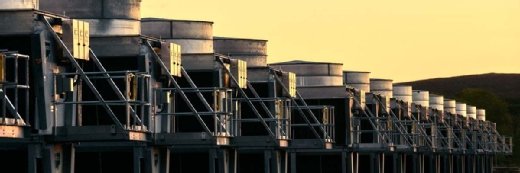
This elevated temperature creates a wide delta against the outside air temperature and means operators can use closed-loop outdoor radiators or dry coolers. As the fluid inside the radiator stays sealed and simply dumps its heat into the passing ambient air, an AI factory can run at maximum compute capacity while requiring near-zero ongoing water consumption.
Shifting KPIs: tokens per watt
This physical engineering shift is changing how the datacentre sector calculates success. For two decades, the gold standard for datacentre efficiency was power usage effectiveness (PUE) – a simple ratio to measure how much power a facility consumed to keep its IT systems running.
But in the era of AI, PUE looks like an incomplete metric. Hyperscalers and enterprise operators no longer look just at how much power enters the building. They are now focused on computational yield, with the industry moving towards application-layer key performance indicators (KPIs) such as tokens per watt and cost per token.
“We wanted to get the most out of datacentres to produce power,” said Whitmore. “What AI has taught us is that now we’re converting power into revenue. So, being able to optimise these systems to get the most tokens per watt or the lowest cost per token is really where the value is.”
Direct-to-chip liquid cooling acts as the ultimate multiplier for these new performance metrics. When a GPU overheats, its internal safety mechanisms automatically trigger thermal throttling – slowing down clock speed to protect the silicon – which causes token production to drop off a cliff while the chip continues to draw massive amounts of power.
By eliminating thermal bottlenecks and maintaining stable and optimal silicon temperatures, liquid cooling ensures GPUs can run continuously at peak performance without throttling. This drastic reduction in computational waste potentially means every single watt delivered to the rack yields the highest possible volume of tokens. To maximise tokens per watt and minimise cost per token looks set to become the defining factor for competitive survival.
Optimise for tokens per watt
The trajectory seems clear. The high-heat demands of modern AI processing have made the migration to direct-to-chip liquid cooling completely unavoidable. By trapping heat in closed fluid lines and utilising high-temperature dry rejection, modern AI factories can completely isolate their cooling needs from municipal water networks.
But companies that try to prolong the life of legacy air-cooled facilities by running fans faster or pushing evaporative systems past their design limits will face a double blow. Namely, soaring operational costs driven by thermal throttling, and intense regulatory and public backlash over unnecessary water evaporation.
The future belongs to those who optimise infrastructure to deliver the maximum tokens per watt while leaving the local water supply completely untouched.
Read more about datacentres and TeraWulf’s AI factory
- From rust belt to megawatt AI factory: We visited Terawulf’s Lake Ontario 750MW datacentre development. Photos and recordings weren’t permitted, so we took notes and wrote them up in more traditional ways.
- ‘We’re at Chinese levels’ at TeraWulf 750MW AI factory: We see the latest in AI factory technology and construction at TeraWulf’s Lake Ontario datacentre, where a former coal-fired power station is site of a rapid transformation.
- Do AI datacentre physics make on-premise unviable? Does massive GPU power draw and liquid cooling mean the end of the on-prem datacentre? We look at the AI factory revolution and find that a hybrid path for enterprises will likely still exist.
Read more on IT outsourcing
-
![]()
Pure DC launches €7.5bn Finland AI datacentre campus
By: Antony Adshead
-
![]()
Telehouse completes fossil fuel-free datacentre retrofit as £251m West 2 build begins
By: Antony Adshead
-
![]()
The power crunch: How energy constraints reshape datacentre strategy
-
![]()
nLighten completes £15m refurbishment of Bristol ‘edge’ datacentre
By: Antony Adshead