Schneider Electric
Datacentre dive: ‘We’re at Chinese levels’ at TeraWulf 750MW AI factory
We see the latest in artificial intelligence factory technology and construction at TeraWulf’s Lake Ontario datacentre, where a former coal-fired power station is the site of a rapid transformation

A 1.3 million square foot artificial intelligence (AI) datacentre of 750MW with 100,000 graphics processing units (GPUs) and 175 dry cooling units the size of double-decker buses, built on 180 acres on a former coal-fired power station site. That’s TeraWulf’s Lake Mariner datacentre campus on the shores of Lake Ontario, to which Computer Weekly was granted access last week, as a guest of Schneider Electric, which has delivered $290m of equipment to the site.
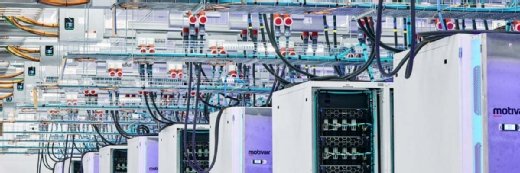
At the site, we saw “Chinese levels” of construction intensity and rapidity, where the first structural steel hit the frozen ground in January and the first live data hall will process workloads by July (cable trays and servers at Lake Mariner pictured above).
The metric that once governed datacentre site selection in the US – “no more than a two-hour drive from a football stadium” to guarantee access to fibre – has given way purely to the need for electrical headroom. And that’s why it is here.
Read more about datacentres and TeraWulf’s AI factory
- From rust belt to megawatt AI factory: We visited Terawulf’s Lake Ontario 750MW datacentre development. Photos and recordings weren’t permitted, so we took notes and wrote them up in more traditional ways.
- Do AI datacentre physics make on-premise unviable? Does massive GPU power draw and liquid cooling mean the end of the on-prem datacentre? We look at the AI factory revolution and find that a hybrid path for enterprises will likely still exist.
- GPU power draw will require grid partnerships: But water use will likely decrease. We look at energy as the key driver – and bottleneck – in development and why water use is less of an issue now datacentres aren’t like a VW Beetle.
Electricity the draw
This 1,800-acre plot on the isolated shores of Lake Ontario, formerly home to the Somerset coal-fired power station, is undergoing a seismic mutation – from defunct monument of the fossil-fuel era into a 1.2 million square foot AI factory.
The key asset here is not the land, but the raw copper and steel of the existing grid tie-in in the form of two independent 345kV import connections capable of pulling power from two separate utility providers. Where the old coal plant once generated 675MW and employed 270 people, TeraWulf’s development is scaling towards a final 750MW allocation.
The site also features an under-construction 125MW solar array, which, said a TeraWulf executive, exports electricity to the grid but which will likely come straight back for use in the datacentre.
From bitcoin to AI factory
The financial and physical scale of the transition demonstrates the step change we’re seeing as we move into the AI factory age. During the site’s initial tenure under Beowulf (from which TeraWulf was spawned), it was used for bitcoin mining. Design centred on low-grade, air-cooled halls and the cost was approximately $500,000 per megawatt.
Processing occurred in long, narrow halls where simple ventilation moved air across the servers and out the other side, with a required 1Gbit wide-area network (WAN) connection.
The Nvidia-dictated GPU roadmap changed the scale completely. With a capital expenditure of $10m per megawatt, the buildings have become squarer to compress the physical distance between processing clusters. The site – comprising five datacentre buildings – will eventually run around 100,000 GPUs and require terabit-scale WAN pipelines routed directly into the primary network arteries of Buffalo and New York City.
Direct-to-chip liquid cooling
That kind of GPU density creates unprecedented cooling and resource challenges. Direct-to-chip liquid cooling (DLC) is standard across all data halls to manage the immense thermal output of the processing cores.
Meanwhile, the initial closed-loop fill requires roughly 350,000 gallons of water per data hall – totalling nearly 1.4 million gallons across the current multi-building construction block, which equates roughly to the annual consumption of 10 American households. This will be drawn from the local municipal grid’s potable water supply, but will require minimal top-up through their lifetime.
Cooling of the warmed water will eventually require 175 Evapco condensing units – each the size of an oversized double-decker bus – to continuously vent heat into the air.
To achieve this scale, the pace of work is occurring at “Chinese levels” of construction intensity and rapidity, according to one on-site TeraWulf executive. It’s a purposeful and well-organised 24-hour industrial grind involving 1,600 workers on two shifts that drive a staggered, relentless three-to-four-week lag between successive halls to allow ongoing customer access to the colo facility.
Read more on Datacentre capacity planning
-
![]()
Datacentre dive: Through the looking glass at Telehouse South
By: Antony Adshead
-
![]()
Pure DC launches €7.5bn Finland AI datacentre campus
By: Antony Adshead
-
![]()
Telehouse completes fossil fuel-free datacentre retrofit as £251m West 2 build begins
By: Antony Adshead
-
![]()
Datacentre dive: Inside nLighten’s Bristol edge datacentre
By: Antony Adshead