North News & Pictures Ltd
Port of Tyne charts successful course with private 5G
One of the UK’s most dynamic and key deep-sea gateways reports strong operational gains after several years using private 5G across its 620-acre estate using sensor-driven processes

Following several years using a dedicated network, including support for a command system that drives remotely controlled machinery, the Port of Tyne is reporting strong operational gains after adopting private 5G using Ericsson technology running on a BT network.
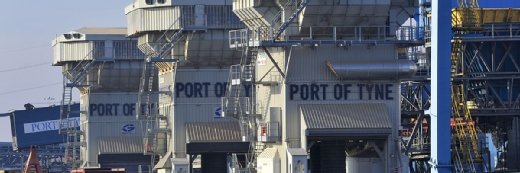
Based near Newcastle on the River Tyne in North East England, and comprising an area of 620 acres, the Port of Tyne is one of the UK’s major deep-sea ports, handling cargoes across five continents.
The port operates across both sides of the River Tyne, and depends on connected vehicles, machinery and video-driven processes to realise its efficiency gains. However, as it assessed its connectivity options, the port authorities found that traditional wireless technologies were not able to offer the reliability or scale needed for this environment, where cabling is costly and operational layouts change several times per year.
With its private 5G system in place, Ericsson says the port has been able to run mobility-led and safety-focused applications with greater confidence in performance. Across the site, the private network underpins real-time video analytics, sensor-driven processes and connected machinery.
The private network, which uses BT spectrum and Ericsson’s on-site core and radio infrastructure, has supported daily operations by providing consistent connectivity for real-time applications across a complex site that spans 620 acres and supports operations across more than 3km of berths including dock space for mooring vessels.
Over the past year, the network has supported a broad set of uses and has introduced new safety and efficiency tools, including live container scanning, personal protective equipment monitoring, restricted-area detection, road-condition analysis, emission monitoring, and high-security access control using video and sensors. Vehicle-mounted cameras, connected to an artificial intelligence engine, help teams identify road defects before they grow. Drones are used for stock control and infrastructure inspection.
The port is also working with Caterpillar to enable CatCommand remote-controlled shovels to minimise worker risk by reducing the need for workers to enter hazardous ship holds.
Read more about private networks
- Airbus climbs in industrial digitisation with private 5G deployment: Global aircraft manufacturer advances factory digitisation with private 5G connectivity at production sites supporting critical initiatives such as 3D simulation, augmented reality, improved traceability and predictive maintenance.
- Celanese looks to private 5G to transform manufacturing at the edge: Fully managed private 5G network designed to deliver what is claimed to be resilient connectivity to accelerate Industry 4.0 innovation.
- OPCSA terminal gains sharper edge with private 5G connectivity: Neutral host provider to design, deploy and operate a private 5G network at the Canary Islands’ largest container terminal, reducing costs associated with inefficiencies in the maintenance and monitoring of refrigerated containers.
- Private 5G market ‘nears mainstream’ with $5bn surge: Study finds private cellular networks based on 3GPP-defined 5G specifications are just on the cusp of becoming a mainstream technology, with a market potential exceeding that of established private LTE.
Leaders across the port organisation say the progress to date highlights how reliable connectivity transforms complex industrial operations and accelerates digital innovation. Going forward, the Port of Tyne will continue to expand its use of digital tools supported by high-performance wireless connectivity. The private network is helping the organisation strengthen safety, improve operational awareness and plan for future innovation.
“After a full year of operating on private 5G, we’ve seen firsthand how reliable wireless connectivity strengthens our day-to-day operations,” said Tamsin Warren, head of technology and transformation at the Port of Tyne. “From safety-critical activities to logistical environments, the network has given us consistent, real-time visibility across our whole site. It’s helping our teams to work more safely and make better decisions with the live data to move us forward to becoming one of the UK’s smartest and greenest ports.”
Brian Jackson, director of surveillance and smart solutions at BT, added: “Over the past year, Ericsson’s private 5G network has delivered the performance Port of Tyne needs in an environment that changes constantly. By combining BT spectrum with Ericsson’s dual 4G and 5G infrastructure, the port has a dependable platform for the technologies it relies on today, as well as those it plans to adopt in the future.”
“Port of Tyne is demonstrating how private 5G can support complex industrial operations that depend on mobility, safety and real-time visibility,” said Manish Tiwari, head of enterprise 5G at Ericsson.
“The results from the first year demonstrate what a wireless network with predictable low latency, strong security and support for high mobility can unlock – laying the groundwork for continued digital development across the port.”
Read more on Mobile networks
-
![]()
Port of Tyne advances connected mobility, autonomous logistics
By: Joe O’Halloran
-
![]()
Ericsson, Future Technologies scale wireless infrastructure for industrial AI
By: Joe O’Halloran
-
![]()
NTT Data, Ericsson team to scale private 5G, physical AI for enterprises
By: Joe O’Halloran
-
![]()
Firecell, CloudRAN.AI collaborate to cut cost and complexity of private 5G
By: Joe O’Halloran