Finnish quantum computing champion IQM determined to make ‘impossible’ engineering breakthrough
As US defence research agency Darpa starts a programme to upend the dominant quantum computing architecture it says will fail, the CEO of Finland’s IQM speaks to Computer Weekly about why his firm is aiming to succeed
The boss of Europe’s largest quantum computing firm says it is determined to make the engineering breakthroughs that superconducting quantum computers need to become capable of running the world-changing applications expected of them. This is despite US Advanced Defense Research Agency’s (Darpa’s) warning that the current architecture will fail to fulfil its promise.
Jan Goetz, CEO of Finnish quantum scale-up IQM, says in an interview with Computer Weekly that Darpa might be right to say the dominant quantum computing architecture cannot scale using current technology. However, he adds, engineering breakthroughs can and will happen to prove that the US agency is wrong to say that it will fail.
Goetz speaks to Computer Weekly while making preparations to list on a US stock exchange, which involves raising roughly €300m to fund research and development, and to acquire other companies to get technologies that make those engineering breakthroughs.
The high cost of quantum computation is one of the problems IQM needs to solve, says Goetz in answer to Darpa’s prediction. That would make it feasible to scale the computational capacity of its system to a size where it might have utility, running applications from which industry can derive greater value than their cost of computation – the very thing that Darpa says cannot be done.
The size of the challenge is apparent in the technology roadmaps of IQM and others trying to build utility scale quantum computers – such as IBM, which is using the same superconducting technology as IQM; and Pasqal, the French champion that plans to raise money from US investors this summer with its own stock exchange listing.
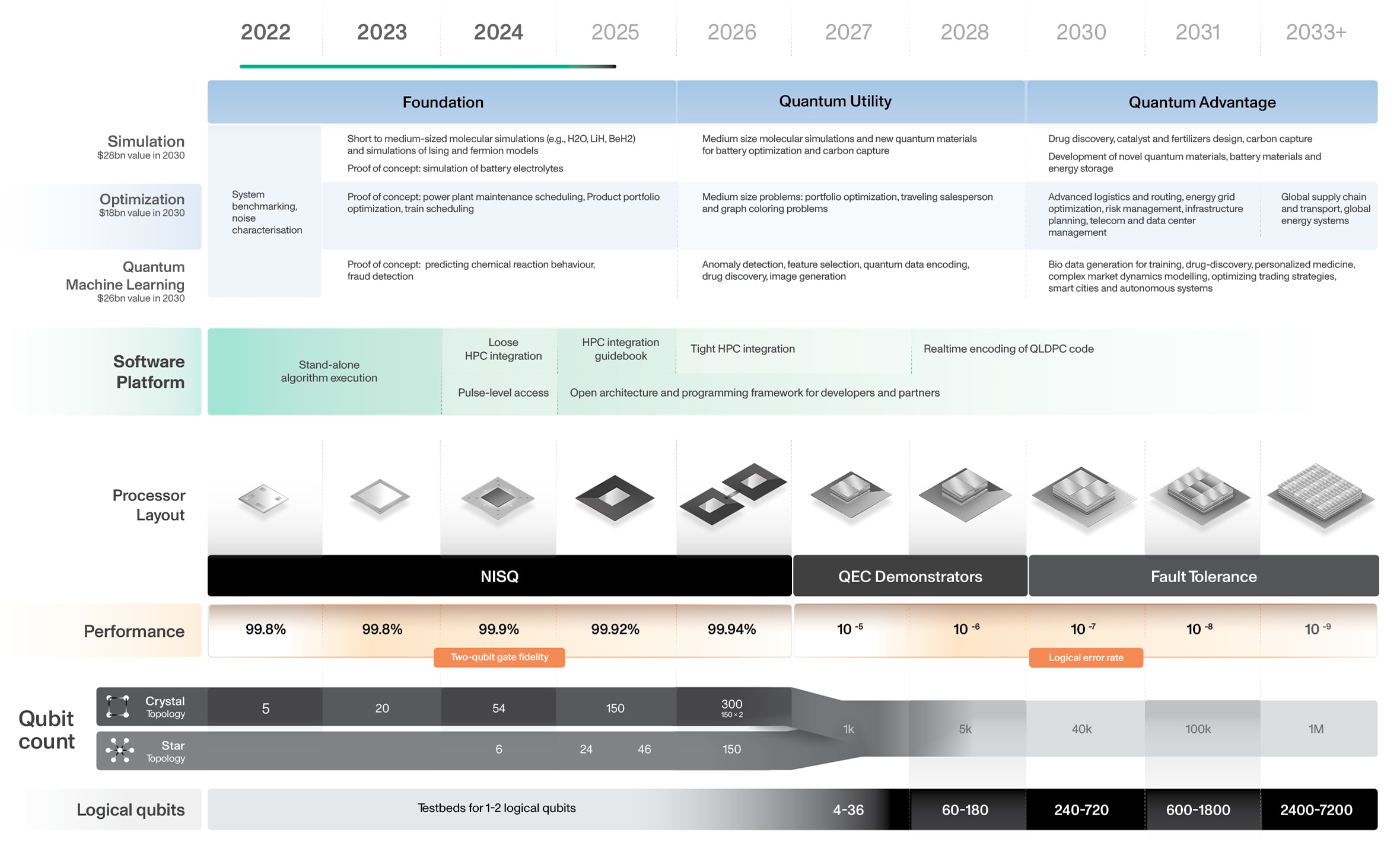
With the error rate of quantum computers being inherently high, and the difficulty of building systems capable of handling quantum bits (roughly comparable to binary bits) at scale, their roadmaps number in ones and twos – if any at all – the logical qubits they can derive from systems made from physical qubits numbering in the hundreds. They aspire typically by 2030 for the ratio to be hundreds from tens of thousands, and promise utility-scale vaguely – with a small few thousand from hundreds of thousands – after 2033.
But that is simply not possible with today’s technology, says Goetz: “If we scale now from hundreds of qubits to thousands or millions, this cannot scale linear like the price. We need to find more cost-efficient ways of doing this. But this is possible.”
“We want to build quantum computers that ultimately reach millions or more qubits,” he says. “We will need to change some of the approaches. For example, the cabling. We will not scale by having millions of microwave cables in a single system. It just doesn’t work.
“We need alternative technology. There are ways to completely reduce those cables and bring them into the silicon. There’s huge potential to reduce cost on the electronics and on many other aspects.”
Similarly, IQM’s systems house their physical qubits on a single tile. That cannot scale because it involves implausibly complex engineering and an accumulation of errors. So, IQM aims to build smaller tiles and pretest them before stitching them together.
IQM will invest “a lot” in advanced processor packaging and connectivity to solve these problems, says Goetz. Ultimately, it promises to build an architecture in which the ratio of physical to logical qubits is a tenth smaller.
Darpa HARQ programme ‘highly speculative’
Yet the inability of this roadmap – and others – to achieve its aims was the premise of a programme that Darpa began in February as IQM announced its bid to raise money to fund it.
All the major quantum computing firms are working to build systems that will prove by 2033 to be either “prohibitively expensive to build or prohibitively expensive to run” the applications industry expects of them, Darpa concluded.
This opinion was gathered after 12 months of Darpa working with 18 of the world’s leading QC firms under its Quantum Benchmarking Initiative (QBI). The programme aimed to determine if any could achieve utility-scale computing within the decade.
It concluded they could not, because they were all trying to scale systems using a single type of atomic-scale particle – a single modality of qubit, such as superconducting – for all functions needed in a computing circuit: processing, memory and communications. Yet each modality was suitable typically for only one. The modular methods QC firms were developing to overcome their scaling problems would moreover fail.
Darpa’s Heterogeneous Architectures for Quantum (HARQ) programme proposed developing a quantum computing circuit in which the different qubit modalities that QC firms are using to build homogeneous systems are instead employed solely for the specialist functions to which they are suited, creating an architecture akin to semiconductor computing circuits.
What happens maybe 10 years from now is a completely different question. This is the question the Darpa programme addresses
Jan Goetz, IQM
On 10 March, Darpa extended its QBI in search of architectures more novel than the major firms had developed, in the hope of finding one that might succeed. Darpa says it was in a hurry to get results from HARQ within two years – soon enough to stop QC firms investing so much money and R&D into homogeneous architectures before it became too late for them to change course.
Goetz insists Darpa’s heterogeneous architecture is a great vision but not one that has any practical use for industry in the near or midterm. “It’s about timelines, what you can do today and what is the long-term vision. What happens maybe 10 years from now is a completely different question. This is the question the Darpa programme addresses,” he says.
The HARQ architecture is “highly speculative”, says Goetz, because there is no quantum memory today suitable for integrating to create a QC circuit. Even if someone does develop a quantum memory, technical challenges will hinder its integration because, being a different modality, its physical qubits will operate at a different frequency. It could be integrated only if it becomes possible to convert frequencies between modalities without destroying their fragile quantum states, introducing more costly errors.
A universal frequency converter, likened to USB for atomic states, is a HARQ priority. The engineering challenge is so great that the programme aims to determine if it is even possible to create a heterogeneous quantum computing circuit at all, and then if it is any more feasible than the homogeneous architectures being pursued by the likes of IBM and IQM.
“We are very pragmatic. We want to start from something that works,” says Goetz. “We are building a business today and we are selling quantum computers that are functional today, that we can ship and deliver to customers today.”
Quantum computers today are simply processors, and what works today is to integrate them with high-performance computers (HPCs), which provide those functions such as memory that the QC lacks, says Goetz.
Deepening that quantum-classical integration – which is an aim common to other QC roadmaps – is a necessary first step toward utility-scale computing, says Goetz. HARQ might bring subsequent steps, further down the road, should it prove viable. IQM was monitoring the market for companies with technologies suitable for integrating into a QC circuit that it might acquire. But its priority now is scaling superconducting processing power, integrating with classical HPC GPUs and CPUs, and developing a software stack that makes it easy for developers to build quantum applications.
How are IQM’s rivals moving?
HPC integration is also prominent on IBM’s quantum computing roadmap and for the same reasons, according to Alessandro Curioni, head of IBM Research Europe.
It aims to demonstrate quantum advantage – the ability of QCs to compute more effectively something that an HPC might have done alone – this year, says Curioni. That and HPC were two necessary steps on the road to quantum utility.
“I’m not saying the architecture we have is the one that will prevail 20 years from now,” says Curioni in answer to the HARQ analysis. “But it is the one that will bring quantum advantage this year and will be able to get the first full tolerant quantum computing in 2030. The superconductive one, integrated with classical, is going to be the first and it’s going to set the benchmark.
“If by 2030 – with the convergence of classical and quantum, and with a more tolerant qubit architecture – if by that time we are not able to make a difference in a transformational way, there will not be a future for quantum,” he says.
Contending with IBM and Google’s massive budgets may not be the best path for European quantum computing manufacturers
Charles Foley, memQ
IBM expects to solve the engineering problems of scaling superconducting qubits by 2029, says Curioni. It chose that modality a decade ago after determining that it was the one most suited to general-purpose quantum computing, because it could scale with few errors and integrate effectively with HPCs. IBM pledged last year to invest $30bn in mainframe and quantum computing to that end by 2029.
Darpa found that of six modalities from which different QC firms build their systems, only superconducting qubits were particularly suitable for quantum processing. But they were unsuitable for either memory or communications. It used the Blue Jay quantum processing chip, which IBM has promised will deliver utility-scale computing after 2033, to exemplify the homogeneous, modular architecture it said will fail.
Which qubit modalities can be integrated into a heterogeneous architecture at all is another question HARQ aims to answer. It reckoned that of the other qubit modalities that different quantum computing firms are using to build homogeneous systems, none is at all suited for the purpose.
Pasqal, rival to IQM’s title of largest European quantum computing firm, which will be competing with the Finnish firm for US public investors this summer as well, is building computers from neutral atoms – a modality Darpa says is somewhat suitable for quantum memory and of questionable facility for either communications or processing.
Pasqal promotes neutral atoms as the modality with the lowest cost-per-qubit, and one that has no need of the complex cabling and packaging of superconducting qubits. Pasqal CEO Wasiq Bokhari says in a written statement that neutral-atom systems were one of the most promising approaches for fault-tolerant computing. It will demonstrate quantum advantage this year, he says. Pasqal’s roadmap aspires to utility by 2029.
“There are technological risks in reaching maximum qubit levels using the very expensive monolithic designs of players such as IBM and Google,” says Charles Foley, executive chairman of memQ, a US quantum networking company waiting to hear if the proposal it submitted to HARQ won it a place on the programme.
“But they have the money to push through and try to make it work. Contending with IBM and Google’s massive budgets may not be the best path for European quantum computing manufacturers,” he says, repeating Darpa’s assertion that a heterogeneous architecture would both more feasible and more powerful.
Since the article was written, Darpa has announced the official launch of HARQ and admitted 15 companies and universities onto the programme, including memQ.