Viva la devolution – rebalancing power through technology
A note for Andy Burnham - on how digital operating models and infrastructure can improve UK devolution and strengthen democratic accountability
By
James Findlay & Jerry Fishenden
Published: 20 Jul 2026
Andy Burnham has promised to deliver the "biggest rebalancing of power our country has seen" as our new prime minister, with power taken away from Westminster and redistributed to all parts of the UK. This could herald the most significant act of devolution since the creation of the Scottish Parliament, Welsh Parliament, and Northern Ireland Assembly in the late 1990s.
Although those changes helped bring power closer to people in some parts of the UK, they’ve also provoked endless debates about a so-called “postcode lottery”, where the quality, funding, and availability of services varies by geographic location, along with the seemingly eternal “West Lothian question” - where non-English constituency MPs still vote on England-only matters.
Added to this is the growing phenomenon of regulatory friction - the compliance costs for businesses and citizens navigating different rules depending on where they happen to operate or live.
Before rushing into another programme of major constitutional reform, the government should pause to assess where the current settlement is working well, where it falls short, and how it can be improved.
This should include making time to consider the transformative impact of technology, a topic that remains surprisingly absent from devolution debates.
Yet digital technologies and practices are a gamechanger in terms of improving how organisations work. They create new options for devolution that were simply unavailable when the current model was developed in the last century - options that can help to strengthen democratic accountability while reducing duplication and lowering costs.
Rather than simply viewing devolution as a question of redistributing power, policymakers should take the opportunity to rethink the design of our public institutions, combining the benefits of local decision-making with the efficiencies of shared digital capabilities.
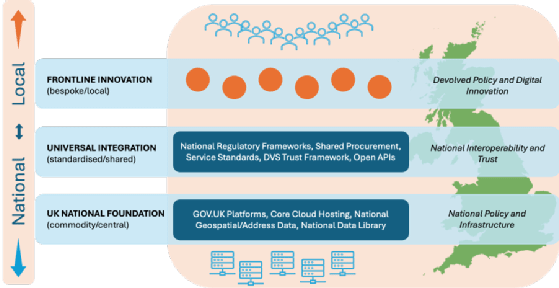
Techniques such as value-chain and Wardley mapping, for example, can identify where it’s best to share governance and technical infrastructure at a UK-wide level and where it’s better for devolved authorities to innovate using their unique local context and accountability.
Mapping a new consensus on devolution, from national to local
Common standards and infrastructure, decentralised innovation
The government can use this work to improve devolution by committing to:
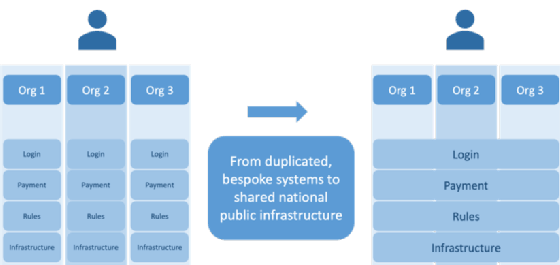
A national digital infrastructure: extend and adopt Gov.uk and other successful platforms, such as Notify and Pay, as foundational national public infrastructure across the UK, using regional and local white labelling where desired. A UK-wide approach to digital identity - building on the success of the Digital Verification Services (DVS) trust framework - could identify and authenticate users regardless of whether they're accessing reserved or devolved services, reducing the need for multiple logins and accounts, lowering costs, and improving the user experience.
A secure data access and exchange layer: draw on the experiences of systems such as Estonia’s X-Road and the UK government’s own former secure digital backbone. Estonia achieves near-100% digital public services via decentralised databases - each organisation controls its own data - linked by a secure, logged interoperability layer. Citizens update information once, such as their address, and it propagates with consent and audit trails. Importantly, citizens can also hold officials to account for the use or misuse of their data. A UK version would securely connect central government, devolved administrations, local authorities, and NHS systems while respecting devolved data sovereignty and privacy legislation and rules. It would deliver streamlined cross-tier services, such as health records and benefits, and policy insights without the drawbacks of overly centralised or overly siloed systems.
Shared cloud services: expand the use of standardised, commodity shared services - cloud services for the likes of HR, finance, payroll - across all public sector bodies, fixing the failures of the current broken approach, and pool procurement to secure economies of scale and reduce costs and vendor lock-in.
Open standards, APIs, and the National Data Library: mandate open standards, APIs (interfaces), and the National Data Library for reusable, high-quality data. This will provide "once-only" acquisition and re-use, with safeguards and resilience, and reduce today’s currently endlessly repeated data collection, helping remove the need for most of the 10,000-plus online forms that pointlessly replicate their paper predecessors. Artificial intelligence (AI) and other digital tools can help analyse government-held data to improve policymaking and resource allocation whilst ensuring rigorous, and transparent, performance and ethical safeguards.
The decision to abolish NHS England demonstrates that the government already recognises the need for significant structural improvements in the public sector to reduce duplication, strengthen democratic accountability, and improve effectiveness and efficiency. It should review the outcome of this major change - what works and what doesn’t - to inform decisions about similar structural improvements elsewhere.
Useful insights can also be gained from work that’s already taken place to rationalise how local government operates, such as the Greater Manchester Combined Authority, which has shown benefits from consolidated technology estates and the better use of data. However, in other areas, such as the failed tri-borough experiment in London, the results have proved less convincing.
Steve Reed, the secretary of state for housing, communities and local government, has also recently confirmed the biggest reorganisation of English local authorities in half a century, with 134 councils streamlined into 38 unitary authorities. Reed says reorganisation will leave councils “ready for devolution”. Whether it leaves them ready in digital terms is another question. And this move to overhaul local government has previously been reported to cost as much as £1.5bn, raising questions about how “machinery of government” changes are being planned and designed at both a political and technological level. The transition support announced, of just over £1m per new unitary authority, is a fraction of what it will cost to converge the systems, processes, contracts, and data estates of the hundreds of councils being abolished, as previous unitarisations in Buckinghamshire, Cumbria, and North Yorkshire showed.
A new phase of devolution is an ideal opportunity for the government to better integrate policymaking and digital expertise to improve how the public sector plans and operates
The reorganisation announced by Reed gives new councils barely a year post-election to merge by April 2028. This ambitious timing is another reason why it makes sense to capitalise on the adoption of common platforms and shared infrastructure and services, instead of the new bodies each specifying, procuring, or building their own local solutions yet again - which would be a once-in-50-years design opportunity missed.
An increase in devolution will be judged a success only if it supports more effective, evidence-based policymaking; boosts economic growth and prosperity; streamlines and reduces the duplication of organisations, processes, systems, resources, and costs; lowers the administrative burden ("time tax") on citizens and businesses; frees up more resources for frontline services; and, most importantly, restores public trust.
However, if it becomes just another headline-grabbing political soundbite that ends up rearranging bureaucratic deck chairs while consuming ever more precious resources, it will further undermine the entire concept.
A digital-era operating model
A new phase of devolution is an ideal opportunity for the government to better integrate policymaking and digital expertise to improve how the public sector plans and operates. Among the alternative options it should consider are:
Digital bill tagging and gated voting: bills and statutory instruments could be classified by territorial or “community-of-interest” scope based on content, metadata, and impact assessments. A secure parliamentary platform could help to assign and authorise appropriate voting rights, with hybrid and remote digital voting making it cheaper and seamless – for example, all MPs engaged on UK-wide matters; only English MPs vote on England-only matters (addressing the “West Lothian question”); Scottish MPs on Scottish-only matters. This would create a well-mapped "soft" democratic separation of place-based powers without the need for additional physical institutions and all their related overheads
Virtual/hybrid devolved chambers: Scottish, Welsh, Northern Irish, English, London or any other agreed constitutional grouping of MPs – such as “the North of England”, “Island Communities”, “Rural Communities”, “Cities” - could convene in dedicated digital sessions or virtual chambers for devolved legislation, scrutiny, and committees. Advanced tools would support real-time transcription and summarisation, secure collaboration, translation if/when needed, and automatic release in real-time onto public websites for transparency and accountability. This would reduce the need for separate physical parliamentary estates long-term while preserving the essential democratic focus on devolved issues. MPs could still choose to sit in an appropriate geographical physical assembly building as and when required - Edinburgh, Cardiff, Belfast, London, etc - to ensure they’re routinely accessible, visible, and accountable to their electorate. But one benefit of a virtual/hybrid approach is that devolution need no longer be defined or limited purely by place or geography
Single election layer with commodity digital support: a constituency MP would handle both reserved and devolved matters, removing the need for separate elections for separate assemblies with all their added costs, bureaucracies, complexity, and potential voter fatigue alongside blurred lines of democratic responsibility and accountability. Better technology would help MPs manage their workloads, including tailored policy research, constituency casework, and impact modelling
Broader efficiencies: shared parliamentary digital infrastructure - communications and collaboration, document management, Hansard-style systems, petition platforms - would support work across all levels, with common digital repositories/libraries for transparent funding transfers and budgeting, and improved digital participation tools for consultations and scrutiny that work within and across tiers
Separate legislatures incur additional costs without necessarily improving democratic accountability or delivering better outcomes. They consume over £350m a year in direct costs plus substantial hidden costs in terms of their duplicated resources, systems, and corporate functions - money that could instead be flowing into improved frontline services or reducing the administrative burden.
An improved devolutionary settlement, however, provides the opportunity to deliver the upside of enhanced democratic representation and accountability while also yielding major efficiencies.
Some challenges to consider
The political desire to find a better approach already exists, with the secretary of state Reed commenting that, “We won’t achieve effective devolution … with outdated and misaligned structures that slow down delivery, fragmenting public services [and] slowing down important decision making.”
However, improving the UK’s devolutionary model is a major undertaking and will require a cross-party, cross-UK consensus on how best to make it happen. Among the issues to consider are:
Political and constitutional buy-in: some politicians and voters may value distinct institutions regardless of their cost and impact on the public purse; integration must preserve autonomy and not feel like recentralisation while also delivering better value for money. Any changes should be supported by legislation and consent.
Privacy, security, and trust: robust safeguards, audit logs, and devolved control over data are essential. This should include defining what “digital sovereignty” means not only at the UK level but also in the context of devolved powers and responsibilities. UK cyber security and resilience, for example, must never be diluted by the creation or adoption of lower standards within any constituent part of the UK.
Asymmetry: England’s fragmented local devolution, with mayors, combined authorities, local authorities - 32 boroughs in London alone despite the existence of the Greater London Authority - and the lack of an English assembly, also needs revisiting, as the recent government announcements in part acknowledge, to improve accountability and reduce duplication, benefitting from the use of common capabilities and platforms.
Implementation: start with well-scoped trials - such as secure data access or DVS-accredited digital identity in specific policy areas - in a real-life environment with real people involved, built on cloud-based platforms and other common infrastructure, and use intergovernmental agreements for devolved participation, using an incremental test, learn, and grow approach.
Conclusion
More devolution could be a good thing for the UK, but only if it’s designed to avoid increased fragmentation, duplicated direct costs and overheads, and a growing administrative burden.
Creating yet more layers of bureaucracy on top of an already complex system could, however, have the very opposite impact - further alienating an already cynical public and directing more precious resources away from where they’re most needed and can have the most beneficial impact.
A better devolution settlement can build on what already works while also fitting the UK’s unique constitutional structure. It can make democratic governance more effective, responsive, and cost-efficient without sacrificing local autonomy and innovation, strengthening both local power and UK cohesion.
Designing, agreeing, and implementing a better approach will require cross-party and intergovernmental collaboration. The good news is that recent digital strategies already point us in a better direction.
By accelerating and extending this work, the government has a perfect opportunity to deliver a democratic digital devolution, with substantial benefits to citizens, businesses, and politicians alike.
James Findlay is a former CTO/CIO in the UK government. He is the author of the Isle of Wight Living Lab proposal, which advocates for the island's designation as a Special Policy Zone for cross-departmental government trials.