Datacentre dive: Through the looking glass at Telehouse South
We visit London’s Docklands datacentre cluster, where former docks now house windowless, aluminium-clad monoliths and Telehouse South is Thames-side fortress of edge connectivity

I cross the road on a concrete footbridge, the multi-lane A1261 rumbling beneath. Ahead, men in the “uniform” of contemporary IT staff trudge to their afternoon shift, tidy-but-boring shirt and trousers, and a rucksack that lets the side down as it slumps off both shoulders.
On the far side, the herb streets announce themselves – Coriander Avenue, Nutmeg Lane, Oregano Drive – a faintly ridiculous grid of suburban-sounding thoroughfares in this nexus of modern industry.
Where goods transit sheds once lined the East India Dock, datacentres now rise: grey, aluminium-clad, multi-storey blocks whose roofs and facades are shrouded in baffles to dampen the noise from cooling equipment behind.
The Global Switch building catches the eye with its giant on-off symbol facade – a piece of architectural semaphore that signals what happens inside. I stop to take a photograph. A security guard approaches before I’ve framed my pic.
“Where are you from?” he asks. I tell him. “Who are you taking pictures for?” Computer Weekly, I say. He tells me I can’t photograph here and I put the phone away. It looks just like a public street, but apparently it isn’t. In this cluster of buildings – perhaps 32 acres in total – looking too closely triggers a response.
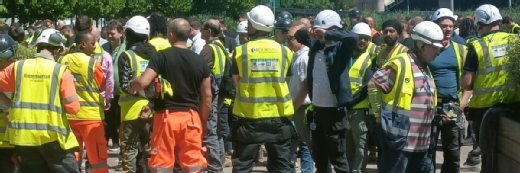
Some old dock walls are still here, the dock itself now a feature lake – a rectangle of still water that once heaved with shipping. Beside it the sudden manifestation of massed construction workers (pictured) suggests solidarity of labour, but it’s probably just a fire alarm.
The focus of our visit is half a mile away, on the other side of the A1261 and closer to the Thames: Telehouse South. The herb street cluster feels like a pleasant piazza that happens to house London’s internet aorta. But then we didn’t try to enter anything there. The entrance to Telehouse South shows us what that might be like.
Foolproof layers of security
At the gate, the scale becomes inhuman; cleansed of unwanted or unnecessary activity, with double barriers, tight-wire fences, electric doors, cameras and pre-fabricated walls rising high. You can just about glimpse cooling units silhouetted against the sky. We wait at the gatehouse as security staff take fingerprints and check photo ID, the whole transaction hampered by double-thickness soundproofed glass and reflections from bright June reflections that make it hard to relate to the faces on the other side.
There are five of us in the party. Almost all fail some of our attempts to negotiate the RFID card, fingerprint and face-recognition entry dance. Eventually, at least 30 minutes after arriving at the perimeter, we get through the first skin and go to meet our guide.
Julian Hennessey is projects director for development and construction at Telehouse, and Telehouse South – the building we stand in – is, he tells us, “one of my babies from the beginning”. He has designed and built all its phases.
The building has a curious provenance. Originally designed by Richard Rogers – the architect behind the Pompidou Centre and the Millennium Dome – it was conceived with a modular facade that allowed any floor to be either datacentre or office simply by swapping aluminium-clad panels for glazing. Thomson Reuters occupied it as a mixed-use facility: three floors of trading desks above data halls that delivered a PUE of 1.74. When Telehouse acquired the building in 2020, the sitting tenant remained until 2021. Then the work began.
What Telehouse has done to the building is less a refurbishment than reinvention. Every gas-fired boiler and water heater was removed and taken off-site, and the building now heats itself entirely from waste heat recovered from the data halls. The roof has been replaced and its insulation thickened. The external facade is new. The glazing on level eight is new. All electrical and mechanical infrastructure – from the perimeter of the building to the customer rack – is new.
“We’ve given the building a new lease of life,” says Hennessey. “The building’s bones are the same but the infrastructure is completely new.”
CRAC out; CRAH in
We walk the data halls. The lighting is cool and even the air moves with a steady, low-pressure hum. Cold-aisle containment channels chill air under a raised floor and up through customer racks, where it picks up heat and returns to computer room air handling units – CRAHs, as the acronym goes – before being pumped to the roof for heat rejection. The CRAH units, all brand new, contain only water: closed-loop chilled, no adiabatic consumption.
“It’s filled once, it’s maintained once a year, it doesn’t constantly use water,” says Hennessey. “It’s like your heating system at home – you fill it once and it just works.”
On each rack, an Ekkosense display glows to show rack temperature. Engineers adjust floor dampers in response, tuning the environment rack by rack.
The customers in here are a spectrum. Some occupy shared facilities management – racks in an open aisle, secured by locks and monitored by CCTV, trusted to the building’s five layers of perimeter and biometric security. Others require dedicated facilities management: their own cages, their own additional biometric locks, their own modesty panels.
One cage is completely blacked out. No visibility through the grille, not even a gap large enough for a USB stick to pass through. Four layers of security on the cage itself, that adds to the five to get to the floor.
Inside, Hennessey tells us, equipment labels indicate what those servers support – information the customer does not want anyone, even Telehouse’s vetted staff, to see. “The only way we can get in is if there’s an emergency and maintenance staff need to get in,” he says. “But then it needs to be written down who went into it.”
Then there are the quarter-racks – a few units of shared space sold at a quarter of the price of a full footprint, aimed at smaller operations that need an edge presence in London. A business might have its main equipment in another country and deploy a single edge router here, buying access to more than 1,000 connectivity partners and the same power and cooling resilience as the largest tenants. “I think that’s the coolest thing we do,” says Hennessey.
Wrapped in polythene
We take the lift to the roof. The lift is still wrapped in protective plastic, like the film they put on new cars, to guard against scratches while construction continues on the unfinished floors below.
Up here, old and new cooling regimes sit side by side. The old coolers are disconnected, pipework severed. Hennessey gestures towards them. On a mild day like this, he says, they would have sounded “like a helicopter taking off”.
Their replacements – rows of new Trane chillers – are purring quietly behind sound attenuation panels mounted on rails, designed to slide aside for maintenance. These units deliver free cooling by ambient air for roughly 78% of the year, which is what helps drive the building’s PUE down from 1.74 to 1.27.
Between the chiller rows stand buffer vessels – giant insulated tanks that hold chilled water at supply temperature, ready to ride through a power outage while the generators start. The generators themselves, 12MW of new capacity at N+1 redundancy, sit below – kept, says Hennessey, “almost like prize stallions out there waiting”.
The view from the roof is panoramic. Below us on the south side, the Thames curves past the Isle of Dogs toward North Greenwich, where the domed roof of the O2 dominates. Further is the green mound of Crystal Palace Park with its transmitter aerial on top. To the north, the rest of the Telehouse Docklands campus unfolds: the copper-coloured Telehouse Central administration building, the West and East facilities, the original North building – the one that opened in 1988 and now hosts more than 1,000 connectivity partners – and North 2 with its blue columns. And on a plot of land just beyond, the foundations of West 2 are being laid.
Old satellite dishes still crown the roof here at Telehouse South – relics of Reuters TV, which once broadcast from here. They no longer function. “No scrap value,” says Hennessey. But they serve an incidental purpose. Their height defines the building envelope for planning; a fixed point against which all new equipment – the acoustic packs on the chillers, the attenuation panels – must be measured.
Next to the A1261 the futuristic 1960s ventilation shaft from the Blackwall Tunnel rises, Grade II protected. Telehouse had to consult on that, too.
Blitz target
Telehouse South sits on what was once Blackwall Yard, the site of two graving docks where ships were floated in, gates closed, water pumped out, and hulls exposed for cleaning and repair. During the Blitz, the East India Dock and its surrounding Poplar streets were prime Luftwaffe targets – the warehouses and goods sheds that occupied this land were as concentrated and vital to Britain’s wartime supply chain as the datacentres are to its digital economy today.
We go down the caged steel staircases and walkways beloved of shootout-and-chase-scene movie-makers and back into the building. Past data halls, past aisle cages under construction and fibre routes being pulled, past the breakout spaces with subdued lighting and meeting rooms.
This is not a hyperscale AI factory. At 2.7MW per floor, it does not pretend to be. But it does not need to be. The value here is not in compute density, but in connection density – in the dark fibre routes that link every customer on the Docklands campus to every other, in the submarine cables that land in Cornwall and break out here, in the 900 networks that converge through Linx exchanges housed in these buildings, in the financial services and streaming platforms and emergency services infrastructure that depend on microsecond latencies across a few hundred metres of fibre.
Back at ground level, we pass through the exit gates and step out onto the public road. A final glance back: the grey facade, the rooftop baffles, the tight-wire fence, the electric gates.
Read more datacentre dives
- Datacentre dive: Inside nLighten’s Bristol edge datacentre: We visited nLighten’s BRS1 datacentre, and travel from gritty city centre fringe to a high-tech overhaul that makes the case for reusing legacy infrastructure over new construction.
- Datacentre dive: From rust belt to megawatt AI factory: We visited Terawulf’s Lake Ontario 750MW datacentre development. Photos and recordings weren’t allowed, so we took notes and wrote them up in more traditional ways.
Read more on Datacentre backup power and power distribution
-
![]()
MPs heard Manchester is better than FDP. It seems they were misled
By: Tom Bartlett
-
![]()
Telehouse completes fossil fuel-free datacentre retrofit as £251m West 2 build begins
By: Antony Adshead
-
![]()
Datacentre dive: Inside nLighten’s Bristol edge datacentre
By: Antony Adshead
-
![]()
Blackbox replaces two racks of HPE storage with 8U of Everpure
By: Antony Adshead