sdecoret - stock.adobe.com
The CERN laboratory and the Big Bang theory – Essential Guide
We answer 10 frequently asked questions about the CERN laboratory and Big Bang theory

1. What is the CERN physics laboratory and what does it do?
CERN, the European Organization for Nuclear Research, is a particle physics laboratory based in Geneva, Switzerland.
A huge innovator and user of technology, the lab was designed primarily to provide the particle accelerators and infrastructure needed for high-energy physics research.
In total, CERN operates a network of six particle accelerators and a decelerator.
CERN is funded by 20 European member states, and is currently the workplace of 2600 full-time employees, as well as around 8,000 scientists and engineers.
2. When was CERN set up, and what have been its achievements?
Founded in 1954, CERN has a distinguished scientific pedigree. It has been home to three Nobel laureates, and it is the place where computer scientist Tim Berners-Lee invented the World Wide Web in 1989.
The scientific achievements at CERN have been profound for the scientific community, although the layperson may not recognise their significance.
They include: the discovery of neutral currents in the Gargamelle bubble chamber, in 1973; the 1983 discovery of W and Z bosons; and the determination of the number of neutrino families, in 1989.
3. How did CERN help to create the web?
In 1980, while working at CERN, Tim Berners-Lee wrote a program for storing information using random associations, which he called Enquire.
This formed the conceptual basis for the global hypertext project which Berners-Lee proposed in 1989, to be known as the World Wide Web.
WorldWideWeb was also the name of the hypertext browser that Berners-Lee created, along with the initial specifications of URIs, HTTP and HTML.
4. What is CERN's Large Hadron Collider (LHC) particle accelerator?
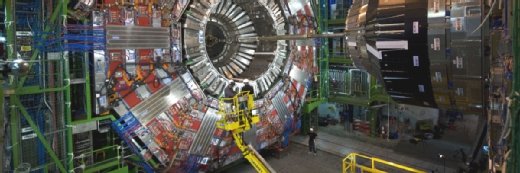
CERN is the home of the Large Hadron Collider (LHC), an enormous particle accelerator that smashes particles into each other at extremely high speeds.
As a result, the scientists can learn insights into the nature of matter and the universe itself.
The LHC has taken six and a half years to build, at a cost of £4.75bn. Located 100 metres underground, in the region between the Geneva Airport and the nearby Jura mountains, the LCH uses a 27km long circular tunnel.
5. What is the point of the Large Hadron Collider?
The point of the collider is to monitor collisions between particles, and gather and analyse the data to learn about the nature of matter.
From an IT perspective, CERN's major challenge has been to put in place the technology to collect, store and analyse the data, and share it with the world.
6. What is CERN's Big Bang project?
As of August 2008, the world's biggest particle accelerator, the Large Hadron Collider (LHC), will begin hurling subatomic particles, called protons, around a 27km circular tunnel running beneath the Swiss-French border, before crashing them into each other.
By recreating the universe's Big Bang, particle physicists hope to learn more about the physical universe.
For example, scientists believe they will learn more about the actual mass of particles, and about the nature of dark matter, and whether there are 26 dimensions, or just 12.
The 'Big Bang' project is an international initiative that will involve more than 2,000 physicists from 150 research institutions in more than 30 countries.
7. CERN's Big Bang project uses grid computing to crunch the data, but how big is the grid?
The IT department at CERN is creating the world's largest computing grid - known as the LHC Computing Grid - for the Big Bang project.
The LHC Computing Grid (LCG) went live in June 2008, pooling the processing power of around 100,000 CPUs worldwide.
It will process information at a rate of 1gbps, to cope with the massive outpouring of data that will come from the LHC particle accelerator.
8. What sort of network does CERN use to share its data with the world?
As well as pioneering grid computing, CERN is also paving the way for large-scale intercontinental networking with a 10Gigabit wide area network (WAN).
9. What are the database technologies CERN is working on?
CERN has extended database-clustering technology to enable a single database to run across a number of distributed computers.
The LCG database deployment project has set up a worldwide distributed database infrastructure for the LHC.
It will do this using a program called Oracle Streams to capture, filter and synchronise data stores worldwide.
As well as working with Oracle, IBM also worked with CERN to build a massive Linux-based storage system supplying many terrabytes of disk storage.
10. How can other sectors, such as finance and banking, benefit from all these technologies?
Grid computing is already being used by Google and Amazon, as well as banks like HSBC. It will have more applications in the financial sector as processing demand grows, predicts analyst firm Gartner.
Analysts have said financial firms will deal with gigabytes of data per second within the next five years. So the sorts of grid processing, networking and storage technologies that CERN is pioneering will soon become relevant to many technology users.
Read more about the CERN laboratory
- For information on other CERN innovations, see: Virtualisation to the fore at CERN phase two.
- Reporting live from CERN in Switzerland day 1 part 1 (Networx Generation).
- Reporting live from CERN in Switzerland day 1 part 2 (Networx Generation).
- Reporting live from CERN in Switzerland day 2 part 1 (Networx Generation).
- Reporting live from CERN in Switzerland day 2 part 2 (Networx Generation).
- CERN: bringer of the apocalypse or hit factory?.
Read more on Database software
-
![]()
Interview: Data processing for particle physics at Cern
By: Cliff Saran
-
![]()
SURF glides to 800Gbps transmission on existing fibre through Nokia
By: Joe O’Halloran
-
![]()
Developed for Big Science in Europe, highly accurate time protocols ensure fair trading in finance
By: Pat Brans
-
![]()
Containerisation in the enterprise - Open Infrastructure Foundation: The flavours of containers
By: Adrian Bridgwater