


Recent Blog Posts
-
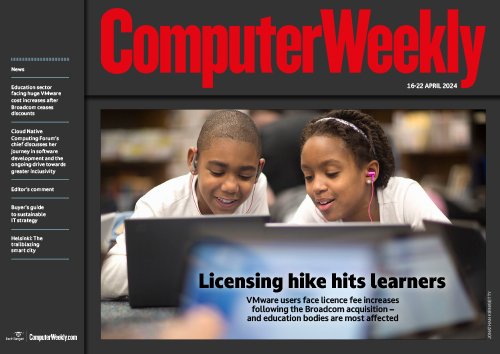 In The Current Issue:
- Education sector facing huge VMware cost increases after Broadcom ends discounts
- Helsinki: The trailblazing smart city

CW Developer Network
NTT SVP: Optimising 'deployment architectures' for hybrid cloud & edge-apps
19 Apr 2024This is a guest post for the Computer Weekly Developer Network written in full by Rishi Kulkarni in his capacity as SVP cloud services division at NTT Data. In the modern landscape of software ...

Write side up - by Freeform Dynamics
Taking the next step in mainframe observability
Freeform Dynamics 18 Apr 2024Despite their frequently less visible role, mainframes remain indispensable in supporting the critical operations of many large organisations. With technology advancements over recent years, ...
-
Appian World was held this year at the Gaylord Inner Harbor resort in Washington DC from 15-17 April 2024. Starting off proceedings this year as always was Appian CEO Matt Calkins. With more than ...

Write side up - by Freeform Dynamics
The mainframe skills crunch; an outsider vs insider perspective
Freeform Dynamics 16 Apr 2024During my career, I’ve worked hands-on with a great many operating systems, programming languages, mainstream database engines and countless generations of different hardware and application ...
-
Accessibility matters. When users first say Microsoft’s ‘accessibility’ features appear some three decades ago, not everybody knew what was being offered. Stanford University’s history of ...

When IT Meets Politics
Organising the political scrutiny of Digital Manifestos
Winsafe Ltd 15 Apr 2024The first step is to identity those with budgets, resources, expertise and experience, who are interested in working together to identify topics and problems of interest to candidates and voters, ...
-
News this month sees StarlingX 9.0 offering an open source cloud stack that has been ‘hardened’ by telcos such as Kddi, T-Systems, Verizona and Vodafone/ StarlingX itself is an open source ...
-
The Computer Weekly Developer Network team packed its bags, put some flowers in its hair... and headed to San Francisco this week for NTT Research’s Upgrade 2024. This two-day event was designed to ...
-
CW Developer Network
NTT Research focused on ‘physics of intelligence’ with Harvard Center for Brain Science
11 Apr 2024Software development platform companies love AI. They have (arguably) always been fairly fond of digital intelligence as it has evolved through various decades and iterations that have taken it ...

Cliff Saran's Enterprise blog
VMware changes are hurting users in education
Managing Editor 10 Apr 2024VMware has been officially part of Broadcom since November 2023. On March 14 2024, a hundred days on from the acquisition, CEO Hock Tan wrote a blog post stating: “We overhauled our software ...
-
Write side up - by Freeform Dynamics
Mainframe Skills: Challenge or Opportunity?
Freeform Dynamics 09 Apr 2024People in mainframe circles have been talking about skills development and succession planning ever since it was pointed out that the average age of mainframe specialists was pretty high and ...
-
Write side up - by Freeform Dynamics
Taking IT Cost Tracking and FinOps to the next level
Freeform Dynamics 08 Apr 2024A CIO I interviewed recently told me candidly: “It's always a bit nerve wracking when you go into a meeting with a set of top-level numbers that look very sound, but inside you're dreading being ...
-
Amusingly, these days, when the Computer Weekly Developer Network and Open Source Insider team attended Red Hat Summit 2012, some of the event reportage ran with headlines that read ‘Linux comes of ...
-
This is a guest post for the Computer Weekly Developer Network by Vishal Ghariwala, senior director and CTO for Asia Pacific region at SuSE. Ghariwala writes in full as follows... When I was a Java ...
-
Open Source Insider
OpenStack Caracal improves agility & delivers bite as VMware alternative
03 Apr 2024The OpenStack has released Caracal (pronounced:‘keh·ruh·kal’ and named after the medium-sized wild cat native to Africa, the Middle East and Asia) marking the 29th version of this widely deployed ...
-
Every company is a data company. Now, of course, every company is an Artificial Intelligence (AI) company. Plus, logically every company must now think of itself as a generative AI company. But how ...
-
CW Developer Network
Green coding - MinIO: An unlikely problem in 'modern' software environments
03 Apr 2024This is a guest post for the Computer Weekly Developer Network written by Keith Pijanowski in his role as subject matter expert (SME) for Artificial Intelligence & Machine Learning (AI/ML) at ...
-
There’s only one problem with Logitech. Spoiler alert, it’s a good problem, but it is an issue. I’ve not found a keyboard or mouse combination to rival it (okay, the PC mouse products from Razer ...
-
CW Developer Network
Green coding - KX: Going green in preparation for the year of the AI agent
02 Apr 2024This is a guest post for the Computer Weekly Developer Network written by Conor Twomey in his position as head of customer success at KX. KX describes itself as a global leader in vector and ...
-
This is a guest post for the Computer Weekly Developer Network written by Varun Mohan in his role as CEO and co-founder at Codeium – the company is known for its platform designed to help ...
-
This is a guest post for the Computer Weekly Developer Network written by Dr Leslie Kanthan, CEO and co-founder of TurinTech. TurinTech pledges to help software application developers unlock the ...
-
CW Developer Network
Green coding - Ryan Mangan: The role of energy efficiency in development
22 Mar 2024This is a guest post in the ‘green coding’ story series written by Ryan Mangan, FBCS CITP. Mangan a datacentre and cloud evangelist… and founder of Efficient Ether. Efficient Ether is a startup on ...
-
Open Source Insider
No slacking at #TeamCloudNative hacking: CNCF CloudNativeHacks hackathon
22 Mar 2024What’s a hard-core cloud-native focused conference without a solid fingers-to-keyboard code challenge? Well, nothing, clearly. Thankfully the Cloud Native Computing Foundation (CNCF) knows this ...
-
Write side up - by Freeform Dynamics
Challenging the traditional boundaries between IAM and UEM
Freeform Dynamics 21 Mar 2024It's always refreshing to engage with vendors who aren't bound by the rigid category definitions that large analyst firms often impose on the market. At Freeform Dynamics, our view is that it's ...
-
The Computer Weekly Developer Network team found itself in the city of lights this week for the Paris, France-located KubeCon + CloudNativeCon Europe conference. The Cloud Native Computing ...

Networks Generation
Maybe Einstein Was Wrong with E and MC - Apparently SoftIron = VM Squared...
Broadband Testing 20 Mar 2024Let’s face it, the scenario facing VMware for resellers and customer alike, post-Broadcom acquisition is common knowledge – the future landscape is not as it was. On top of that, it has to be ...
-
Write side up - by Freeform Dynamics
IT Governance for Today and Tomorrow: Minimum Viable Principles
Freeform Dynamics 19 Mar 2024Introduction The traditional one-size-fits-all approach to IT governance, particularly in relation to data, is becoming increasingly unsustainable in the flexible, Agile/DevOps/AI-driven IT ...
-
DataStax appears to have changed its name. Once the enterprise database company, the organisation then became the real-time vector database company… then, after a while, it became the real-time AI ...
-
Whether you prefer to say Suse, SUSE or SuSE, the team at Gesellschaft für Software und Systementwicklung (Ed: surely that should GfSuS?) know a thing or two about open source enterprise software, ...
-
Write side up - by Freeform Dynamics
Making IT sustainability more objective and actionable
Freeform Dynamics 15 Mar 2024I’ve heard a lot of pitches from technology companies on how they can help customers achieve their sustainability goals, and many of these follow a familiar pattern. They start with the global ...
-
This is a guest post for the Computer Weekly Developer Network written in full by Maurice Kalinowski, product director at Qt - the company is known for its cross-platform application and UI ...
-
CW Developer Network
Green coding - PagerDuty: Mindfulness mechanics, an efficient code system is an 'off' system
13 Mar 2024This is a guest post for the Computer Weekly Developer Network written by Mandi Walls in her role as DevOps advocate, PagerDuty – the company is known for its platform designed to automate critical ...
-
CW Developer Network
Green coding - Tricentis: Testing times for suboptimal algorithms & code bloat
12 Mar 2024This is a guest post for the Computer Weekly Developer Network written by Mav Turner, chief product and strategy officer at Tricentis - a company known for its software testing platform aligned to ...
-
Coders code, obviously. But in fact (and as we know) as the law of thirds governs a lot of what happens on the command line. That ⅓ 33.3% law of thirds comes down to the fact that a third of ...
-
The Computer Weekly Developer Network team is off to San Francisco for Upgrade 2024, NTT Research’s Global Research & Innovation Summit, so what can we expect? Since the millennium, some ...
-
For what might be the fifth time this year, the Computer Weekly Developer Network team is at Appian World, so what can we expect? It’s hard to think about Appian World without remembering the ...
-
The perfect smartwatch is a good dream to work towards and the Google Pixel Watch 2 is probably a step towards that Nirvana, it’s certainly a leap forward in terms of some of the functionality ...
-
As already previewed here, Kubecon CloudNativeCon Europe 2024 is staged in Paris on 19-22 March this year. The Computer Weekly Open Source Insider blog took an early virtual tour of four companies ...
-
CW Developer Network
Cloudinary developer lead: When (and when not) to use multi-modal LLMs for visual content
08 Mar 2024This is a guest post by Sanjay Sarathy, VP of developer experience and self-service at Cloudinary, an organisation which helps companies unleash the full potential of their media to create the most ...

Computer Weekly Editors Blog
Chancellor Jeremy Hunt gives the magic technology tree a shake
Editor in chief 07 Mar 2024During her ill-fated 2017 general election campaign, prime minister Theresa May told an audience of voters on the BBC that there was no “magic money tree that we can shake to get everything we ...
-
This is a guest post for the Computer Weekly Developer Network written by Ryan Mangan, datacentre and cloud evangelist… and founder of Efficient Ether. Efficient Ether is a startup on a mission to ...
-
Councils around the UK are looking at how to save money as they struggle to keep a tap on inflation and rising costs. Local services are being cut and council taxes are being hiked. None of this is ...
-
It’s not easy being green, just ask Kermit. But thankfully, we’re a long way past the 1970s and the naysayers who laughed at the then Prince Charles (now our course our gracious King) and his ...
-
CW Developer Network
Cockroach CEO: Resilience breeds robust scalability for regulated data zones
06 Mar 2024Spencer Kimball knows the City of London. He makes it his business to be in town (typically) at least once a year to meet with the company’s customers in the UK and European financial markets. As ...
-
CW Developer Network
Progress OpenEdge widens & deepens developer infrastructure services
05 Mar 2024Infrastructure software company Progress has continued to expand, augment, enhance (and perhaps even pare back where needed) the fabric and functions of its Progress OpenEdge flagship application ...
-
CW Developer Network
Catchpoint aims to elevate Google Cloud resilience with 'Internet stack' APM
04 Mar 2024As we work more prevalently and prolifically on the web, the cloud, the edge and the virtualised abstracted world of ephemeral computing, we want to hear terms like robustness, an absence of ...
-
Last week there were two questions asked in the House of Commons during Prime Minister’s Questions about the Post Office scandal. How refreshing it is to see this finally becoming a regular part of ...
-
Cloud security company Sysdig has made note of Falco now reaching graduated project status within the auspices Cloud Native Computing Foundation (CNCF). Falco was initially developed by Sysdig in ...
-
NTT Docomo and NEC Corporation have used a presence at this year’s Mobile World Congress conference and exhibition to establish a joint venture company, OREX SAI Co, Ltd. (OREX SAI). The new ...
-
Workday followed the growing cadre of technology organisations taking the (arguably somewhat progressive) approach to media and analyst relations by hosting a study tour of its Dublin headquarters ...